We’ve all done the following when we need to find some information: we fire up a browser, type a few words into a search box, and hope to be presented with answers to our enquiry.
We never stop to ponder how it happens that we get the results that we’re presented with. We’re usually just happy if we get an answer that satisfies our need. If not, we repeat the process with a different string of words.
However, it’s not an accident that we see a particular set of results when we conduct a search on Google and other search engines.
The reason why we see the results that we do is the outcome of successful search engine optimization (SEO) on the part of the owners of those websites.
But what are search engines, what exactly is search engine optimization, and why is it so important?
What Are Search Engines?
Some of the most popular search engines
Search engines are software programs that help people find information in a computing environment.
That environment could be within a single website, a standalone software program or on the internet.
In the case of engines like Google and Bing, they operate on the internet.
How the Search Engines Came to Control the Internet and Who Gets to See What
In the early days, the internet was a chaotic mess, with tons of web pages in existence and no catalog of those pages or an organized system to find the information on those pages if you didn’t already have an exact web address or uniform resource locator (URL).
The search engines saw this problem and created their software programs to find as many pages as possible online, add them to a database, establish relationships between the content and provide a way for internet users to find information even if they didn’t have a specific URL to locate what they needed.
Thus, the search engines were born. Many algorithm changes later to improve their processes, today, those search engines are the gatekeepers of the internet.
They’ve earned our trust in their ability to help us find the exact information we’re looking for or the closest alternatives.
Of course, they don’t do all of this altruistically.
Having successfully positioned themselves as the starting point for most online explorations, they’ve been able to build an advertising business on top of the search results and charge a premium to businesses that want the greatest visibility on those search results pages.
Thus, if you’re not prepared to pay for the privilege to be featured at the entrance to the internet kingdom, then you must be ready to work very hard to get that kind of prominence with organic search engine optimization.
What’s worth understanding today is that this dynamic is shifting further. More and more searches now begin and end on Google itself, with AI Overviews providing answers directly on the results page rather than sending users to other websites.
The core principle hasn’t changed: you still need to be the most relevant, authoritative source on your subject.
But the stakes for achieving that status have risen, because being surfaced as the answer is increasingly the only visibility that matters.
The New Frontier – Artificial Intelligence (AI) Powered Generative Engines
The rise of Artificial Intelligence (AI) tools like ChatGPT, Perplexity, and Google’s AI search mode which is now the default going forward, to name a few, is rapidly transforming the ways people find content online, inclusive of legal content.
These types of tools, also called Generative Engines, are increasingly doing more than just assisting their users with a variety of tasks or problem-solving. They are also synthesizing online content and making recommendations to their users.
While regular search engines typically provide ranked lists of what they believe are relevant results based on a user’s search and then leave it up to their users whether or not to click through to any of those results, AI-powered search tools provide their explicit recommendations, often backed with an analysis of their reasoning for making the recommendation.
This approach greatly influences the user to actually engage with the content these AI engines recommend. However, these generative engines typically produce a limited list of recommendations, which makes it even more competitive for content producers.
In such a system where only one or two recommendations are made, it’s harder for your law firm to have any real visibility online. That makes it imperative that your website is optimized heavily for these AI generative engines.
The scale of this shift is no longer theoretical. Google’s AI Mode surpassed one billion monthly users in its first year, with queries more than doubling every quarter since launch.
In 2024, Google began replacing traditional lists of website links on many searches with automatically generated AI Overviews. In 2025, it added AI Mode as a dedicated search experience where users can ask multiple layered questions the way they would with a chatbot.
As of May 2026, Google has overhauled its search box for the first time since 2001, making it larger and more interactive so users can submit longer queries and upload photos, videos, and files alongside their search. The search box itself is now powered by AI.
Google is also introducing what it calls search agents, background agents that proactively monitor the web on a user’s behalf and surface answers without the user actively searching. A potential client looking for a personal injury lawyer in their city may soon receive a recommendation from an AI agent before they ever open a search bar. For law firms, this makes being a recognized, authoritative presence across the web more important than ever. If you exist only on one thin webpage, you are invisible to these systems.
The question that search and AI engines are now asking has fundamentally changed. It is no longer just which page ranks highest. It is which source is trustworthy enough, authoritative enough, and relevant enough to be surfaced as the answer.
For a law firm, that shift means the goal of SEO is no longer simply to rank a page. It is to become the answer. And if you are not the answer when an AI system is looking for one, that may be the only shot you get.
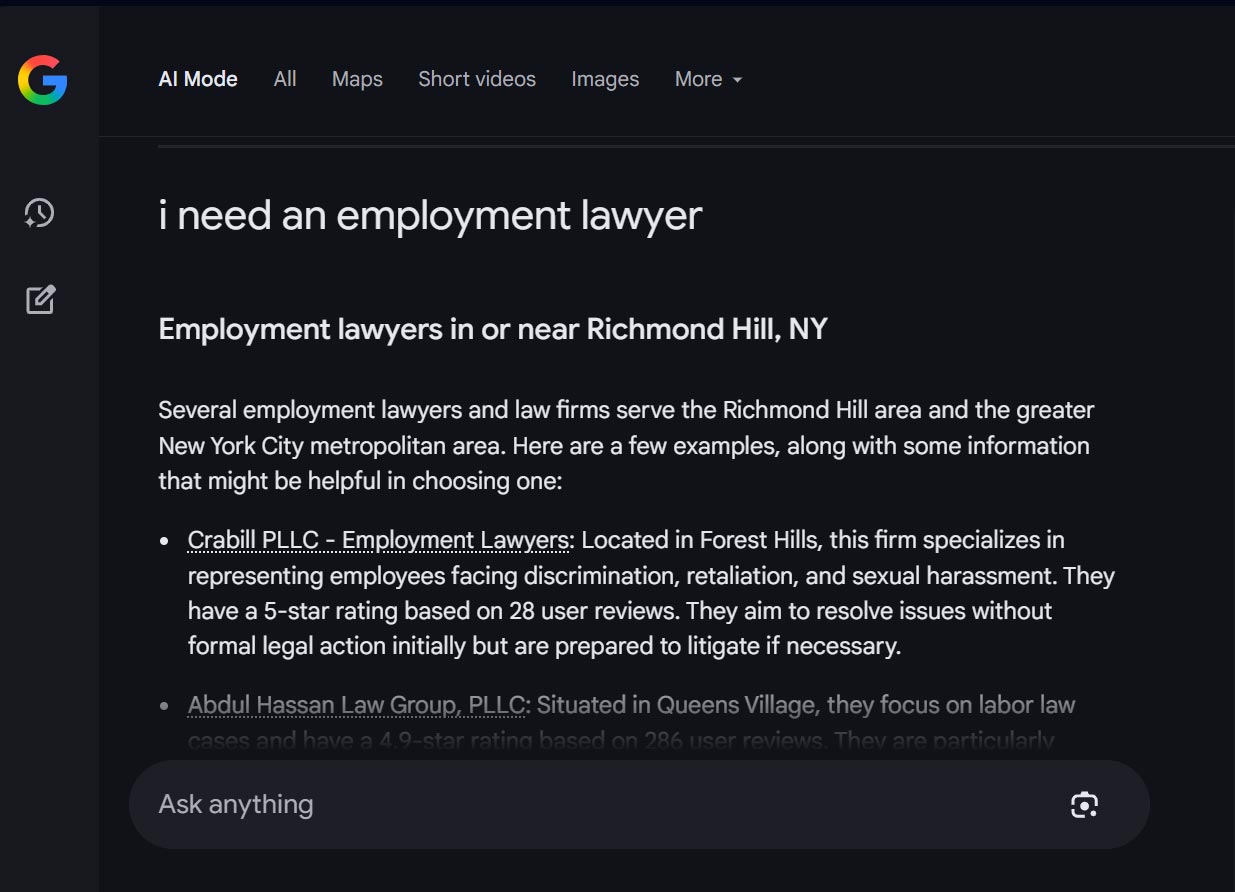
Search results for lawyers in Google’s AI mode showing a limited list of recommendations.
What Is Search Engine Optimization (SEO)?
Traditionally, search engine optimization was everything you needed to do to get search engines like Google and Bing to index your web pages – which is to include them in their database of pages that they could present in search results – and to rank those pages high on their search results pages (SERPs). The goal was simple: appear at the top of the list when someone searched for a lawyer in your practice area and location, and let your website do the rest.
That definition is still accurate, but it is no longer complete. The rise of AI-powered search has shifted what visibility actually means. Increasingly, search engines don’t just return a list of links and let the user decide. They synthesize content from across the web and surface a direct answer, often citing only one or two sources. For law firms, this means the goal of SEO is evolving from ranking your pages high in a list to becoming the source that gets cited as the answer. Those are related but meaningfully different objectives, and the distinction matters for how you build and optimize your content.
With the newer AI-driven generative engines like Perplexity and ChatGPT, Generative Engine Optimization (GEO) is everything you need to do to make your web presence visible to those AI engines and to have them recommend you to their users.
SEO and GEO are not one thing, but rather many different activities and processes working in combination to get your pages indexed, ranked well, and trusted enough to be cited.
This means that there are two hurdles to scale. Getting your web pages indexed and getting them to rank well on the search engine results pages (SERPs). For the AI engines, your pages need to be visible to them and deemed authoritative and trustworthy for them to cite them as sources or recommend them.
If a page on your website is not indexed, it’s not going to appear in search results.
If your web page doesn’t rank well, it’s not going to show up in the traditional search results pages.
As a website owner, your goal must be to appear on the first page of the SERPs for traditional search. But that goal is now only part of the picture. In AI-powered search, there is no second page. There is often no list at all. An AI system surfaces one answer, or a handful at most, and if your firm is not among them, you are invisible for that query.
The implication is that appearing on the first page of Google is increasingly a floor, not a ceiling. Being the source AI systems trust enough to recommend is the higher bar that firms now need to clear.
Most search users don’t go beyond the first page of traditional SERPs. In AI search, they don’t need to. The engine makes the choice for them.
With AI engines, you’re competing for far fewer slots, typically just one to three recommendations or cited sources that they surface to their users.
Why Some Web Pages Don’t Get Indexed by Search Engines
Not every page on a website will automatically get indexed or crawled by the search and AI engines.
The decision whether or not to index any page of a website lies in the hands of the website owner, as well as the search engines.
For instance, there might be sections of your site that you don’t want to make publicly available. You could issue specific directives to the search engines not to index that content.
To instruct the search engines not to index a page on your site, include the following page metatag in the <head> section of the source code of the page.
<META NAME="robots" CONTENT="noindex">

How to instruct the search engines not to index a page on your website
Additionally, if you would like for them not to follow any links on those pages, you could issue a directive like this,
<META NAME="robots" CONTENT="noindex nofollow">
Most search engines will honor these instructions and not include such pages in their database. However, on their own, they may decide not to index some of your pages, even if you’d want them indexed.
There are many reasons why but some of the most common include: the affected page having little textual content; the page being substantially similar in content to another page; having errors or programming scripts that affect the page’s performance or that make it impossible for the search engines to read it; or being the subject of penalties by the search engines, for any number of reasons.
If your website has a lot of webpages, it can be helpful to create a sitemap of your website that you submit to the search engines to help them discover your web content easier. Learn how to create a sitemap here.

Sample snippet of a sitemap for a law firm’s website
However, if you do want to have your pages indexed and visible to the search and AI engines, you need to make sure that you are not inadvertently blocking them from doing so.
Gatis Viskers Founder & CEO, Ambition Digital, stresses this point. “Generative search and answer engines need to actually be able to crawl and index your site. If their crawlers are blocked by WAF rules, IP blocking, or “block unknown bots” settings, your content simply will not be used in their answers,” he explains. “Many small law firm websites, especially those on budget hosts or using security plugins/CDNs, use default protections rules (e.g., Cloudflare or Wordfence). When an LLM tries to crawl the site for information it gets treated like any other bot by the site’s security or CDN layer, essentially leaving you invisible in answer engines. So you have to make sure your site is actually visible to LLM crawlers, which many law firms fail to do, or any GEO efforts will be wasted.”
Why Is Search Engine Optimization (SEO) Important for Lawyers?
Traditionally, lawyers have relied on people in their familial, social, and professional circles for referrals to clients.
This has been necessary given the many rules that guide how attorneys can solicit business.
However, with the rise of the internet, potential legal clients have found greater autonomy with the process of finding legal help, by conducting searches for lawyers on their own, in addition to asking to be referred to such professionals.
As far back as 2013, Google’s research showed that 96% of people who needed legal counsel consulted a search engine.
Also, marketing data and statistics show that website traffic and conversions from search produce the highest quality leads. This is the case because search is intent-driven. A customer goes searching for a product or service when there is a need. Where that need exists, also exists an opportunity to close a transaction.
As a lawyer, today, if you don’t have a solid digital marketing strategy to make your law firm highly visible on the internet to this audience that’s actively looking for legal services providers, you will miss out on a sizeable segment of your target market.
And that’s going to be problematic for your business because there is always going to be a low ceiling on the number of referrals that could come your way on any given day or month.
Loyd Bourgeois, a Lousiana personal injury attorney and the founder of Loyd J Bourgeois Injury & Accident Lawyer sees great value in performing search engine optimization for his law firm. “Search continues to play a major role in bringing in new cases,” he says. “In 2025, about 35 percent of our signed cases came directly from the web. That tells us people are actively searching for legal help and choosing firms based on what they see online. Strong SEO and GEO builds credibility, answers real client questions, and helps the right people find you at the right time. When done well, they support both brand trust and new client acquisition.”
However, Jose Garcia of Economista 3909 – Marketing 447 believes that SEO is one of the most underutilized channels by law firms, especially in the United States. “Many firms in the U.S. are investing heavily in paid advertising, whether on Google or on social media, paying astronomical amounts while being unable to generate organic content”, he explains. “Even today, with the rise of artificial intelligence, SEO has become an even more valuable strategy. This is because LLMs, or artificial intelligence systems, have been trained by scraping the internet, and when they need additional information, they rely on major search engines. So if your firm isn’t well positioned or doesn’t appear in search results, it’s very unlikely to show up in AI-driven searches either. For all these reasons, SEO is the first strategy I recommend to any lawyer or law firm.”
How to Optimize Your Website and Web Pages for Search
The first thing to get out of the way is that search engine optimization is not an easy task. There’s no quick – or simple – one-day fix.
There’s no magical AI or software that will get you to the top of the SERPs or get the AI engines to recommend you overnight without a clear strategy and a lot of detailed ongoing work.
There are many different things that you will need to be monitoring, and possibly modifying, on a regular basis.
Some of those will require you or your team to have some understanding of – or the willingness to learn about – how web software works, how web pages should be built and structured, and how to fix technical issues that may affect your website.
A good starting point is Google’s Search Engine Optimization (SEO) Starter Guide . You can also read Google’s Webmaster Guidelines.
There’s a lot of information to cover, but you’ll succeed better when you understand and adopt the following principles as a guide.
Think Like a Search Engine to Achieve Success With SEO
Search engines are businesses. Their primary service is producing relevant, valuable, and credible content in their search results for their customers, search users.
If their search results are not top-notch, their users will lose faith in their service and abandon them. If their search business collapses, their profitable advertising business will follow suit.
Their loyalties are to their search users and their advertising clients, not to your business. They will do you no favors if it gets in the way of the success of their business model.
The same logic applies to AI engines. ChatGPT, Perplexity, Google’s AI Mode, and every other AI-powered search tool have one job: give their users the most accurate, trustworthy, and useful answer possible. They will cite whichever source best serves that goal. Your job is to be that source.
To have a fighting chance with SEO and GEO, you must commit to producing the best, most relevant, valuable, and authoritative content for your subject matter. Having a mindset different from this will likely not give you the results you want.
Understand Search Engine Algorithms & Ranking Factors
The methodology that the search engines use to determine what pages to return in their SERPs, and the order in which to rank those pages is the search algorithm for that particular engine.
Every search engine has its own algorithm, the specifics of which are secret and frequently updated.
However, there are some ingredients – known as ranking factors – that are known to heavily influence how well a page will do for its subject matter.
These ranking factors are what the search engines evaluate and weigh on an ongoing basis to determine the ranking order of the results they return.
There are a great number of rumored and suspected ranking factors but the most important – and corroborated by the search engines – are listed below
SEO Ranking Factor #1 – The Quality of the Content on Your Law Firm’s Website
First and foremost, the content that you will be producing for your website, blogs, white papers, articles, etc., is the most important ranking factor, and it is the most important factor in whether an AI system trusts your content enough to cite it.
To have a shot at ranking well in traditional search, and at being surfaced by AI engines, your content has got to be the most comprehensive, authoritative, credible, and relevant content that matches the search user’s needs on the subject matter of their search. The bar for both is the same: be the most useful, trustworthy source on the topic.
That means as you create content, you should be keeping your focus on your audience and their information needs for that content. Make sure that you are thoroughly answering all the questions they have on the topic.
John Malm, founding principal, of John J. Malm & Associates Personal Injury Lawyers employs this approach at his personal injury firm, dedicating resources to this task. “Two of us at the firm now devote a substantial amount of our professional time to handling all things digital marketing. It is a big change from just a few years ago,” he says. “In order to keep up with SEO and GEO, we write our own content, keep our site as fresh as possible, and try to focus on what people are searching for, not just what we want to talk about.”
How to Satisfy User Intent With Your Topic
Before you start to produce any content, you should conduct proper keyword research to find out what your audience really cares about regarding your subject matter.
That way, you can understand what their expectations for the content are and create material that will satisfy their needs. If you don’t satisfy their needs, the search engines will not serve up your pages when those users go searching.
For instance, if you’re an Employment law attorney and you’re writing about sexual harassment in the workplace, you need to find out what your target audience wants to know about that broad subject.
Some users might want to know what exactly constitutes sexual harassment and what the law says about it. Some might be interested to learn what to do if they’ve been victimized. Others might be interested in learning how to avoid inadvertently harassing an employee or co-worker.
The examples above are all different questions about a central topic. Each one of those questions would be associated with different search phrases that would suggest what the user’s needs – for the content they hope to find – are.
Make sure that you’re answering all the questions they have about their specific query as exhaustively as possible. Providing cursory responses or merely stating your list of services related to the topics will not impress your audience or the search engines.
You should be aiming to be the most authoritative and credible resource on the topic you’re producing content about. You can’t succeed at that if you don’t research what questions your audience has.
Keyword research is a huge topic in itself. We have an in-depth article on how to conduct effective keyword research for lawyers here.
What About Google’s E-E-A-T?
On the subject of creating quality content for your audience, Google has guidelines for evaluating content to determine how it should rank.
They have an acronym, E-E-A-T, that’s used for this quality assessment. E-E-A-T stands for Experience, Expertise, Authoritativeness and Trustworthiness.
The gist of this is that the content should demonstrate expertise, be authoritative and engender trust.
For content to meet this standard, it should be apparent that some work has to go into its production. It can’t be a trivial endeavor
All websites need to stay active, current, and authoritative in their subject matter. This is a big indication to the search engines which sites to return in a result. Websites with thin and infrequently updated content are deprioritized by search engines.
Avoiding Thin Content
While there are no hard and fast rules for how many words your pages should contain, you should be aiming for longer, original, well-written and well-researched content.
Google penalizes the use of the following: auto-generated content, content that’s aggregated from varied sources and stitched together or insubstantial content that adds no value.
You can read more about what Google has to say about thin content in their webmaster guidelines.
If there’s more HTML (the markup language that’s used to structure and present webpages) on the page than actual textual content, that’s going to be problematic.
It’s also possible that pages with low word counts won’t get indexed at all.
While you don’t want to focus on just word counts and fill up your pages with drivel to meet a quota, you do want to produce comprehensive write ups that provide valuable information.
It would be wise to aim for a minimum of 1000 words for the pages you want to have indexed and to rank well.
How to Organize and Structure Your Content
It’s important to understand that search engines return only one page at a time in search results.
The page that’s returned from a website in response to a search user’s query, is the page that most closely matches the search intent of the user on a subject matter or topic.
Users won’t always be automatically directed to your home page or service pages or lawyer bio pages, as examples. They could be sent to your blog pages or other content that most closely matches what the search engines determine the user needs at that moment.
While all the content of your website serves to establish the overall subject matter of your legal practice to the search engines, the goal of the search engines is still to direct their users to the most appropriate page of your site that meets the user’s immediate need.
This means that you need to create individual pages or sections of your website that are focused on one topic and that are all unique in the content they provide. This will include an optimized home page, detailed services pages, biography pages for the lawyers in your practice, and then quality pages with content that address the topics your audience cares about.
As an example, if you’re a Personal Injury law firm and you actively take on a variety of cases, you should be creating separate content for each of those case types, i.e., medical malpractice, car accidents, slips and falls, motorcycle accidents, asbestos-related illnesses, etc.
Within the content for those case types, you also want to be aware of the search intent of your audience and make sure that your pages are answering the specifics of the questions they have.
Help the Search Engines Understand What Your Web Pages Are About with On-Page SEO
Search engines will scan your pages and try to understand what your pages are about so they can index them properly and serve them up to search users who are looking for the kind of information they contain.
However, it’s possible to help the search engines to understand your pages better with On-page or On-site SEO.
On-page SEO is all the things you can do to signal your page’s subject matter to the search engines and help improve how it ranks.
On-page SEO comprises many different activities. Most require you or your web team to have some technical understanding of how web pages are built, how to adjust the underlying code of your web pages, and how to create and name those pages correctly.
Some of the decisions you’ll make in this regard are best made as you initially build out your website architecture, and as you plan your overall digital strategy. However, if you have a competent web team you can still undertake these steps to optimize your existing pages.
-
Focus the content of each page. Make sure the overall content of each page completely speaks to the subject matter of that page.
While that might seem self-evident, it’s possible to create pages that start to go off on tangents and lose focus of what the central topic is.
Use your important keywords and answer the questions your audience has about your topic comprehensively.
-
Optimize your page title tags. The title tag is a page metatag that search engines read to quickly understand the subject matter of a page and get some other important details about your law firm.
The title tag isn’t visible on the web page itself. It shows up at the top of the browser chrome and appears in search results. It is visible in the HTML source code of the page, in the head section of the page’s HTML.
<head>

<title>San Antonio Divorce Lawyer | Perrino Family Law Practice </title>

</head>
Include your important page keywords and other relevant information about your business here. Keep the contents of the title tag relevant but brief.
Ideally, you want to keep the total character count under 80. Don’t overload the title tag with keywords, this could get you penalized by search engines. It’s important to make sure that the title tag for each page is unique.
Read more about what Google has to say about optimizing the title tags.
-
Use descriptive keyword-rich URLs. As you create pages for your content, use unique, descriptive names for each page URL or web address that help to describe the content of the page. Example: “https://www.mylawfirm.com/sexual-harassment-settlements”, etc.
-
Structure your page headings properly. All web pages should be built with a proper structure that define a clear content hierarchy with sections of content and several headings.
Search engines parse the HTML of a web page to discern the structure and understand the most important parts of the page. Every web page should have headings that are structured in HTML with tags <h1> through <h6>, in descending order of importance.
<h1> tags are the most important on the page. Ideally, there should be only one <h1> tag on a page. Search engines pay a lot of attention to the contents of that tag, as well as every other heading tag on the page.
It’s important to have keywords that describe the page and the page sections in those heading tags.
If you’re using content management systems like WordPress, for instance, and working with pre-built themes that you find on those platforms, make sure that the underlying code of those themes are structured properly.
There are some pre-built themes that look good, visually, to a human user, but their underlying code and build is nonsensical to internet browsers and search engines. Themes like that can cause problems with how the browsers and search engines parse the contents of your web pages.
-
Optimize your image and video files. If you have images or other multimedia content on your web pages, you need to optimize their file sizes, so they load quickly.
You can do this with photo editing software like Photoshop that can compress the file size while maintaining a good image quality. Similarly, you should optimize your video files so that they don’t weigh your pages down.
-
Add descriptive alt text to your image tags. If you have images on your page, open up the source code of each page and add alternative (alt) text to all the image tags to provide descriptive text for those images.
The alt text attribute for images helps with accessibility for screen readers and other devices that help visually impaired internet users to understand the contents of a page and what an image is about, even if they can’t see it. Search engines also read the content in those alt descriptors, and that helps to provide extra context about the content of your page.
-
Consider the growing role of video content. Google’s new search box now accepts video and images as inputs alongside text queries. AI systems increasingly consume content in multiple formats, not just written text. For law firms, this doesn’t mean every firm needs a YouTube channel tomorrow. But attorney-to-camera video content, particularly when paired with a written transcript on the same page, creates an additional discoverability pathway that text-only content cannot. A short video where an attorney explains what to do after a car accident, with a full transcript beneath it, serves both the human visitor and the AI system trying to determine whether your firm is a credible source. It also reinforces your entity authority across platforms, which is one of the signals AI engines use when deciding whose content to surface.
SEO Ranking Factor #2 – Links, Mentions, and Authority Signals
Hyperlinks are the currency of the internet. They connect pages across the internet, creating the complex network that is the world wide web. Search engines eagerly follow those links from page to page, making connections and establishing relationships between websites. For traditional search engines, the number and quality of backlinks pointing to your site has always been one of the most powerful ranking signals available.
But authority is no longer measured by links alone. AI-powered search engines operate differently from their traditional counterparts. They have been trained on vast amounts of text from across the internet, which means they have absorbed not just the link graph but the language of the web. When your firm is mentioned by name in a credible publication, when a journalist quotes one of your attorneys in a news article, when your name appears consistently in bar association features, legal industry roundups, or podcast transcripts, those mentions are part of the fabric of text that AI systems learn from and continue to reference. The AI does not need a hyperlink to know your firm exists and is associated with a particular practice area and geography. It needs to have encountered your name in trustworthy contexts enough times to recognize you as a credible entity.
This is what is increasingly referred to as entity recognition, and it is a meaningful signal for AI discoverability even when it produces no direct SEO benefit in the traditional sense. For law firms, this means that digital PR, getting quoted in legal publications, earning local news coverage, contributing to bar association content, and appearing as a guest on relevant podcasts or panels, builds authority that AI engines recognize regardless of whether those placements come with a followed link back to your website.
All Links Are Not Created Equal
The more links you have pointing to your site, the better your website will generally do in traditional search. However it is not just a question of quantity but also one of quality.
Links from websites that share the same or related subject matter as yours carry the most weight. Links from influential websites like news organizations, government agencies, and educational institutions consistently carry significant authority. Editorial links, links contained in the body of articles on other websites that point directly to your content, are the most valuable of all. They are usually the result of producing content that other websites find genuinely worth sharing with their own audience.
If there is an article in a publication like the National Law Review that mentions and links to your law firm’s website, that is a prime example of the kind of backlink that meaningfully moves the needle. Links buried in footer sections or on low-quality directory sites that exist only to link to large numbers of websites carry far less weight and can sometimes hurt your SEO performance.
Mentions Without Links Still Matter
A mention of your firm in a credible source, even without a hyperlink attached, contributes to how AI engines perceive your authority. Think of it as the digital equivalent of word of mouth. The more often your name appears in trustworthy contexts across the web, the more recognizable your firm becomes as an entity that AI systems can confidently surface when someone asks for a recommendation.
Practically speaking, this means you should not dismiss media placements, contributed articles, expert commentary, or podcast appearances simply because they do not always come with a dofollow link to your website. A quote from one of your attorneys in a local news story about a legal topic, a mention in a roundup of top personal injury firms in your city, or a guest appearance on a legal podcast that references your firm by name, all of these build the kind of presence across the web that AI engines use to determine whether your firm is a credible answer to a legal query.
How to Build Links and Earn Mentions
Getting backlinks to your website is not the easiest thing. It is one of the most important authority signals you cannot directly control. You cannot force other websites to link to you, and most will not do so without a good reason.
What you can do is produce the best content possible that other websites and publications find genuinely worth referencing. If your site becomes associated with authoritative legal content rather than just advertisements for your services, it is more likely that other websites will link to your content and that journalists and publishers will cite your firm as a credible source.
This is where your content marketing and digital PR activities become especially valuable. A well-executed digital PR strategy pursues both links and mentions intentionally, placing your attorneys as expert sources, pitching original research or legal commentary to relevant publications, and building relationships with journalists who cover legal topics in your market.
What you should avoid is buying links, participating in link schemes, or adding your website to sketchy directory sites that promise links for a fee. These tactics negatively impact your rankings. Search engines frown heavily on these activities and can penalize your website with removal from their index or an outright ban that can last for years.
It is also important to regularly scrutinize the links pointing to your website to make sure spam sites or low-quality directories are not linking to yours. You can use Google’s Search Console to see who is linking to your site. If you find links you do not recognize or trust, you can disavow them within the tool so they do not negatively affect your rankings or risk getting your site blacklisted.
Linking Within Your Own Website Is Also Important
While links from other websites to yours are the most valuable external signal, the links within your own website matter too. They help search engines navigate your site and find important content within it. Make sure your navigation menus include links to your most important pages, that every page on your site is easy to discover, and that the anchor text on your internal links is descriptive enough to signal what the linked content is about.
SEO Ranking Factor #3 – The Technical Performance of Your Legal Website
Besides the content of your website and the backlinks pointing to you, which we’ve already discussed, the technical performance of your website is another major ranking factor.
The architecture of a website – the way it’s built – and how well it performs from a technical perspective can greatly impact your search performance.
Problems of this type aren’t easy to fix without substantial technical expertise on how to build a website, how to maintain a web server and how to write or fix scripting or programming code. As such, the activities that address problems of this nature are known as Technical SEO.
If your website has issues in this area, it will negatively impactive your performance with SEO.
Improve Your Search Performance With Technical SEO
-
Make sure that your website is responsive. A responsive website is one that functions smoothly and perfectly across all devices – cellphones, tablets, and desktops – with the same codebase.
What this means is that you should have only one website that smoothly adjusts and adapts regardless of the device a user is viewing it on. Any situation where you are building different websites or serving up different content for different devices will significantly hurt your SEO performance.
Search engines like Google will penalize your website heavily if it is not responsive in its build.
Be careful when using some website builders which inherently create separate websites for you that use different codebases to serve content to different devices.
-
Make sure your website and web pages load fast. If your website takes a long time to load, the search engines will downgrade it in search results.
There are many things that can cause your web pages and website overall to load very slowly. Some of those include: badly written programs or scripts that run on individual pages or on the whole website; bloated content management systems or themes; bad web hosting providers or insufficient webserver resources serving up your web pages; too much multimedia content – images and videos – that aren’t properly optimized to improve their file sizes, and much more.
Regardless of the cause, it must be fixed, otherwise your website will tank in search results.
-
Make sure that your site has not been compromised with malware. If you’re not paying close attention to your website, especially what’s happening on your webserver, you may not know if malware or other malicious scripts have infected your website. If that has happened, your website may start to send out spam and malware across the internet.
Search engines will penalize you heavily and block your website if it’s spewing spam or other malicious content across the internet.
-
Fix any interface or user experience issues. Your website should provide a good experience to your visitors. This means that it should have good information architecture that’s structured properly for visitors to be able to discover your content easily.
It also means that your website should have an interface that’s easy to use and that provides a pleasant user experience
Elements like annoying pop-ups (interstitials) and other dialogs should be avoided or used with great caution because they can also get your site penalized.
Other Ranking Factors
As mentioned earlier, there are many potential ranking factors, but the three mentioned above are the most important. There is consensus that they impact your SEO performance the most.
Other factors that are also suspected to be impactful include having clear contact information for your business on your website. For lawyers, this is already mandated.
It’s also helpful to have a privacy policy on your website.
Finally, the length of time that your website has been in existence also factors in the rankings. A website that’s been around for 10 years, will do better than a website that was launched a week ago.
Boost Performance With Local SEO
More likely than not, you provide your legal services in specific local markets.
When someone searches for legal services online, search engines try to match them with relevant results from lawyers that appear to be close in proximity to the search user.
That’s why it’s important that you send location signals that alert the search engines to those markets that are serviced by your law firm.
You can do this by including location-specific keywords in your page title text, headlines and in your content overall. Avoid keyword stuffing, but signal your location in naturally occurring contexts as you create your content.
You can also use schema structured data to communicate your location information to the search engines. Learn how to use schema local business structured data here.
There are also other things that you can do to help with placements on maps and other local business indexes, local search pack listings, as well as implicit, contextualized, location-based searches. Learn more about local SEO for Lawyers here
Create or Claim Your Business Listings
Claiming, creating and maintaining profiles on business listing sites like Google business profiles, Yelp, Facebook, Better Business Bureau, LinkedIn, Apple Maps and many other platforms is going to be helpful with local SEO.
Search engines cross-reference your information across a variety of platforms and factor the information gleaned from these sources.
These will also be helpful in getting featured on local maps and directories that list local businesses in proximity to search users.
Create a Profile on the Top Legal Directories
There are many legal directories that you should be promoting your legal services on. While some of these are subscription-based services, others provide free listings, which can be supplemented with sponsored premium listings.
Search engines also reference information about your legal practice from sites like these.
Some of these directories and portals include Findlaw, Justia, Avvo, Lawyers.com, Martindale, Nolo, and many more.
Register Your Site With the Top Local Business Aggregators
There are some business data brokerages that aggregate local business data and disperse that information to many different properties online. These companies are known as aggregators.
There are many of these companies but the four largest are Factual, Acxiom, Neustar Localeze, and Infogroup. The data they hold feed many of the other smaller aggregators.
These aggregators typically have information such as your business name, address, phone numbers, ownership, etc.
Search engines reference the information held by these aggregators against the information you provide on your own online properties, like your website, social profiles and business listings, to verify the legitimacy of your business.
These pieces of information are especially important for local business searches.
It’s important that the information contained across the web about your business is kept accurate and up to date.
It’s important to regularly verify and update the data about your business that’s held by these companies. It’s tedious to do this manually, based on the sheer number of directories you’d need to contact, but there are services like Brightlocal and other SEO tools like Moz local that can help with this for a moderate monthly or annual fee.
Monitor Your Reviews
As you create and maintain profiles across different platforms online, you also want to be conscientious about monitoring the reviews you inevitably will start to receive.
Be careful to respond to as many reviews as you can – whether good or bad. Make sure you address any negative reviews immediately.
Online reviews are also factored in your rankings.
Providing great service to get referrals and reviews is something that Hunter Garnett, Managing Partner and Founder, Garnett Patterson Injury Lawyers agrees has been beneficial to his firm.
“The most effective driver of our website’s SEO has been building genuine relationships with past clients and community partners, which naturally lead to referrals, mentions, and reviews,” he says. “Paired with patient, continuous content updates aligned to the local market, this has been our core strategy for website results.”
How to Perform Generative Engine Optimization (GEO) for Your Law Firm’s Website.
All of the processes and activities that we’ve already covered so far related to conducting effective search engine optimization also apply when optimizing for greater AI visibility. This process is also known as Generative Engine Optimization (GEO)
Having a website that’s well-built, programmed correctly, and technically sound overall will help your case with the AI engines.
Having a good digital reputation, demonstrated by links to your website, positive mentions of your brand from trustworthy, authoritative sources online, and good reviews across the web is also important.
However the most important factor is producing great, relevant, content that answers the questions that your audience is asking. With the AI engines it’s especially important to be as direct, clear and to the point as possible with your content. Forgo unnecessary fluff, legalese, jargon or language that’s hard to understand. Write as clearly as possible about who you are, what you do and who you do it for and highlight what makes you unique or different from the competition.
Understanding How AI Engines Discover and Evaluate Legal Content
AI generative engines like ChatGPT, Claude, Perplexity, and Google’s AI Overviews operate differently from traditional search engines in how they discover, evaluate, and surface content. Understanding these differences is critical to optimizing your law firm’s visibility in this new landscape.
Unlike traditional search engines that primarily crawl and index web pages based on links and technical signals, AI engines synthesize information from vast amounts of online content to generate direct answers and recommendations. They don’t just rank pages – they actively interpret, summarize, and cite specific sources based on perceived authority and relevance.
This means that your content needs to be optimized not just for being found, but for being understood, trusted, and cited by AI systems that are looking for the most authoritative and helpful information to present to their users.
Create Content That AI Engines Can Easily Parse and Cite
AI generative engines favor content that is structured in a way that makes it easy to extract specific information. This means your content architecture matters more than ever.
Use clear, descriptive headings. Structure your content with H2 and H3 tags that clearly signal what each section addresses. Instead of clever or vague headings like “The Details” or “What You Should Know,” use explicit headings like “What Happens During the Discovery Phase of a Personal Injury Case” or “How Long Do I Have to File a Medical Malpractice Claim in California?”
AI engines use these headings to understand the structure of your content and to extract specific answers to user queries. Clear, descriptive headings make it more likely that your content will be cited when someone asks a related question.
Answer questions directly and comprehensively. AI engines look for content that provides complete, authoritative answers to questions. When you write about a topic, anticipate the full range of questions someone might have and address them systematically within your content.
For example, if you’re writing about divorce in your state, don’t just provide a basic overview. Answer specific questions like: What are the grounds for divorce? How long does the process take? What factors determine child custody? How is property divided? What does it cost?
The more thoroughly you address a topic, the more likely AI engines are to recognize your content as authoritative and cite it in their responses.
Use natural language and conversational structure. AI engines are trained on conversational text and are optimized to understand and generate natural language. While you should maintain professionalism and accuracy, avoid overly formal or archaic legal language when plain English would work just as well.
Write as if you’re explaining concepts to a potential client sitting across from you in your office. This conversational approach not only makes your content more accessible to human readers but also aligns with how AI engines process and generate responses.
Optimize for Featured Snippet and AI Citation Formats
Many AI-generated responses cite sources in formats similar to Google’s featured snippets – pulling specific passages that directly answer questions. Optimizing your content for these citation formats increases the likelihood of being referenced.
Create FAQ sections. Dedicated FAQ sections with clear question-and-answer formats are ideal for AI citation. Structure these as actual questions (the kind people type into search engines or ask AI assistants) followed by concise, direct answers.
For example: “Can I lose my home in a Chapter 7 bankruptcy?” Followed by a 2-3 paragraph answer that directly addresses the question.
Use definition and explanation formats. When introducing important legal concepts, provide clear definitions and explanations that can stand alone. AI engines often pull these types of explanatory passages when users ask “what is” or “how does” questions.
Include step-by-step processes. When explaining legal procedures, use numbered lists or clearly delineated steps. AI engines frequently cite this type of structured information when users ask “how to” questions.
Build Authority Signals That AI Engines Recognize
AI generative engines don’t just look at your content in isolation. They evaluate your overall authority based on signals from across the web. These authority signals heavily influence whether AI systems will trust and cite your content.
Earn citations from authoritative sources. When reputable legal publications, news outlets, bar associations, or educational institutions cite your content or mention your expertise, these citations serve as strong authority signals to AI engines.
Focus on creating content valuable enough that other authoritative sources will want to reference it. This might include original research, comprehensive guides, unique legal analysis, or practical frameworks that other legal professionals and publications find useful.
Maintain consistent expertise across platforms. AI engines evaluate whether you demonstrate consistent expertise on your topics across multiple platforms. This means your content on your website should be reinforced by your presence on legal directories like Avvo and Justia, your contributions to legal publications, your LinkedIn activity, and mentions in news articles.
The more consistently you appear as an expert on your practice area topics across various reputable platforms, the more likely AI engines are to recognize and cite your authority.
Build a robust backlink profile. While AI engines don’t use backlinks in exactly the same way traditional search engines do, links from authoritative websites still serve as important signals of credibility and expertise.
Focus particularly on earning editorial links from respected legal publications, local news outlets, bar association websites, and educational institutions. These high-authority backlinks help establish your content as trustworthy and citation-worthy in the eyes of AI systems.
Make Your Company Information Clear and Consistent
AI engines need to clearly understand who you are, what you do, and where you practice to make appropriate recommendations. Inconsistent or unclear information can prevent AI systems from confidently citing your firm.
Use structured data markup. Implement schema.org structured data on your website to explicitly communicate key information about your firm – your practice areas, location, contact information, and credentials – in a format that AI systems can easily parse.
Legal-specific schema types like Attorney, LegalService, and LocalBusiness help AI engines understand exactly what services you offer and who you serve.
Maintain NAP consistency. Your Name, Address, and Phone number (NAP) should be identical across every platform where you have a presence – your website, Google Business Profile, legal directories, social media profiles, and any other online listings.
Inconsistent information confuses AI engines and reduces their confidence in recommending your firm. Regular audits of your online presence to ensure NAP consistency are essential.
Clearly state your practice areas and geographic service areas. Don’t make AI engines guess what you do or where you practice. Explicitly state your practice areas and the geographic regions you serve in multiple places on your website – your homepage, about page, practice area pages, and footer.
For example: “Smith & Associates practices family law, criminal defense, and estate planning, serving clients throughout Miami-Dade, Broward, and Palm Beach Counties in Florida.”
Create Comprehensive, Authoritative Content on Core Topics
AI engines favor comprehensive resources that thoroughly address topics over thin content that only scratches the surface. For your core practice areas, create in-depth, authoritative resources that serve as definitive guides.
Develop pillar content pages. For each of your main practice areas, create comprehensive pillar pages (2,000-4,000 words) that thoroughly cover the topic from multiple angles. These should address common questions, explain key concepts, outline processes, and provide practical guidance.
For example, a personal injury firm might create a comprehensive guide covering: types of personal injury cases, how to prove negligence, what damages you can recover, the claims process from start to finish, how to choose an attorney, and common mistakes that hurt cases.
Update content regularly. AI engines prioritize current, up-to-date information. Content that reflects recent legal developments, current laws, and contemporary practices is more likely to be cited than outdated information.
Set a schedule to review and update your core content at least annually, or more frequently if your practice area experiences regular legislative or case law changes. Add update dates to your content to signal freshness.
Demonstrate local expertise. For law firms serving specific geographic markets, demonstrating deep local knowledge increases your authority in AI recommendations for users in your area.
Include location-specific information throughout your content – local court procedures, jurisdiction-specific laws and regulations, local statistics and case examples, and references to local resources and agencies. This geographic specificity helps AI engines match you with users seeking legal help in your specific market.
Monitor and Adapt to AI Engine Behavior
As AI generative engines continue to evolve, monitoring how they surface legal information and adapt your content accordingly becomes increasingly important.
Test your visibility. Regularly query major AI engines (ChatGPT, Claude, Perplexity, Google’s AI Overviews) with questions relevant to your practice areas to see which firms and sources they cite. If competitors consistently appear and you don’t, analyze what they’re doing differently.
Track AI referral traffic. Use analytics tools to identify traffic coming from AI platforms. Some AI engines are beginning to drive direct referral traffic to websites they cite. Understanding which content generates this traffic helps you optimize effectively.
Stay informed on GEO best practices. Generative Engine Optimization is still an emerging field. Stay current with developments by following legal marketing publications, SEO industry leaders, and AI technology news. What works for GEO in today may evolve significantly as these systems mature.
The intersection of AI technology and legal marketing is rapidly evolving, but the fundamental principle remains constant: create authoritative, helpful, clearly-written content that genuinely serves your audience’s needs. AI engines, like traditional search engines before them, ultimately reward content that provides real value to users seeking legal information and assistance.
How Quickly Will I See Results if I Start SEO Now?
SEO results are not instantaneous. They accrue incrementally over time. It is a gradual process for the search engines to register new changes and activity on a site, and for that to reflect in your search rankings and your visibility in AI-powered search.
Realistically, it can take anywhere from six months to a year to see dramatic results, dependent on how many factors are already working positively in your favor when you start your SEO endeavors.
However, in contrast to buying advertising on the search engines, the results and benefits of SEO are longer-lasting.
To employ a cliché, think of SEO as a marathon not a sprint.
Do I Always Need to Do SEO for My Law Firm?
Yes. Search Engine Optimization, and increasingly Generative Engine Optimization, are continuous processes that all owners of web properties must make continual investments in.
In the crowded space that is the internet, every entity that exists on there is continuously optimizing their web presences, so that they can get indexed, rank higher, and have greater visibility across both traditional search and AI-powered search.
Your competition is constantly optimizing for improved search performance, so the strategies you will need to employ must be focused on leapfrogging their activities wherever possible.
SEO is not a one and done process. It is a continuous process that you must continue to undertake as long as you have a web presence and want to improve and maintain the visibility that you have, in search results and in AI recommendations alike.
SEO Tools
As you undertake your SEO strategies to improve your rankings on the search engines, you will need to use a lot of tools to help with the activities you will be carrying out.
These tools will help with things like keyword research, checking your rankings, monitoring your backlinks, tracking and measuring your progress as you go, and more.
Some of the tools are free to use and others are paid utilities that you will need to get a subscription to in order to access their full features and benefits.
It is possible to achieve some success with SEO without using any of these tools, but having a combination of some of these in your arsenal will definitely be beneficial.
- Google Search Console
- Bing Webmaster Tools
- Yandex Webmaster
- Google Analytics
- Raven
- Semrush
- Moz
- Ahrefs
Why SEO for Lawyers Is More Difficult Than for Most Other Industries
Adhering to the Rules that Govern Attorney Advertising
As an attorney, you are held to a higher standard for the content of your advertising materials, which includes the content of your websites.
The Bar associations that provide oversight over attorney conduct demand that all claims you make be factual, accurate and not misleading in anyway.
The use of superlatives and other self-aggrandizing adjectives that are common in online advertising in other industries are discouraged by the American Bar Association and every other local bar association.
This means that you can’t call yourself the “best” or the “specialist” or the “expert”, etc., in your practice area, without being able to factually back up such a claim.
Make sure you and your SEO team understand all the rules that govern your jurisdiction as you map out your SEO strategy.
The Extra Scrutiny Google and Search Engines Place on YMYL Content
There’s a category of content which Google designates as YMYL content – YMYL meaning Your Money or Your Life.
These types of content have the potential to materially impact a search user’s wellbeing. Some examples include news, financial, health and legal content.
As a result, Google places heavy scrutiny over websites that provide these kinds of information.
Their goal is to not return pages that could negatively impact their users if the content is potentially false, inaccurate, or dangerous.
This means that there is a higher bar for the legal content you will need to produce and disseminate online.
The Rewards of Good SEO for Lawyers
The lawyers who take search engine optimization seriously end up controlling the online market for legal services providers in their practice areas.
They dominate their markets and garner the majority of cases and clients who are online looking for legal help.
The Penalties for Bad SEO for Lawyers
For lawyers who engage in bad SEO practices, the penalties can be harsh and long-lasting.
Employing SEO tactics that go against the rules of the various bar associations under whose jurisdictions you practice open you up to disciplinary actions, including being disbarred if your marketing tactic or conduct is particularly egregious.
On the part of the search engines, you run the risk of being de-indexed or blacklisted from the search results pages, which renders your practice virtually invisible online.
It’s always advisable to follow the rules that the search engines lay out and also the guidelines for attorney advertising as mandated by the American Bar Association and the bar associations in the jurisdiction of your legal practice.
Summary
Search engine optimization is a critical component of your overall marketing strategy for your legal practice.
The core of what makes SEO work has not changed. Search engines and AI systems alike are looking for the same things they always have: content that is useful, relevant, authoritative, and trustworthy. What has changed is the competitive environment and the way that visibility is delivered. Fewer slots. More direct answers. AI systems that surface recommendations rather than lists of links. That raises the bar for what it means to show up at all.
The firms that will win in this environment are the ones that have always won in search: those that produce the best, most genuinely helpful content for their audience, maintain a technically sound website, earn credible links from authoritative sources, and build a consistent presence across the web. The difference now is that doing those things well doesn’t just help you rank. It determines whether an AI system considers you the answer when a potential client asks for a lawyer in your practice area and your city.
While there are a lot of factors that influence how well you will do on the search engines, there are a few things that you need to pay special attention to:
-
How well your website communicates its subject matter to both search engines and your site visitors.
-
The numbers of quality links from other websites that point back to your website, as well as credible mentions of your law firm across the internet.
-
The architecture of your legal website and how well it performs from a technical perspective.
-
The relevance, authority, comprehensiveness, and currency of the content of your website to your identified subject matter.
Keep your focus on these and your visibility in both traditional search and AI-powered recommendations will improve.