When someone in your city types “divorce attorney near me” or “criminal defense lawyer in [your city]” into Google, what happens next determines whether they call you or someone else. That moment, repeated hundreds or thousands of times every month in your market, is what local SEO is about. And for most law firms, it represents the single highest-intent traffic source available: people who need a lawyer right now, in your area, actively looking.
Local SEO is not the same as general SEO. It has its own set of ranking factors, its own competitive dynamics, and its own set of tools and strategies. A law firm can have an excellent website with strong general SEO and still be invisible in local search if they haven’t done the specific work that local rankings require.
This guide covers everything that moves the needle in local search for law firms in 2026. Google Business Profile optimization, review strategy, Local Services Ads, directory management, citation building, website content strategy, schema markup, local link building, and more. The technical stuff is explained in plain language. The strategic stuff is grounded in what actually works for law firms specifically, not generic local SEO advice recycled from retail or restaurant marketing.
If your firm isn’t showing up prominently in local search right now, this guide will show you exactly why and exactly what to do about it. If you are showing up, it will show you how to extend that lead and keep competitors from catching up.
What Is Local SEO and Why It’s Different for Lawyers
Local SEO is the practice of optimizing your online presence so that your firm appears prominently when people search for legal help in your geographic area. It’s the discipline that determines whether you show up in the local map pack, in Google’s local results, and in the AI-generated answers that are increasingly dominating what people see when they search for a lawyer near them.
The distinction from general SEO matters. General SEO is about ranking for search terms across the web, competing with every other website on the internet for a given keyword. Local SEO is about ranking in a specific geographic context, competing with a much smaller set of firms for the attention of people who are physically near you or explicitly searching for services in your area.
What the Local Pack Is and Why It Matters
When someone searches for a lawyer in their city, Google typically shows what’s called the local pack: a map with three business listings below it, each showing the firm’s name, rating, review count, address, hours, and a link to their website. This pack appears above the organic search results and often above paid ads in many searches. It is prime real estate.
Getting into the local pack is the central goal of local SEO for most law firms. The three spots in that pack capture a disproportionate share of clicks compared to the organic results below them. Firms that consistently occupy those spots have a significant client acquisition advantage over every other firm in their market.
Why Local Intent Searches Convert at a Higher Rate
Someone who searches “personal injury attorney Houston” is not doing research. They or someone they know has been injured and they need help. The search itself is an expression of intent to hire. This is fundamentally different from someone reading a blog post about personal injury law out of curiosity. Local searches happen at or near the moment of decision, which is why they convert to consultations and retained clients at a much higher rate than most other traffic sources.
This is also why local SEO investment tends to produce a higher return than general SEO investment for most law firms. You’re capturing people who are ready to act, not people who are browsing.
The Local SEO Factors That Are Unique to Law Firms
Local SEO for law firms operates under a few conditions that don’t apply to most other businesses. The competitive intensity is extraordinary. Legal is one of the most competitive local search categories in existence. In a major metro area, a personal injury attorney is competing for local pack positions against firms spending tens of thousands of dollars a month on SEO and advertising. Even in smaller markets, legal is typically the most competitive local category.
The ethics rules that govern attorney advertising also apply to your online presence, including your Google Business Profile, your directory listings, and the review solicitation practices that are central to local SEO. Understanding where those rules intersect with local SEO tactics is not optional. We address it specifically in the reviews section.
Finally, the geographic complexity of legal practice adds a layer that doesn’t exist for most local businesses. A law firm may be licensed to practice across an entire state but have a physical office in one city. Managing how Google understands your service area while maintaining a legitimate local presence requires specific strategies that we’ll cover throughout this guide.
How Google Decides Who Ranks Locally
Google uses three primary factors to determine local rankings: relevance, distance, and prominence. Understanding each one is the foundation of everything else in this guide, because every tactic you’ll learn here is ultimately working on one or more of these three factors.
Relevance
Relevance is how well your business profile and website match what the person is searching for. A family law attorney with a Google Business Profile that clearly describes their practice as family law, with a website full of content about family law, optimized for family law keywords, and with services listed that are consistent with family law practice is highly relevant to a search for “family lawyer near me.”
Relevance is influenced by your Google Business Profile categories and description, the content on your website, the keywords your site ranks for, and the consistency of your information across the web. The more clearly and consistently Google can understand what you do and who you serve, the better your relevance signals.
Distance
Distance is how far your business is from the searcher or the location they’ve specified in their search. Google factors in the physical location of the person searching when they haven’t specified a location, and the location they’ve mentioned when they have. A searcher two miles from your office is more likely to see you in the local pack than one twenty miles away, all else being equal.
Distance is the one factor you can’t directly optimize, which is why the other two matter so much. You can’t move your office, but you can make your relevance and prominence strong enough to overcome distance disadvantages in many cases.
For firms with multiple offices, distance becomes an opportunity to manage rather than a fixed constraint. Each office location, with its own properly optimized Google Business Profile, extends your local footprint and captures searches near each location. We cover multi-location strategy in depth in its own section.
Prominence
Prominence is how well-known and well-regarded your business is, both online and offline. Google measures prominence through a combination of signals: the number and quality of reviews, the strength of your backlink profile, your presence and consistency across directories and citations, how often your firm is mentioned around the web, and the overall authority of your website.
Prominence is the factor with the most variables to optimize, and it’s where most of the sustained effort in local SEO goes. A firm with strong relevance signals but weak prominence will lose to a firm with strong signals on both. Building prominence is a long-term investment that compounds over time in a way that’s very difficult for competitors to quickly replicate.
How the Three Factors Interact
Google doesn’t rank solely on any one factor. A firm that’s extremely close to the searcher but has a poorly optimized profile and weak reviews will often lose to a firm that’s further away but has a fully optimized profile and a strong review base. A firm with hundreds of reviews but an irrelevant category selection will rank below a firm with fewer reviews whose profile is precisely matched to the search query.
The firms that dominate local search in competitive legal markets have all three factors working together: a fully optimized, highly relevant Google Business Profile, strong and consistent prominence signals across the web, and the geographic positioning to be competitive for the searches that matter most to their practice.
Google Business Profile: Your Most Important Local SEO Asset
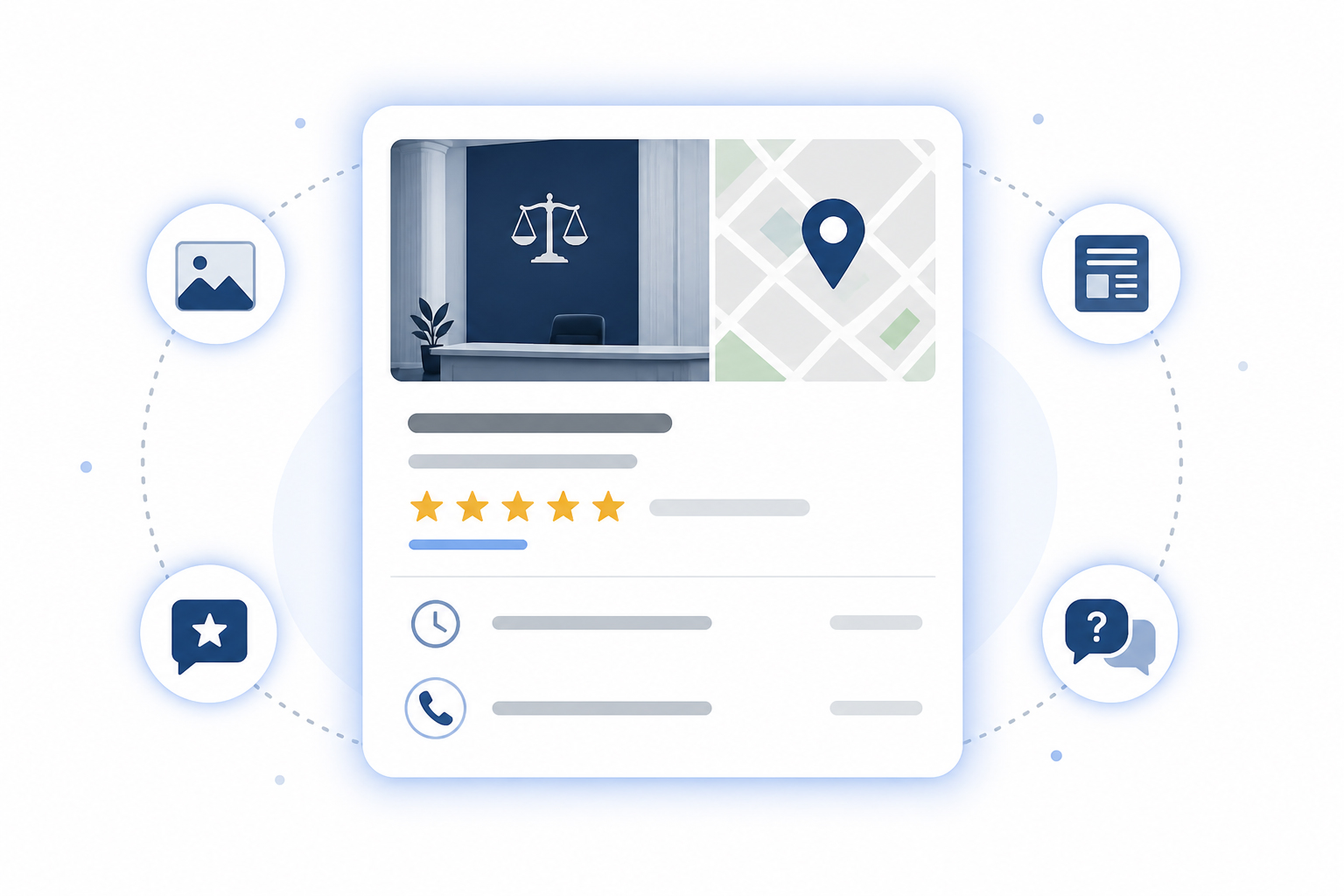
A fully optimized Google Business Profile is the single most important asset in your local SEO strategy.
Your Google Business Profile (GBP) is the single most important piece of real estate in local SEO. It’s what populates your listing in the local pack, it feeds Google Maps, it displays your reviews and photos, and it’s what Google uses as the primary signal when deciding whether your firm is relevant to a local search.
Most law firms claim their GBP and fill in the basics. The firms that rank consistently in competitive markets have gone much further. Here’s what a fully optimized GBP actually looks like.
Claiming and Verifying Your Profile
If you haven’t already claimed your GBP, go to business.google.com and claim it. Google will verify your business through a postcard mailed to your office address, a phone call, or in some cases email or video verification. You cannot optimize a profile you haven’t verified, and an unverified or unclaimed profile is one of the most common reasons law firms don’t appear in local results despite having a strong website.
If you search for your firm on Google Maps and see a listing that says “Claim this business,” someone else has not claimed it for you. That listing exists based on publicly available information but is completely unmanaged. Claim it immediately.
Business Name
Your business name in GBP should match your actual legal business name exactly. Not your business name plus your primary keyword. Not your business name plus your city. Your actual name. Google’s guidelines prohibit keyword stuffing in the business name field, and profiles caught doing this are subject to suspension. Beyond the suspension risk, it signals to Google that you’re trying to game the system rather than provide accurate information, which undermines your credibility across all your local signals.
If your actual firm name includes practice area descriptors (“Smith Personal Injury Law” or “Johnson Family Law Center”), you’re fine to use it as is. What you shouldn’t do is take “Smith and Jones LLP” and turn it into “Smith and Jones Personal Injury Lawyers Houston LLP” in your GBP.
Primary and Secondary Categories
Your primary category is the single most important optimization decision in your GBP. Google uses it as a central relevance signal. Choose the category that most precisely describes your primary practice area. For most law firms, the primary category will be one of the following:
- Personal Injury Attorney
- Family Law Attorney
- Criminal Justice Attorney
- Divorce Lawyer
- Estate Planning Attorney
- Immigration Attorney
- Business Attorney
- Employment Attorney
- Real Estate Attorney
- Bankruptcy Attorney
- General Practice Attorney
Choose the most specific category that applies. “Personal Injury Attorney” is better than “Lawyer” if personal injury is your primary practice. “Divorce Lawyer” is better than “Family Law Attorney” if divorce work makes up the majority of your caseload, because it more precisely matches how potential clients search.
Secondary categories should reflect your other practice areas. A family law firm that also handles estate planning should add “Estate Planning Attorney” as a secondary category. You can add up to nine additional categories. Add every relevant one, but don’t add categories that don’t reflect work you actually do. Google’s algorithm can detect inconsistency between your categories and your website content, and it works against you.
Business Description
The business description field gives you 750 characters to describe your firm in a way that helps both Google and potential clients understand what you do, who you serve, and why you’re worth calling. Use it fully.
A strong GBP description for a law firm:
- Names your primary practice areas explicitly
- Mentions your geographic service area
- Includes a sentence about your experience or approach that differentiates you
- Uses natural language that incorporates relevant keywords without reading like a keyword list
- Includes a call to action
Do not copy your website’s about page verbatim. Write a description that’s specifically crafted for the person deciding whether to click on your listing in a local search result. They’re making a quick decision. Give them a reason to choose you.
Address and Service Area
If you have a physical office that clients visit, enter your full address precisely. Street address, suite number if applicable, city, state, zip code. Make sure this address matches exactly what appears on your website, in your directories, and everywhere else your firm’s address appears online. Inconsistency here is a citation signal problem that we’ll address in its own section.
If you serve clients across a broader geographic area than just your office’s immediate vicinity, add a service area in addition to your address. Go to the “Service area” section of your GBP and add the cities, counties, or regions you serve. This tells Google to show your listing to searchers in those areas, not just searchers who are immediately adjacent to your office.
If you operate a fully virtual practice or don’t want your office address publicly visible, you can hide your address and operate as a service-area business. Be aware that hiding your address can reduce your visibility for searches near that address, so this is a trade-off worth thinking through carefully based on your practice model.
Phone Number
Use a local phone number, not a toll-free number, as your primary contact number in GBP. Local numbers are a relevance and trust signal for local search. They tell Google and potential clients that you’re genuinely located in and serving the area you claim to serve. Toll-free numbers suggest a national or non-local operation, which works against you in local search specifically.
The phone number in your GBP must match the phone number on your website, in your directories, and in every other online mention of your firm. This is part of NAP consistency, which we cover in its own section.
Website Link
Link to your primary website homepage, or to a specific practice area or location page if you’re managing a GBP for a specific office location or practice group. Make sure the link is accurate and goes to a live, properly functioning page. A broken website link in your GBP is both a user experience failure and a negative signal to Google.
Hours of Operation
Enter your actual office hours. If you offer after-hours consultations or emergency availability, you can reflect that in your hours. Keep your hours current and update them for holidays using the “Special hours” feature. Google shows your hours prominently in your listing, and a listing that shows “Closed” when a potential client is looking for a lawyer on a Sunday afternoon is a conversion killer, even if you would actually take that call.
Services
The Services section of GBP allows you to list specific legal services your firm offers. This is an underused feature that sends clear relevance signals to Google. Add every practice area and service type you actually offer. For a personal injury firm, this might include:
- Car accident representation
- Truck accident claims
- Slip and fall cases
- Medical malpractice
- Wrongful death claims
- Workers’ compensation
Use the language your potential clients use, not legal jargon. “Car accident lawyer” over “motor vehicle tort representation.” Google uses these service listings to match your profile to more specific search queries, which expands the range of searches for which your listing is eligible to appear.
Dennis Quast, a digital branding and marketing strategist at Tailored Tactiqs, audited a GBP that had listed “tort litigation” as a service. “Nobody searches that. Change it to ‘car accident lawyer’ and you immediately speak Google’s language.” The services section is also where the Q&A and posts strategy should stay aligned, since Google reads all these fields together as part of your relevance picture.
Photos and Videos
Photos matter more than most law firms realize. Google favors profiles with consistent, high-quality photo activity, and potential clients use photos to make judgments about your firm before they ever visit your website.
At minimum, your GBP should have:
- A professional logo image
- A cover photo that represents your firm well
- Interior photos of your office
- Exterior photos of your building (helps clients find you)
- Professional headshots of the attorneys at the firm
- Team photos
Add photos regularly. A GBP that was loaded with photos two years ago and hasn’t had a new photo since signals to Google that the profile is stale. Aim to add at least a few new photos every month. They don’t need to be professionally produced every time. A candid shot of the team, a photo from a community event, or an updated office photo all contribute to the signal of an active, well-maintained profile.
Google also allows short videos (up to 30 seconds) in your GBP. An attorney introduction video, a brief overview of your firm, or a client testimonial video (where bar rules permit) can significantly improve engagement with your listing.
The Q&A Section
The Questions and Answers section of your GBP is both an opportunity and a risk. Anyone can post a question on your GBP, and anyone can post an answer, including people who know nothing about your firm. Left unmanaged, the Q&A section fills up with unanswered questions and sometimes inaccurate answers from random contributors.
The right approach is to proactively populate the Q&A section yourself. Think of the questions potential clients most commonly ask before hiring a lawyer in your practice area and post them yourself, then answer them. “Do you offer free consultations?” “Do you take cases on contingency?” “What areas of [city] do you serve?” “How long does a [type of case] typically take?” These proactive Q&As populate the section with useful, accurate information and reduce the likelihood of problematic user-generated content taking over the space.
Monitor the Q&A section regularly and respond to any questions that come in. Set up Google Business Profile notifications so you’re alerted when new questions or reviews appear.
GBP Posts
Google Business Profile allows you to publish posts that appear in your listing. These posts expire after seven days for standard posts, which means you need to post consistently to maintain a presence. Types of posts that work well for law firms include:
- Legal tips and educational content relevant to your practice area
- Links to new blog posts or guides on your website
- Firm news and announcements (new attorney joins, office expansion, awards)
- Event announcements for webinars or community events
- Offers such as free consultations
Posting consistently to your GBP signals to Google that your profile is active and well-maintained, which is a positive local ranking signal. Once a week is a sustainable cadence for most firms. The content doesn’t need to be elaborate. A short, useful post with a relevant photo is more than sufficient.
Cyrus Kennedy, Chairman and Acting CEO of The Ad Firm, has seen posting frequency drive results that surprised even him: “Google Business Profile posting frequency is, hands down, the single biggest ranking factor. Far too many lawyers fill out their Google Business Profile, throw up a few pictures, and then wait 6 to 12 months before posting anything new. Google likes to reward profiles for sending strong recency signals and showing activity. That means a law firm posting updates, summaries of case results (without personal info), and practice area FAQs directly to their GBP on a weekly basis will nearly always outrank competitors with better reviews and stronger backlink profiles. Law firms we’ve worked with who post anywhere from 3 to 4 times per week receive 40 to 60 percent more profile views over a 90-day period than firms who post once a month or less.”
Google Business Profile Strategies That Move the Needle
Profile setup is the foundation. The firms that consistently outperform competitors in local search go further. Here are the specific GBP strategies that produce measurable ranking improvements beyond the basics.
Category Selection as a Competitive Strategy
Most lawyers choose their primary GBP category based on what seems most accurate. The firms that rank best choose their primary category based on what their highest-value potential clients are actually searching for. These are sometimes different things.
Research the search volume for different category-related terms in your market before finalizing your primary category. In some markets, “Divorce Lawyer” generates significantly more searches than “Family Law Attorney.” In others, the reverse is true. The right primary category for your GBP is the one that most precisely matches the highest-volume search behavior in your specific market for your highest-value practice area.
You can research this through Google’s Keyword Planner, through the keyword research we covered in our keyword research guide, or by examining which terms your competitors who are ranking in the local pack are targeting most heavily.
Keyword Integration in Your GBP
Your business name cannot contain keywords that aren’t part of your actual firm name. But your business description, your services list, your Q&A answers, and your GBP posts can all incorporate relevant keywords naturally. Google reads these fields and uses them as relevance signals.
Write your business description with your target search terms in mind. If “car accident attorney Houston” is a term you want to rank for, make sure your description naturally mentions car accidents, personal injury representation, and Houston. Write it for the reader first, but write it with keyword awareness. The same applies to your services list and your posts.
Review Response Strategy
Responding to reviews is not just good client relations. It’s a local ranking signal. Google’s own guidance indicates that responding to reviews improves your local search performance. The response itself also gives you an opportunity to incorporate relevant keywords naturally.
When responding to a positive review, thank the reviewer, mention your practice area and location naturally, and invite them to refer friends or family. Something like: “Thank you for trusting our Houston family law team with your case. We’re so glad we could help you through this difficult time. If anyone you know ever needs family law representation in the Houston area, we hope you’ll think of us.” That response is natural, genuine, and contains relevant local keywords without being forced.
Emma Alves, a family and criminal law attorney at Alves Law, manages her own GBP and credits this level of attention for real business results. “I use BrightLocal to check our Google Business Profile twice a week. I reply to every review within 24 hours with specifics of exactly what that client experienced, not templates. I also update our photos every quarter and check our hours are right, as Google rewards firms that are active. Most lawyers create their profile once and leave it alone. We don’t. And we saw a 40 percent increase in consultation calls after we corrected duplicate listings and fixed our address across 12 legal directories.”
That kind of outcome is traceable. “A woman called last February and told me she chose us from reading a review of a mom who kept her kids in their school district during separation. She retained us that same day. The reason she found it is because we’re in the top three for ‘family lawyer Brampton’ on Google Maps, so it was the first profile that she clicked on.”
We cover review strategy in much more depth in the next section.
Leveraging the Products Section
Many law firms don’t realize GBP has a Products section that can be repurposed for legal services. Create a “product” for each of your primary practice areas, using it as an additional opportunity to describe the service, include relevant images, and link to the corresponding page on your website. This isn’t a traditional use of the Products feature, but it’s within Google’s guidelines and adds another layer of keyword-rich content to your profile linked directly to your site.
Christopher Coussons, Director of Visionary Marketing, has documented what a neglected GBP costs and what attention to it produces. Working with a personal injury firm that was getting about 40 profile views a month, his team didn’t touch their website at all for the first eight weeks. “All we did was GBP optimisation. Updated every service category. Wrote proper descriptions for each practice area. Added 35 photos. Started posting weekly updates. Got them responding to every review within 24 hours. Views went from 40 to about 340 a month within 10 weeks. They signed 3 new clients in month three who specifically mentioned finding them on Google Maps.”
Ryan Adcroft, Managing Partner at Tribal Media, frames the mindset that drives those kinds of results: “We treat it like a second homepage. That includes writing a clear description, uploading real photos regularly, posting updates weekly, and managing Q&A. A neglected profile is one of the biggest missed opportunities. For high-intent searches like ‘car accident lawyer near me,’ we regularly see calls come in within minutes. In many cases, the Google Business Profile drives more immediate leads than the website itself.”
Managing Multiple GBP Locations
If your firm has more than one office, each location should have its own GBP. Each profile should be fully optimized for the geographic area it serves, with location-specific photos, location-specific posts, and a location-specific service area. Never try to manage multiple physical locations under a single GBP listing. Google wants one profile per location, and trying to represent multiple locations under one profile confuses the algorithm and dilutes your local signals for each area.
We go deep on multi-location strategy in Section 15.
What to Do When Your GBP Gets Suspended
GBP suspensions happen to law firms, and they’re alarming when they do because your listing disappears from local search entirely. Common reasons for suspension include suspected duplicate listings, a violation of Google’s guidelines (intentional or not), suspicious review activity, or flagging by a competitor.
If your profile is suspended, the first step is to identify whether it’s a “soft” suspension (profile still visible but you can’t manage it) or a “hard” suspension (profile removed entirely). For a soft suspension, you typically need to re-verify your business. For a hard suspension, you need to submit a reinstatement request through Google’s Business Profile support, provide documentation of your legitimate business (bar association registration, business license, lease agreement for your office address), and wait for Google to review.
The best defense against suspension is maintaining a clean, guideline-compliant profile from the start. Never keyword-stuff your business name, never use a virtual office address that Google has already flagged, and never use review acquisition tactics that violate Google’s policies.
Reviews: The Local Ranking Factor Most Firms Underinvest In
Reviews are one of the most powerful local ranking signals available to law firms, and one of the most consistently underinvested. The difference in review volume and quality between the firms in the local pack and the firms just outside it is often one of the most visible distinctions.
Google uses reviews as a prominence signal. More reviews, from more reviewers, with higher ratings, signal to Google that your firm is well-regarded and worth showing to searchers. The recency of reviews also matters. A firm with 50 reviews from three years ago is outranked by a firm with 30 reviews from the last six months in many cases, because recency signals that the firm is actively serving clients right now.
Quast has watched this dynamic play out consistently across service-based clients: “Velocity and recency matter more than most firms realize. A firm sitting at 4.8 stars with 200 reviews but no new reviews in six months will often lose ground to a competitor with 4.5 stars who is pulling in 8 to 10 new reviews per month. And the sentiment inside the review text matters too. Phrases like ‘personal injury,’ ‘car accident attorney,’ or your city name appearing naturally in client reviews act as soft keyword signals. I have seen this shift local rankings noticeably when a firm goes from passive to active review collection.”
Josiah Roche, Fractional CMO at JRR Marketing, tracks review impact at the intake level with one suburban family law firm. After cleaning up categories, rewriting services around specific matters people actually search for (parenting orders, consent orders, property settlement), and fixing inconsistent citations, “map pack calls went from about 15 a month to around 28 to 32 within three months, and they said 6 to 8 of those turned into paid matters most months.” He asks firms to request reviews after a clear milestone and to get reviewers to mention the service and suburb naturally, then respond to every review with a short, human response.
Kim McNeil, Founder of Hatchify Marketing, works with a criminal law firm and has seen the same shift. “Today, local SEO is less about technical setup and more about active reputation management, and reputation impacts visibility. Google is placing more weight on review sentiment and overall trust signals. Since shifting our focus to this, we’ve seen our client’s average position improve from 7.45 to 4.32 across over 50 keywords. Many lawyers get this wrong. They focus on technical SEO but ignore reviews and reputation. You can’t outrank poor sentiment anymore.”
Building a Consistent Review Acquisition Process
The firms with the most reviews didn’t get them by accident. They built a systematic process for asking satisfied clients to leave reviews at the right moment, through the right channel, with the right ask.
The right moment is immediately after a positive outcome or a moment of expressed satisfaction. When a client says “thank you, you’ve been amazing through all of this,” that’s the moment to ask for a review. Not three months later. Not in a mass email. In that moment, while the satisfaction is at its peak.
The right channel is usually a direct text message or email with a link directly to your Google review page. Make it as easy as possible. A link that takes the client directly to the review form requires one click and thirty seconds. A process that requires them to find you on Google, navigate to your profile, and figure out how to leave a review loses most people before they get there.
Your Google review link is available in your GBP dashboard under “Get more reviews.” Copy it and use it consistently. You can shorten it with a URL shortener for use in text messages.
The right ask is simple and direct. “We’re so glad we could help you through this. If you have a moment, a Google review would mean a lot to us and helps other people in your situation find us.” Don’t offer incentives. Don’t write the review for them. Just ask genuinely and make it easy.
Building Review Acquisition Into Your Intake and Offboarding
Systematic review acquisition requires more than asking at the right moment. It requires building the ask into your firm’s processes so it happens consistently regardless of which attorney or staff member is handling the case closure.
At case closure, your standard offboarding should include a direct review request. This can be an automated email triggered when a matter is closed in your practice management software, a text message sent by the responsible attorney, or a personal phone call that includes the ask. The key is that it happens every time, not just when someone remembers to ask.
Ryan Duffy, an attorney who runs two firms in the Carolinas and also operates Legal Verb, a legal content service, treats reviews as part of his client offboarding without exception. “I have a systematized process for requesting a review from every single satisfied client the moment a case closes or an estate plan is signed. For a geographically tied practice like estate planning in Charlotte, NC, local SEO is the main driver of new business. The biggest difference-maker has been aggressively targeting hyper-local keywords rather than broad, highly competitive national terms, and treating my Google Business Profile like my digital storefront. Reviews are the lifeblood of the GBP.” Ryan Duffy is an attorney at Estate Planning of the Carolinas.
Many practice management platforms and CRM tools have review request automation built in or available through integrations. Setting this up once produces review acquisition that runs on autopilot.
Responding to Reviews: The Right Way
Respond to every review, positive and negative. For positive reviews, keep your response warm, genuine, and brief. Thank the reviewer, mention the practice area and location naturally for the keyword benefit, and express that you hope to be a resource for them in the future.
Coussons tracked the ranking impact of response time across four law firm clients and found a consistent pattern. “Firms that responded to every review within 48 hours ranked consistently higher in the local pack than firms with more reviews but slower response times. One client had 47 reviews. Their competitor had 120 or more. Our client outranked them in the local 3-pack for 8 months straight.”
For negative reviews, the stakes are higher and the approach requires more care. Never respond defensively or dismissively. Never provide any details about the client’s matter. Never confirm or deny that the reviewer was a client. The correct response to a negative review acknowledges the concern, expresses that client satisfaction is important to you, and invites them to contact you directly to discuss the matter. Something like: “We take all feedback seriously and are sorry to hear your experience didn’t meet your expectations. We’d welcome the opportunity to discuss this further. Please feel free to reach out to us directly.”
Never argue with a negative review publicly. Other potential clients are reading not just the negative review but how you responded to it. A calm, professional response to a critical review often does more to build trust with new potential clients than no negative reviews at all, because it shows how you handle conflict.
Ethics and Bar Rule Considerations
Review solicitation for lawyers intersects with bar rules in ways that don’t apply to other businesses. The specific rules vary by state, but several considerations apply broadly.
You cannot pay clients for reviews, offer discounts or other incentives in exchange for reviews, or require clients to leave reviews as a condition of any agreement. These practices violate both Google’s policies and bar rules in most states.
You should not write reviews on behalf of clients or ask clients to use specific language you’ve drafted for them. The review must be the client’s own words.
In some states, soliciting reviews from clients you’ve represented may be treated as attorney advertising and subject to the same rules as other forms of advertising. Know your state bar’s specific guidance before building out your review acquisition program.
Some clients may have confidentiality concerns about leaving a public review that identifies them as having worked with a particular type of lawyer. A client who hired a criminal defense attorney, for example, may not want to publicly confirm that they faced criminal charges. Be sensitive to this. The ask should always make clear that leaving a review is entirely voluntary and that you completely understand if they prefer not to.
Review Platforms Beyond Google
Google reviews carry the most weight for local search rankings, but other review platforms matter too. Avvo, Martindale-Hubbell, and Lawyers.com are the most relevant legal-specific review platforms. Yelp matters in some markets. Facebook reviews affect your firm’s social presence and appear in some local search contexts.
Your primary focus should be Google reviews because of their direct impact on local rankings. Once you have a consistent Google review program in place, expand the ask to include Avvo and other relevant platforms. Some firms rotate their review requests, asking satisfied clients to leave a Google review one month and an Avvo review the next, to build their presence across platforms without putting all review acquisition in one place.
Local Services Ads for Lawyers
Local Services Ads (LSAs) are one of the most powerful and underutilized tools in legal marketing, and one of the most misunderstood. They’re not the same as Google Ads. They work differently, they appear differently, and for law firms that qualify, they offer a unique combination of high visibility and efficiency that regular paid search can’t match.
What Local Services Ads Are
Local Services Ads are pay-per-lead (not pay-per-click) ads that appear at the very top of Google’s search results page, above both regular paid ads and the local pack. They show your firm’s name, star rating, review count, years in business, and a “Google Screened” or “Google Guaranteed” badge. They look like this in search results: a small card with your photo, your rating, and a direct call button or message button.
For lawyers, the relevant badge is Google Screened. This badge tells potential clients that Google has verified your license, run background checks on attorneys at the firm, and confirmed your business registration. It’s a significant trust signal, and it’s one of the reasons LSAs convert at a higher rate than standard paid ads for many law firms.
LSAs appear for searches Google identifies as having local service intent. “Personal injury attorney near me,” “divorce lawyer Houston,” “criminal defense attorney Chicago” are the kinds of searches that trigger LSAs. They don’t appear for informational searches or searches without local intent.
How LSAs Differ From Google Ads
The most important difference is how you pay. Google Ads charges you every time someone clicks your ad, regardless of whether that click results in any contact or conversion. LSAs charge you only when a potential client contacts you directly through the ad, either by calling the number shown in the ad or by sending a message. You pay for leads, not for clicks.
This fundamentally changes the economics. With Google Ads, you pay for traffic that may or may not convert. With LSAs, you pay only for people who actually reached out. For many law firms, the cost per lead from LSAs is lower than from Google Ads, and the quality of leads is often higher because the Google Screened badge has already built a layer of trust before the potential client even contacts you.
LSAs also don’t require the same keyword management, ad copy writing, and landing page optimization that Google Ads demands. The ad format is standardized. Your firm’s information, your rating, and your badge do the selling. The management is simpler, though it still requires attention.
The Google Screened Process for Lawyers
Getting the Google Screened badge requires passing Google’s verification process. For law firms, this involves the following steps:
- License verification. Google verifies that the attorneys at your firm are licensed to practice in the states where you’re advertising. You’ll need to provide your bar license information and Google will verify it against state bar records.
- Background checks. Google runs background checks on the owner of the firm and, in most cases, on the attorneys who will be listed in the ads. This typically means consenting to a background check through a third-party provider Google works with.
- Business registration verification. Google verifies that your firm is a legitimately registered business. This may require providing your EIN, business license, or other documentation.
- Insurance verification. Google may require proof of general liability insurance for your firm.
The verification process typically takes one to four weeks. Some firms encounter delays if documentation is incomplete or if there are discrepancies between the information submitted and what Google’s systems verify independently. Having your bar registration information, business documents, and insurance certificates ready before you begin speeds up the process considerably.
Once verified, the Google Screened badge appears on your ads automatically and remains as long as you maintain compliance with Google’s ongoing requirements. Google may re-verify periodically.
Setting Up Your LSA Campaign
LSA setup is done through Google’s Local Services Ads platform at ads.google.com/localservices. The setup process includes:
- Business profile. You’ll complete a profile that includes your firm’s information, the practice areas you want to advertise, your service area (by zip code, city, or county), and your hours of availability for receiving leads.
- Budget setting. You set a weekly budget that determines how many leads Google will send you. Start conservatively and adjust based on your capacity to follow up on leads and your conversion rate from LSA leads to retained clients. You can pause your ads at any time if your lead volume exceeds your capacity.
- Practice area selection. Select the specific practice areas you want to advertise. LSAs are available for most practice areas including personal injury, family law, criminal defense, estate planning, immigration, employment, real estate, and others. Not every practice area is available in every market, but coverage has expanded significantly.
- Bid type. Google offers automated bidding that optimizes for the number of leads within your budget. For most law firms starting with LSAs, the automated bidding is a reasonable starting point. As you accumulate data on lead quality and conversion rates, you can make more informed decisions about bidding strategy.
Optimizing Your LSA Performance
Unlike Google Ads, LSA optimization is less about keywords and more about your profile quality and lead management. The factors that most directly affect your LSA performance are:
Review count and rating. Your Google review count and average rating display directly in your LSA. A firm with 80 reviews at 4.8 stars will significantly outperform a firm with 12 reviews at 4.2 stars in LSA click-through and conversion. Investing in your review acquisition strategy directly improves your LSA performance.
Response rate and speed. Google tracks how quickly and how consistently you respond to LSA leads. Firms that respond to leads quickly, ideally within minutes during business hours, and that maintain a high response rate perform better in Google’s LSA ranking algorithm. A lead that calls you and gets voicemail, that you then call back four hours later, is a signal to Google that you’re not managing leads well. Set up notifications so you’re aware of new LSA leads immediately.
Lead disputes. Google allows you to dispute leads that don’t meet their quality standards: leads that are clearly spam, wrong numbers, or for practice areas you don’t cover. Dispute bad leads promptly through the LSA platform. This keeps your cost per lead accurate and signals to Google that you’re actively managing your campaign.
Profile completeness. A complete, detailed LSA profile with a professional photo, a strong business description, and all relevant practice areas selected performs better than a sparse one. Treat your LSA profile with the same care as your GBP.
Budget management. Monitor your budget against your lead volume and conversion rate. If you’re converting LSA leads to retained clients at a strong rate, increasing your budget captures more of the available lead volume. If your conversion rate is low, examine whether the leads are of poor quality (and should be disputed) or whether your intake process needs improvement before you scale spending.
LSAs and Your Overall Local Marketing Mix
LSAs work alongside your organic local SEO and GBP efforts, not instead of them. A firm that shows up in LSAs at the top of the page, in the local pack below, and in the organic results below that, has dominated the visible real estate on the search results page for that query. That level of visibility creates a reinforcing trust effect. When a potential client sees your firm in three different places on the same search results page, you appear to be the dominant firm in that market, which makes them more likely to click on you regardless of which result they choose.
Building your organic local presence and your LSA presence simultaneously is the most effective approach. Don’t wait until your organic rankings are strong before starting LSAs, and don’t rely on LSAs as a substitute for the organic foundation that produces sustainable long-term results.
NAP Consistency and Why It Matters More Than Most Firms Realize
NAP stands for Name, Address, and Phone number. NAP consistency means that your firm’s name, address, and phone number appear in exactly the same format everywhere they appear online: your website, your Google Business Profile, every directory listing, every citation, your social media profiles, and anywhere else your firm’s contact information exists on the web.
This sounds simple. In practice, most law firms have significant NAP inconsistencies scattered across the web, often without knowing it, and those inconsistencies silently undermine local search rankings.
Why NAP Consistency Matters for Local Rankings
Google uses your NAP information as a verification signal. When your firm’s name, address, and phone number appear consistently across dozens of authoritative sources, Google becomes more confident that you are a legitimate, established business at that location. That confidence is part of what drives local prominence.
When your NAP is inconsistent, those verification signals conflict. Google sees “Smith Law Firm” on your website, “The Smith Law Firm” on Yelp, “Smith and Associates Law” on a bar association directory, and “Smith Law” on an old directory listing. To a human, these are clearly the same firm. To Google’s algorithm, they’re potentially different entities, which dilutes the strength of every citation that doesn’t match exactly.
Common NAP Inconsistency Problems
The most frequent NAP problems law firms encounter include:
- Firm name variations. “LLC” vs. “L.L.C.” vs. no designation. “and” vs. “&”. “Law Firm” vs. “Law Office” vs. “Attorneys at Law.” These seem trivial and they are to a human reader, but they create inconsistency signals for the algorithm.
- Address format variations. “Suite 400” vs. “Ste. 400” vs. “#400.” “Street” vs. “St.” “Avenue” vs. “Ave.” Pick one format and use it everywhere.
- Old phone numbers. If your firm changed phone numbers at any point, old numbers may still appear in directories and citations. These need to be found and corrected.
- Old addresses. Firms that have moved offices often have their old address still appearing in dozens of places online. This is one of the most damaging NAP problems because it sends conflicting location signals to Google.
- Multiple phone numbers. If you have a tracking number for advertising, a direct line, and a main office number, decide which one is your canonical NAP phone number and use that one consistently everywhere. Use other numbers only where appropriate for tracking purposes.
How to Audit Your NAP
Start with a Google search of your firm’s name and phone number to see what comes up. Then search your firm’s name and address. Note every listing that appears and check whether the NAP matches your canonical version exactly.
Tools like Moz Local, BrightLocal, and Whitespark allow you to run a more comprehensive citation audit that surfaces listings across hundreds of directories simultaneously. These tools are worth the investment for any firm serious about local SEO because manual auditing at that scale is impractical.
Once you’ve identified inconsistencies, correct them by claiming the listing and updating the information, or by submitting correction requests to directories that don’t allow self-service editing. This process takes time but pays dividends in local ranking improvements that can be significant, especially for firms in competitive markets where every signal matters.
Coussons audited one firm and found their phone number was wrong on 11 directory listings. “Fixing that alone moved them from position 8 to position 3 in the local pack within 6 weeks.” Duffy echoes the importance of this from his own practice: “Most lawyers fail at local SEO because they fail to maintain consistent NAP citations across the web, which confuses Google’s local algorithm.” And Alves saw a 40 percent increase in consultation calls after correcting duplicate listings and fixing her firm’s address across 12 legal directories.
Establishing Your Canonical NAP
Before you start auditing and correcting, decide on your canonical NAP: the exact version of your name, address, and phone number that will be the standard everywhere. Write it down. Use it as the reference point for every correction and every new listing you create going forward.
Your canonical NAP should match what appears on your website’s contact page and in your website footer exactly. Your website is the authoritative source. Everything else should match it.
Legal Directory Management
Legal directories serve two distinct functions in local SEO. They send referral traffic directly to your firm from people searching within the directory, and they create citation signals that contribute to your local prominence. Both functions matter, but the SEO value of maintaining accurate, complete directory profiles is worth pursuing independently of whether a given directory sends meaningful direct traffic.
The Directories That Matter Most for Law Firms
Avvo is the most widely used legal directory in the United States and one of the highest-authority legal sites on the web. An Avvo profile is automatically created for every licensed attorney in the country based on public bar association data. If you haven’t claimed and optimized your Avvo profile, it exists in an incomplete state and may contain inaccurate information. Claiming your profile allows you to add a professional photo, a detailed biography, practice area information, languages spoken, and client reviews. The Avvo rating is calculated algorithmically based on the information in your profile, peer endorsements, and client reviews, so a complete profile typically produces a better rating than an incomplete one.
Martindale-Hubbell is one of the oldest and most established legal directories, and its peer review ratings carry significant weight in professional credibility. A Martindale listing with strong peer endorsements and client reviews is a meaningful authority signal. Martindale and Lawyers.com are owned by the same company and share data, so optimizing one tends to benefit the other.
FindLaw is a Thomson Reuters property and one of the most authoritative legal information sites on the web. A FindLaw attorney profile or law firm profile is a high-value citation and a potential source of direct traffic, particularly for consumer-facing practice areas.
Justia provides free attorney profiles and has significant domain authority. It’s worth claiming and completing your Justia profile both for the citation value and because Justia profiles frequently rank well for attorney name searches, which means a complete Justia profile contributes to the positive first impression someone gets when they Google your name.
Super Lawyers and Best Lawyers are recognition-based directories where listings require nomination or selection through their editorial processes. If you qualify for inclusion, these listings carry both SEO value and significant credibility signals to potential clients.
Nolo is a consumer-focused legal information site with an attorney directory. It’s particularly strong for consumer practice areas and generates meaningful referral traffic in some markets.
HG.org and LawInfo are additional directories worth claiming for citation value even if their direct traffic contribution is modest.
State and Local Bar Association Directories
Your state bar association’s attorney directory is one of the most authoritative citation sources available to you. It’s a high-trust, highly authoritative domain that Google uses as a verification source for attorney license information. Make sure your state bar profile is complete, accurate, and consistent with your canonical NAP.
Local bar association directories, county bar associations, and specialty bar association directories (if you’re a member of a relevant specialty bar) are additional high-value citation sources that many firms overlook. These local and specialty associations often have strong local authority that makes their citations particularly valuable for local rankings.
General Business Directories
Beyond legal-specific directories, several general business directories are important citation sources for local SEO. The most important are:
- Yelp
- Better Business Bureau
- Apple Maps (claim your listing through Apple Business Connect)
- Bing Places for Business
- Yellow Pages
- Foursquare
- Chamber of Commerce (local chapter)
Apple Maps deserves particular attention. A significant percentage of local searches now happen on iPhones through Siri and Apple Maps, and many law firms have incomplete or unclaimed Apple Business Connect profiles. Claiming and optimizing your Apple Business Connect listing is increasingly important as Apple’s share of local search queries grows.
Bing Places is often overlooked because Bing’s search market share is smaller than Google’s. But Bing is the default search engine on Edge browsers and Microsoft devices, and Microsoft’s AI search (Copilot) draws from Bing’s local index. A complete Bing Places profile is worth the thirty minutes it takes to set up.
Paid Directory Listings: Are They Worth It?
Most legal directories offer free basic profiles and paid enhanced listings. The value of paid listings varies considerably by directory and by your practice area and market.
Avvo’s paid advertising products have shown mixed results across different firms and markets. The citation value of your Avvo profile exists regardless of whether you pay for enhanced placement. Whether the additional visibility from a paid Avvo listing produces enough direct client inquiries to justify the cost depends on your practice area and market. Test it with a defined budget and track inquiries specifically attributable to Avvo before committing to an ongoing spend.
FindLaw’s paid profiles are generally considered more effective than Avvo’s paid products for consumer-facing practice areas in competitive markets. FindLaw’s SEO authority means that paid profiles often rank well for attorney searches in your area, producing both direct traffic and prominent results for your name searches.
The rule for evaluating any paid directory listing is simple: track whether it produces actual client inquiries and retained clients, calculate the cost per retained client, and compare that to your other marketing channels. If it’s cost-effective relative to alternatives, keep it. If it isn’t, cancel it and redirect the spend to channels with better ROI.
Local Citations: Building the Signals Google Uses to Verify You

Consistent citations across directories tell Google your firm is legitimate, established, and exactly where you say you are.
A citation is any online mention of your firm’s name, address, and phone number. Citations don’t need to include a link to your website to count as a citation signal. The mention itself, when it’s accurate and consistent with your canonical NAP, contributes to your local prominence.
Structured vs. Unstructured Citations
Structured citations are listings in directories and databases where your firm’s information appears in a defined format: name, address, phone number, website, business hours. Directory listings are structured citations.
Unstructured citations are mentions of your firm’s information in a non-directory context: a local news article that mentions your firm’s address, a community website that lists your firm as a local resource, a blog post that references your firm’s contact information. Unstructured citations often carry more weight than structured directory listings because they represent organic recognition from third-party sources rather than self-submitted directory entries.
Which Citations to Prioritize
Not all citations are equal. The most valuable citations come from:
- High-authority legal-specific directories. Avvo, Martindale, Justia, FindLaw, and the state bar directory are the foundation.
- High-authority general business directories. Google Business Profile, Yelp, BBB, Yellow Pages, and Apple Maps.
- Local authority sources. Your local chamber of commerce, local newspaper websites, local business associations, and community organization websites. Local citations carry additional weight because they confirm your geographic positioning to Google.
- Industry-specific sources. Bar association directories, legal aid organization resource pages, court websites that list attorneys, and similar sources.
Building Citations Systematically
The most efficient approach to building out your citation profile is to use a citation management service like Moz Local, BrightLocal, or Whitespark’s citation building service. These services submit your canonical NAP to hundreds of directories simultaneously and monitor those listings for changes or inaccuracies over time.
For the highest-authority directories, particularly those that require manual profile completion and verification, you’ll need to handle the setup yourself or have your marketing team do it, since these directories require more than just a NAP submission. But for the broad base of general business directories, a citation management service is a significant time saver.
After building out your initial citation profile, the ongoing work is monitoring for inaccuracies and updating citations when anything about your firm changes (new address, new phone number, updated hours, firm name change). Letting citations go stale is how NAP inconsistencies accumulate over time.
Website Content Strategy for Local SEO
Your website is the second most important local SEO asset after your Google Business Profile, and the two work together. A strong GBP with a weak website underperforms. A strong website with a poorly optimized GBP underperforms. Together, they produce results that neither can achieve alone.
Local SEO website content strategy is about creating pages that Google can confidently connect to specific geographic search queries. Here’s how to build that foundation.
Practice Area Pages Optimized for Local Search
Every significant practice area your firm handles should have its own dedicated page on your website. Not a bullet point in a list. A full page with substantive content that demonstrates expertise and that’s optimized for the local search terms people use to find that service in your market.
A practice area page for a personal injury firm in Houston should be titled something like “Houston Personal Injury Attorney” or “Personal Injury Lawyer in Houston.” It should contain substantive content about personal injury law, your firm’s approach to personal injury cases, the types of cases you handle, what the process looks like, and why a potential client in Houston should choose your firm. It should mention Houston and surrounding areas naturally throughout the content. It should have a clear call to action to contact your firm.
The depth of content on a practice area page matters significantly for both general SEO and local SEO. A 300-word practice area page is not competing with a competitor who has a 2,000-word page that thoroughly covers the topic. Google rewards depth and completeness because they signal that the page is a genuinely useful resource for someone with that legal need.
Duffy points to writing for colleagues, not clients, as one of the most common failures he sees: “Most lawyers fail at local SEO because they write for other lawyers, not for their clients. They fill their site with dense legalese instead of answering the simple, localized questions people are actually searching for.”
We cover content strategy for law firm websites in comprehensive detail in our content strategy guide. For local SEO specifically, the key is that every practice area page includes geographic context throughout the content, not just in the title and meta description.
Location Pages for Single and Multi-Location Firms
If your firm serves multiple geographic areas or has multiple office locations, location-specific pages are essential for local SEO.
For a single-office firm that serves a broader metro area, this might mean individual pages for the primary neighborhoods or suburbs you serve: “Personal Injury Lawyer in The Woodlands,” “Personal Injury Lawyer in Sugar Land,” “Personal Injury Lawyer in Katy.” Each page should have genuinely unique content relevant to that location, not just the same template with the city name swapped out. Google has become sophisticated at detecting thin, templated location pages and doesn’t reward them.
Coussons is direct about the difference between a location page that works and one that doesn’t. “They’ll have one ‘areas we serve’ page listing 15 towns. That does nothing. When we built individual pages, 800 or more words each with localized content about local courts and local legal issues, one firm saw organic traffic from location searches go up 67 percent in 4 months.”
What makes a location page genuinely unique and valuable:
- Specific references to local courts, judges, or legal procedures relevant to that jurisdiction
- Information about local resources (hospitals, police departments, government offices) relevant to the practice area
- Any specific local laws, ordinances, or regulations that differ from surrounding areas
- References to specific neighborhoods, landmarks, or community context that establish genuine local relevance
- Results or case experience from that specific geographic area (where confidentiality permits)
City and Neighborhood Targeting Strategy
Not all geographic targets are equal in terms of search volume and competition. A personal injury attorney in Houston who tries to rank for “Houston personal injury attorney” is competing in one of the most competitive local search markets in the country. The same attorney who also targets “Pearland personal injury attorney” and “Missouri City personal injury attorney” is competing in much less contested territory for searches that still represent real potential clients.
Research the specific neighborhoods, suburbs, and communities in your service area that have meaningful search volume for your practice area. Create dedicated pages for the highest-opportunity targets. This long-tail geographic strategy often produces faster results and more cost-effective outcomes than competing exclusively for the most competitive primary city terms.
Content That Answers Local Legal Questions
Beyond practice area and location pages, a content strategy built around the questions potential clients in your area are asking produces local SEO benefits through long-tail keyword captures and through establishing the topical authority that both Google and AI search tools reward.
“What happens at a DUI arraignment in Cook County?” “How long does a workers’ compensation case take in California?” “What’s the statute of limitations for personal injury claims in Texas?” These hyper-local, practice-area-specific questions are searched regularly, they have relatively low competition, and answering them thoroughly on your blog or resource section captures traffic from people who are often very close to needing legal help.
Sending Local Signals Through Your Website
Beyond content, several technical and structural elements of your website send local relevance signals to Google that directly affect your local search performance. These are often the details that separate firms with otherwise similar websites in local rankings.
Consistent NAP on Your Website
Your firm’s canonical name, address, and phone number should appear on every page of your website, typically in the footer. The footer NAP is one of the most important local signals on your site because it tells Google that this business information is associated with every piece of content on the domain.
The NAP in your footer must match your Google Business Profile and your directory listings exactly. Not close. Exactly. Same format, same abbreviations (or lack thereof), same suite number format, same phone number.
Local Phone Numbers
Use a local area code phone number as your primary contact number. A local area code signals to both Google and potential clients that you are genuinely based in and serving the local area. If you use call tracking numbers for advertising, make sure your canonical local number still appears prominently on your website and in your footer, and that it matches your GBP and directory listings.
Embedded Google Maps
Embed a Google Map showing your office location on your contact page. This is both a user experience element (it helps potential clients find you) and a local SEO signal. The embedded map reinforces to Google that your business is located at the address you’ve claimed, which contributes to your location verification signals.
If you have multiple offices, embed maps for each location on the corresponding location page or contact page. The map should be embedded directly from Google Maps using the standard embed code, not a static image of a map.
Local Business Schema
Schema markup is one of the most powerful local signals you can add to your website and it’s covered in its own dedicated section below. But it’s worth noting here that properly implemented LocalBusiness schema is a direct local signal that tells Google your business type, location, hours, contact information, and service areas in a structured format the algorithm can read and use with confidence.
Locally Relevant Internal Linking
Your website’s internal link structure should connect your practice area pages to your location pages and vice versa. A page about personal injury law in Houston should link to your Houston office page. Your Houston office page should link to the practice areas handled at that location. This internal linking creates a geographic relevance structure that helps Google understand the relationship between your content, your practice areas, and your geographic targets.
Locally Specific Mentions in Content
Beyond your location pages, naturally incorporating geographic references into your content strengthens local signals. Mentioning local courts, local legal processes, locally relevant case types, local community organizations, and local landmarks in your content establishes geographic context that pure keyword targeting doesn’t achieve. These mentions don’t need to be forced. Write content about the legal topics most relevant to your practice area in your market and the local context will emerge naturally.
Schema Markup for Law Firms
Schema markup is structured data that you add to your website’s code to help search engines understand your content more precisely. It’s not visible to website visitors, but it’s read by Google and used to populate rich search results, local knowledge panels, and AI-generated answers. For law firms, schema markup is one of the most underutilized technical SEO tools available, and implementing it correctly gives you a meaningful advantage over competitors who haven’t done it.
Google recommends and heavily favors JSON-LD format for schema implementation. JSON-LD is added as a script block in the head or body of your page and doesn’t require modification of the HTML structure of your content. It’s the cleanest and most maintainable approach to schema implementation.
LocalBusiness and LegalService Schema
The most foundational schema types for a law firm are LocalBusiness and its more specific subtype LegalService. This schema tells Google that your firm is a local business providing legal services, and it provides structured information about your firm’s name, address, phone number, hours, service area, and other core attributes.
Here is a complete example of LocalBusiness/LegalService schema for a law firm, in JSON-LD format:
<script type="application/ld+json">
{
  "@context": "https://schema.org",
  "@type": ["LegalService", "LocalBusiness"],
  "name": "Smith Personal Injury Law Firm",
  "image": "https://www.yourfirm.com/images/logo.jpg",
  "url": "https://www.yourfirm.com",
  "telephone": "+1-713-555-0100",
  "email": "contact@yourfirm.com",
  "address": {
    "@type": "PostalAddress",
    "streetAddress": "1234 Main Street, Suite 400",
    "addressLocality": "Houston",
    "addressRegion": "TX",
    "postalCode": "77002",
    "addressCountry": "US"
  },
  "geo": {
    "@type": "GeoCoordinates",
    "latitude": 29.7604,
    "longitude": -95.3698
  },
  "openingHoursSpecification": [
    {
      "@type": "OpeningHoursSpecification",
      "dayOfWeek": ["Monday", "Tuesday", "Wednesday", "Thursday", "Friday"],
      "opens": "09:00",
      "closes": "18:00"
    }
  ],
  "areaServed": [
    {
      "@type": "City",
      "name": "Houston"
    },
    {
      "@type": "City",
      "name": "The Woodlands"
    },
    {
      "@type": "City",
      "name": "Sugar Land"
    }
  ],
  "serviceType": ["Personal Injury Law",
"Car Accident Claims",
"Wrongful Death"],
  "priceRange": "$$",
  "description": "Houston personal injury law firm
representing accident victims in car accidents, truck accidents,
slip and falls, and wrongful death cases
throughout the greater Houston area.",
  "sameAs": [
    "https://www.facebook.com/yourfirm",
    "https://www.linkedin.com/company/yourfirm",
    "https://www.avvo.com/attorneys/yourprofile"
  ]
}
</script>
A few important notes about this schema:
- Replace all placeholder values with your firm’s actual information
- The “sameAs” array should include your social media profiles, your Avvo profile, your Justia profile, and any other authoritative profiles. This helps Google connect your website to your broader web presence and strengthens entity recognition
- The “areaServed” array should list the cities and regions you actually serve
- The “geo” coordinates should be the precise latitude and longitude of your office address, which you can find by searching your address in Google Maps
- This schema should be placed on your homepage and your contact page at minimum, and ideally on every page of your site
Attorney Schema
For individual attorneys at your firm, the Person schema type with attorney-specific attributes helps Google understand the credentials and expertise of the people at your firm. This is particularly valuable for establishing E-E-A-T (Experience, Expertise, Authoritativeness, and Trustworthiness) signals that affect both local and general SEO.
<script type="application/ld+json">
{
  "@context": "https://schema.org",
  "@type": "Person",
  "name": "Jane Smith",
  "jobTitle": "Personal Injury Attorney",
  "url": "https://www.yourfirm.com/attorneys/jane-smith",
  "image": "https://www.yourfirm.com/images/jane-smith.jpg",
  "telephone": "+1-713-555-0100",
  "email": "jsmith@yourfirm.com",
  "worksFor": {
    "@type": "LegalService",
    "name": "Smith Personal Injury Law Firm",
    "url": "https://www.yourfirm.com"
  },
  "alumniOf": [
    {
      "@type": "EducationalOrganization",
      "name": "University of Texas School of Law"
    }
  ],
  "hasCredential": {
    "@type": "EducationalOccupationalCredential",
    "credentialCategory": "Bar Admission",
    "recognizedBy": {
      "@type": "Organization",
      "name": "State Bar of Texas"
    }
  },
  "areaServed": "Houston, TX",
  "knowsAbout": ["Personal Injury Law",
"Car Accident Claims",
"Medical Malpractice"],
  "sameAs": [
    "https://www.linkedin.com/in/janesmith",
    "https://www.avvo.com/attorneys/janesmith"
  ]
}
</script>
This schema should be placed on each attorney’s individual biography page. It connects the attorney’s credentials, education, and expertise to your firm in a structured way that Google uses to assess the authority and trustworthiness of your content.
FAQPage Schema
FAQPage schema marks up question-and-answer content on your website so that Google can display it as rich results directly in search results pages. For law firms, this is particularly valuable because FAQ content appears as expandable questions right in the search results, giving you additional visible real estate and answering potential client questions before they even visit your site.
<script type="application/ld+json">
{
  "@context": "https://schema.org",
  "@type": "FAQPage",
  "mainEntity": [
    {
      "@type": "Question",
      "name": "How long does a personal injury
case take in Texas?",
      "acceptedAnswer": {
        "@type": "Answer",
        "text": "The timeline for a personal injury case in Texas
varies depending on the complexity of the case, the
severity of injuries, and whether the case settles or
goes to trial. Simple cases with clear liability may resolve
in six to twelve months. More complex cases, particularly
those involving serious injuries or disputed liability,
often take one to three years. Texas has a two-year
statute of limitations for most personal injury claims,
meaning you must file suit within two years of
the date of your injury."
      }
    },
    {
      "@type": "Question",
      "name": "Do I have to pay upfront for a personal
 injury attorney in Houston?",
      "acceptedAnswer": {
        "@type": "Answer",
        "text": "Most personal injury attorneys in Houston,
 including our firm, work on a contingency fee basis.
This means you pay no attorney fees unless we recover
compensation for you. Our fee is a percentage of
the settlement or verdict we obtain on your behalf.
There are no upfront costs and no out-of-pocket
 expenses for attorney fees."
      }
    },
    {
      "@type": "Question",
      "name": "What should I do immediately after
 a car accident in Texas?",
      "acceptedAnswer": {
        "@type": "Answer",
        "text": "After a car accident in Texas, call 911 and seek
medical attention even if you don't feel seriously injured.
Document the scene with photos if you can do so safely.
Exchange information with the other driver. Do not admit
fault or apologize at the scene. Report the accident to
your insurance company. Contact a personal injury
attorney before giving a recorded statement to any
insurance adjuster, including your own."
      }
    }
  ]
}
</script>
>
Place FAQPage schema on any page of your site that contains question-and-answer content. Practice area pages with FAQ sections are strong candidates. So are dedicated FAQ pages and blog posts structured around common client questions. Each question and answer in the schema must match the actual content on the page.
Review Schema
Review schema marks up testimonials and client reviews that appear directly on your website. This allows Google to display star ratings in search results for your pages, which improves click-through rates significantly.
<script type="application/ld+json">
{
  "@context": "https://schema.org",
  "@type": "LegalService",
  "name": "Smith Personal Injury Law Firm",
  "aggregateRating": {
    "@type": "AggregateRating",
    "ratingValue": "4.9",
    "reviewCount": "87",
    "bestRating": "5",
    "worstRating": "1"
  },
  "review": [
    {
      "@type": "Review",
      "author": {
        "@type": "Person",
        "name": "Michael R."
      },
      "reviewRating": {
        "@type": "Rating",
        "ratingValue": "5",
        "bestRating": "5"
      },
      "reviewBody": "The Smith Law Firm handled my car
accident case professionally from start
to finish. They kept me informed throughout and recovered far
more than I expected. I can't recommend them highly enough."
    }
  ]
}
</script>
An important note on review schema: only mark up reviews that actually appear on your website. Do not pull review data from Google, Avvo, or other third-party platforms and mark it up with schema. Google’s guidelines prohibit schema that represents reviews hosted elsewhere. The reviews in your schema must be reviews that a visitor to your page can actually read on that page.
BreadcrumbList Schema
Breadcrumb schema marks up the navigation hierarchy of your website and helps Google understand your site structure. For law firms with location-specific and practice-area-specific pages, breadcrumb schema reinforces the content hierarchy and the relationship between your pages.
<script type="application/ld+json">
{
  "@context": "https://schema.org",
  "@type": "BreadcrumbList",
  "itemListElement": [
    {
      "@type": "ListItem",
      "position": 1,
      "name": "Home",
      "item": "https://www.yourfirm.com"
    },
    {
      "@type": "ListItem",
      "position": 2,
      "name": "Practice Areas",
      "item": "https://www.yourfirm.com/practice-areas"
    },
    {
      "@type": "ListItem",
      "position": 3,
      "name": "Car Accident Lawyer Houston",
      "item": "https://www.yourfirm.com/practice-areas/car-accident-
lawyer-houston"
    }
  ]
}
</script>
How to Test Your Schema Implementation
After implementing any schema markup, test it using Google’s Rich Results Test at search.google.com/test/rich-results. Enter your page URL or paste your schema code directly and the tool will show you whether your schema is valid, what rich results it’s eligible for, and any errors or warnings that need to be addressed.
Also check your schema in Google Search Console under the “Enhancements” section, which shows you how Google has processed your structured data across your entire site and flags any issues at scale.
For WordPress users, the RankMath and Yoast SEO plugins include schema implementation tools that simplify the process of adding and managing schema across your site. Both plugins generate valid schema automatically for common content types and allow customization for law firm-specific schema needs. However, even with a plugin, review the generated schema to ensure it’s accurate and complete for your specific firm information.
Local Link Building for Law Firms
Links from other websites to your law firm’s website remain one of the most powerful ranking signals in SEO, both local and general. For local SEO specifically, links from locally relevant sources carry additional weight because they confirm your geographic positioning to Google in a way that links from unrelated national sources don’t.
Legal is one of the most competitive link building environments on the web. Links to law firm websites are sought after aggressively, which means low-quality link building schemes are pervasive in the legal space. The firms that build sustainable local search authority do so through legitimate, relationship-based link building that produces links Google genuinely values.
Bar Association Links
Links from your state bar association, local bar association, specialty bar associations, and any bar-related organizations you’re a member of are among the most valuable local links available to a law firm. These are high-authority, highly relevant, geographically specific sources. If your bar association has a member directory with links to member websites, make sure your listing is there and that it links to your site.
Volunteer for bar association committees, write for bar publications, or speak at bar events. These activities often produce additional mentions and links from bar association websites and newsletters that carry real authority.
Local Business and Community Organizations
Your local chamber of commerce, local business associations, neighborhood business improvement districts, and similar community organizations typically maintain member directories with links to member websites. Membership in these organizations is worth pursuing for the local link value alone, separate from any networking benefit.
Sponsoring local community events, charities, youth sports teams, and nonprofit organizations often produces links from the sponsored organization’s website. A link from a local nonprofit’s sponsor page is a genuine, locally relevant link that contributes to both your local prominence and your general link authority.
Local Press and PR
Local newspapers, local news websites, local magazines, and local TV station websites are high-authority local sources. A mention of your firm in a local news article, with a link to your website, is one of the most valuable local links you can earn.
Local press coverage doesn’t happen by accident. It requires proactive outreach. Position yourself as a legal expert resource for local journalists covering crime, courts, family matters, real estate, business disputes, and other topics that intersect with your practice area. When a relevant local story breaks, offer your perspective as a legal expert. Journalists on deadline appreciate having a credible, available source.
Our digital PR guide for lawyers covers this in full detail. For local SEO specifically, the geographic relevance of local press links makes them worth prioritizing alongside the general PR benefits.
Court and Government Websites
Some local courts, courthouse websites, and government legal resource pages maintain lists of local attorneys or legal aid resources. Getting listed on these pages, where possible, produces highly authoritative locally relevant links. Check whether your local courthouse, county website, or city government website maintains any attorney or legal resource directories that you could be included in.
Legal Aid and Nonprofit Organizations
If your firm does pro bono work or partners with legal aid organizations, those organizations often list contributing attorneys on their websites. A link from a legal aid organization’s website is both a locally relevant link and a credibility signal. It also tends to be a stable, long-lived link that continues to pass value for years.
Guest Content on Local Websites
Writing legal education content for local community websites, neighborhood blogs, local business association newsletters, and local media outlets is a legitimate way to earn mentions and links while also building visibility with the communities you serve. A family law attorney who writes a guest piece for a local parenting publication about protecting children’s interests during divorce earns both a relevant local link and visibility with a highly targeted audience.
What to Avoid in Legal Link Building
The link building tactics pervasive in legal SEO that carry real risk include paying for links on link network sites, participating in link exchange schemes with unrelated websites, building links through private blog networks, and using spun content submitted to article directories. These tactics may produce short-term ranking gains but accumulate risk over time. Google’s algorithm has become increasingly sophisticated at identifying and discounting manipulative link patterns, and a manual penalty from Google’s spam team can result in significant ranking drops that take months to recover from.
Build links the way you’d want your firm to be represented: through genuine relationships, genuine expertise, and genuine community involvement. The links that come from those activities are the ones that last and that compound over time.
Mobile Optimization and Local Search
Local search is overwhelmingly mobile. A person who gets in a car accident and immediately searches for a personal injury attorney is doing that search on their phone. Someone who just received divorce papers and starts looking for a family law attorney at 10pm is doing that on their phone. The moment of immediate need that drives local legal searches is almost always a mobile moment.
Matt Suffoletto, Founder and CEO of PageSpeed Matters, works specifically on the technical performance side of SEO and sees the same oversight repeatedly. “A firm can have a perfectly optimized Google Business Profile, great reviews, and solid local content, but if their site takes too long to load when someone clicks through from the search results, they lose that potential client. Google also factors page experience into local pack rankings, so speed directly affects local visibility. Most businesses treat their website like a digital brochure they set up once and forget about. They do not monitor Core Web Vitals, they have oversized images, they load unnecessary plugins, and their mobile experience is an afterthought. For local SEO specifically, mobile performance matters even more because the majority of local searches happen on phones.” His starting recommendation: Google Search Console and PageSpeed Insights. “They are free and show you exactly what Google sees.”
Google’s mobile-first indexing means Google uses the mobile version of your website as the primary version for ranking purposes. A website that’s not properly optimized for mobile is not just providing a bad user experience. It’s actively disadvantaged in Google’s ranking algorithm relative to a properly optimized mobile site.
Page Speed on Mobile
Mobile page speed is a direct ranking factor. A law firm website that loads slowly on a mobile connection loses both rankings and potential clients. Someone searching for legal help urgently will not wait eight seconds for your page to load. They’ll go to the next result.
Test your website’s mobile page speed using Google’s PageSpeed Insights tool at pagespeed.web.dev. The tool gives your site a score and identifies specific issues causing slow load times, along with specific recommendations for fixing them. Common issues on law firm websites include unoptimized images, render-blocking JavaScript, and slow server response times.
Core Web Vitals, Google’s set of page experience metrics that include Largest Contentful Paint (LCP), Interaction to Next Paint (INP), and Cumulative Layout Shift (CLS), are direct ranking signals. Scores for these metrics are visible in Google Search Console under the “Core Web Vitals” report. Firms with poor Core Web Vitals scores should address them, particularly if they’re competing in markets where competitors have better scores.
Click-to-Call
Every phone number on your mobile website should be formatted as a clickable link that initiates a call when tapped. This is both a user experience requirement and a conversion necessity. Someone searching for a lawyer on their phone who finds your number should be able to call you with a single tap. A phone number displayed as plain text that requires manual dialing creates friction that costs you contacts.
The HTML for a clickable phone number is straightforward:
<a href="tel:+17135550100">(713) 555-0100</a>Make sure this is implemented for every phone number on your site, in your header, footer, contact page, and anywhere else your number appears.
Mobile UX for Law Firm Websites
Beyond speed and click-to-call, the mobile user experience of your website affects both your conversion rate and, increasingly, your search rankings. A mobile user on a law firm website typically has a specific goal: find out if this firm handles their type of case, and contact them if so. The mobile UX should make both of those things as easy as possible.
Navigation should be simple and thumb-friendly. Contact information should be immediately visible without scrolling. The primary call to action should be above the fold on mobile. Forms should be short and optimized for mobile input. Text should be large enough to read without zooming. Buttons and links should be large enough to tap without accidentally hitting adjacent elements.
Test your website on multiple real mobile devices, not just in a browser’s mobile simulation mode. What looks fine in Chrome’s developer tools can look very different on an actual iPhone or Android device.
When Your Office Is in One City But Your Market Isn’t
One of the most common local SEO challenges for small and mid-sized law firms doesn’t involve multiple offices at all. It involves a single office in one city and a client base that extends into a larger neighboring city or across a broader regional market. A firm based in Pasadena that wants visibility across Los Angeles. A firm in a county seat that draws clients from several surrounding towns. A practice whose ideal clients consistently default to searching the bigger city name even when they live closer to your office.
This situation requires a different strategic framing than either single-location or multi-location SEO. You’re not managing multiple offices, but you’re also not competing in a single contained market. Here’s how to approach it.
Be Honest About the Map Pack
Google gives a meaningful ranking advantage to businesses with a verified physical address in the city being searched. A firm with a verified office in Los Angeles will rank more easily in the LA map pack than a firm based in Pasadena, all else being equal. That’s simply how the local algorithm weights proximity and address verification.
This doesn’t mean you can’t appear in the map pack for neighboring cities. It means you should go in with realistic expectations. Dominating the map pack in a city where you don’t have an office is harder, and no amount of optimization fully closes that gap. What you can do is close it significantly and compete effectively through the channels where a physical address matters less.
Configure Your Service Area Correctly
Your Google Business Profile allows you to set a service area that extends beyond your office location. Add the cities, counties, and regions you actually serve. Google will show your listing to searchers in those areas, particularly for searches where the map pack results aren’t dominated by well-optimized local competitors.
Be realistic about what service area targeting achieves. It expands your eligibility to appear in searches outside your immediate area, but it doesn’t give you the same ranking weight as a verified address in that city. Think of it as widening the net, not replicating the advantage of a physical presence.
Use Organic Rankings to Level the Playing Field
This is where the single-office firm competing across a regional market has its best opportunity. Organic search rankings are not tied to your GBP address. A well-built practice area page targeting “Los Angeles personal injury attorney” or “LA County civil litigation lawyer” can rank in organic results regardless of where your office sits. Organic results appear below the map pack, but they capture a significant share of clicks, particularly from searchers who scroll past the map pack or who are in research mode rather than ready-to-call mode.
Build dedicated pages for the specific cities and regions you want to rank in. Each page needs substantive, genuinely local content: references to local courts, relevant jurisdictional context, the specific communities you serve. A page that simply swaps city names into a template won’t rank. A page that demonstrates real familiarity with practicing in that market has a legitimate shot.
Frame Your Practice Around the Region, Not Just Your Office City
Many firms in this situation undersell their geographic reach by anchoring everything to their office location. If you serve the broader metro area or multiple cities across a county, your website, your GBP description, your directory listings, and your content should all reflect that. “Serving the greater Los Angeles area and San Gabriel Valley” is a stronger regional signal than “Pasadena attorney.” It’s also more accurate for most firms whose clients don’t care which side of a city line their lawyer’s office sits on.
The regional framing works across every touchpoint: your homepage title, your GBP description, your directory profiles, and your practice area pages. Consistency across all of those sources reinforces to Google that you serve a broader market, not just the city where your office happens to be located.
Use Paid Search and LSAs as the Equalizer
Neither Google Ads nor Local Services Ads have a physical address requirement. You set a geographic target and your ads appear for searches in that area. For a firm doing the slower work of building organic visibility in a larger neighboring city, paid search and LSAs provide immediate presence while that organic footprint develops. For high-value practice areas where a single retained client justifies the spend, this is often the most direct path to capturing cases in a market where your organic presence is still building.
The Honest Bottom Line
If the larger city represents a significant portion of your target market, the most straightforward long-term solution is opening a legitimate office there. A verified address, a staffed location, and a separate GBP profile closes the gap that no amount of content or citation work fully bridges. That’s not always practical, and the strategies above can produce real results without it. But if you find yourself consistently losing map pack visibility in a city that matters to your practice, a physical presence there is worth putting on the long-term roadmap.
Local SEO for Multi-Location Law Firms
Managing local SEO for a firm with multiple offices requires a more structured approach than single-location SEO. Each office location is a separate entity in Google’s local ecosystem, requiring its own Google Business Profile, its own NAP citations, and its own location-specific web presence. Done well, a multi-location firm has a significant competitive advantage, with local search visibility in multiple geographic markets simultaneously. Done poorly, multiple locations create citation conflicts, duplicate content problems, and GBP management headaches that undermine performance everywhere.
Separate Google Business Profiles for Each Location
Every physical office location that clients can visit should have its own fully optimized Google Business Profile. This is non-negotiable. Google does not allow multiple locations to be managed under a single profile, and attempting to do so results in the kind of listing confusion that suppresses rankings for all locations.
Each location’s GBP should:
- Use the exact address of that specific office
- Have a local phone number specific to that office (not a shared toll-free number)
- Have photos specific to that office (interior, exterior, team)
- Have a service area configured for the geographic area that office serves
- Have GBP posts that are relevant to that office’s market
- Have its own review presence building over time
The primary category should be the same across all locations if all locations handle the same practice areas. Secondary categories can vary if different offices have different practice area focuses.
Location-Specific Website Pages
Each office location should have its own dedicated page on your website. This page serves as the local landing page for that location and should contain location-specific content that’s genuinely distinct from other location pages.
A strong location page for a specific office includes:
- The office’s full address formatted consistently with your NAP
- The office’s local phone number
- An embedded Google Map for that specific location
- Office hours for that location
- The attorneys based at or primarily serving from that location
- The practice areas handled at that location
- Local content: references to local courts, local neighborhoods, local legal context
- A location-specific page title and meta description
The URL structure for location pages should be consistent and logical. Something like yourfirm.com/locations/houston or yourfirm.com/houston-office works well. Avoid burying location pages deep in your site architecture where Google has to follow many links to reach them.
Avoiding Duplicate Content Across Location Pages
The most common and damaging mistake in multi-location law firm websites is creating location pages that are essentially the same page with the city name swapped out. Google identifies this as thin, templated content and doesn’t rank it well. More importantly, it provides no genuine value to a potential client searching specifically in that location.
Genuine differentiation between location pages requires real local content. Research each market specifically. What courts does your firm practice in for that location? What local regulations, local bar rules, or jurisdictional nuances are relevant to cases in that area? What neighborhoods does that office primarily serve? Are there attorneys at that office with particular expertise or community ties? These details make each location page genuinely unique rather than superficially differentiated.
NAP Management Across Multiple Locations
With multiple offices, NAP management becomes significantly more complex. You need a canonical NAP for each location, and you need every citation, directory listing, and online mention for each location to use that location’s specific NAP consistently.
Maintain a master document with the canonical NAP for every location. Every team member involved in marketing, and every vendor or agency working on your SEO, should have access to this document and use it as the reference for any new listings or citations they create. Citation management tools like BrightLocal or Moz Local allow you to manage multiple location profiles simultaneously, which is essential at scale.
Review Strategy Across Multiple Locations
Each office location needs its own review building program. Reviews left on one location’s GBP don’t transfer to another location’s GBP. A firm with three offices needs three active review acquisition processes, one for each location.
Staff at each office should be trained on the review acquisition process and should be asking satisfied clients to leave reviews on that specific location’s Google profile. The direct review link for each location is available in that location’s GBP dashboard and should be distributed to the relevant staff at each office.
Consolidated vs. Location-Specific Social Profiles
For multi-location firms, there’s a strategic choice to make about social media: maintain one social presence for the entire firm or create location-specific social profiles. For most multi-location law firms, a single consolidated social media presence is more manageable and produces better engagement than multiple location-specific profiles with diluted audiences. The exception is Facebook, where location-specific Facebook Pages can be valuable for firms with distinct local communities in each market.
Whatever approach you choose, make sure your social profile information is consistent with the NAP for the location it represents, or for the firm’s primary location if you’re running consolidated profiles.
Rank Tracking for Multi-Location Firms
Tracking local rankings across multiple locations requires location-specific rank tracking. Your rankings for “personal injury attorney” in Houston are completely separate from your rankings for the same term in Dallas, because local rankings are tied to the searcher’s location. Tools like BrightLocal, Whitespark, and Local Falcon allow you to track rankings from specific geographic points, which is essential for understanding how each office’s local SEO is performing independently.
Tracking and Measuring Local SEO Performance
Local SEO is an investment, and like any investment, you need to know whether it’s producing returns. The challenge is that the metrics that are easiest to track, like website visitors, don’t always tell you whether your local search performance is improving or whether your local SEO effort is generating actual clients.
Google Business Profile Insights
Your GBP provides insights data showing how people are finding and interacting with your listing. The most important metrics to track are:
- Search queries. What specific search terms are triggering your profile to appear. This tells you what searches you’re already winning and identifies opportunities to optimize for terms where you’re appearing but not capturing clicks.
- Views. How many times your listing appeared in search results and on Google Maps. Track this over time to see whether your visibility is growing.
- Actions. How many people clicked to your website, requested directions, or called your firm directly from your GBP listing. This is the metric most closely tied to actual business outcomes from your local presence.
- Photo views. How often your photos are viewed, which indicates the level of engagement your listing is generating beyond simple impressions.
Google Search Console for Local
Google Search Console shows you the search queries for which your website is appearing in Google search results, along with your average position for each query and the number of clicks and impressions. Filter your Search Console data for local queries by looking at the search terms that include your city name, neighborhood names, and “near me” variations. Track your average position for your target local keywords over time to see whether your local content and optimization efforts are moving the needle.
Local Rank Tracking
General rank tracking tools don’t reflect local search accurately because local rankings vary by the searcher’s location. A law firm ranking in position 2 in the local pack for someone two blocks from their office may be ranking in position 8 for someone five miles away.
Local Falcon is the most widely used tool for local rank tracking in the legal space. It shows your GBP rankings across a geographic grid, revealing exactly where your listing is performing well and where it’s losing ground to competitors. Running a Local Falcon scan monthly for your most important practice area terms gives you a clear picture of your local ranking performance and identifies specific geographic areas where improvement is needed.
Call Tracking
One of the most valuable things you can do for measuring local SEO ROI is implement call tracking for calls that originate from your local search presence. Call tracking assigns unique phone numbers to different traffic sources, allowing you to distinguish calls that came from your GBP listing, from your website’s organic traffic, from your LSAs, and from other sources.
The important nuance for local SEO is that your call tracking number should not replace your canonical local phone number in your GBP or on your website. Call tracking numbers can create NAP inconsistencies if not managed carefully. Use call tracking in a way that doesn’t expose the tracking number in the places where Google reads your NAP: use it in your ads and on specific landing pages, but maintain your canonical local number in your footer, contact page, and GBP.
Connecting Local SEO to Revenue
The ultimate measure of local SEO performance is whether it’s producing retained clients. Build local search attribution into your client intake process. Ask every new client how they found you. When they say “I searched online and found your Google listing” or “I found you on Google Maps,” that’s a local SEO attribution. Track these consistently over time and you’ll have a clear picture of how many clients your local search presence is generating and what that’s worth to your firm.
Roche describes his day-to-day tracking routine: “Most days it’s a quick check in Google Search Console and the GBP dashboard for weird drops, new reviews, or listing changes. The ‘doing’ work is usually weekly: posting one GBP update, replying to reviews, checking the Q&A, and making sure the primary category and services still match what the firm wants to be known for.” His tool stack reflects what most serious local SEO practitioners rely on: BrightLocal for citation audits and local rank tracking, Screaming Frog for on-site issues, and Google Search Console plus GBP Insights for trend checks.
Pratik Singh Raguwanshi, Manager of Digital Experience at LiveHelpIndia, emphasizes building tracking into the system from day one: “Reliable tools for tracking activity, specifically GA4, CallRail, and BrightLocal, will all contribute positively towards increasing visibility. Lawyers often make the mistake of focusing too heavily on general law-related content and too little on local signals, reviews, and intake tracking, leading to increased traffic with little actual conversion to clients.”
Local SEO and AI Search: The New Local Visibility Challenge
AI search tools are changing how people find local legal help in ways that are still developing but already significant. Google’s AI Overviews, which appear above traditional search results for many queries, increasingly incorporate local business information. ChatGPT, Perplexity, and other AI tools are being asked questions like “who is the best personal injury attorney in [city]” with growing frequency. How your firm shows up in these AI-generated answers is becoming a new dimension of local visibility that requires specific attention.
How AI Tools Determine Local Recommendations
AI search tools draw their local recommendations from several sources: Google’s own local data (which means your GBP optimization directly affects AI Overview local recommendations), the broader web including your website content and third-party mentions of your firm, review platforms, legal directories, and local news coverage. A firm with strong local SEO fundamentals tends to show up well in AI-generated local recommendations because the signals that drive local search rankings are largely the same signals AI tools use to assess local business authority.
The specific factors that most consistently produce visibility in AI local recommendations for law firms are: a fully optimized and actively maintained GBP with strong reviews, comprehensive and authoritative website content about your practice areas and service area, consistent NAP across the web, strong directory presence including legal-specific directories, and mentions in local news and authoritative local sources.
Optimizing for AI Overview Local Results
Google’s AI Overviews pull local business information primarily from GBP data and from website content. The optimization advice for AI Overviews in a local context largely mirrors strong GBP and website optimization:
- Keep your GBP fully optimized and actively maintained with posts, photos, and prompt review responses
- Make sure your website content clearly and specifically answers the questions potential clients in your area are asking
- Implement schema markup correctly so Google can read your firm’s structured information with confidence
- Build your review presence across Google and other platforms because review data is heavily weighted in AI local recommendations
- Ensure your firm is cited consistently across authoritative directories and local sources
Generative Engine Optimization for Local
Beyond Google’s AI Overviews, optimizing for ChatGPT and Perplexity local recommendations requires making sure your firm’s information is available to these tools through the sources they crawl. Maintaining active, accurate profiles on legal directories that these AI tools draw from (Avvo, Justia, Martindale, FindLaw) is particularly important. Local press coverage, as mentioned in the link building section, also feeds into AI knowledge bases in ways that pure directory listings don’t.
We cover Generative Engine Optimization in comprehensive detail in our SEO guide for lawyers. For local specifically, the key insight is that the firms building the strongest local AI search visibility are doing so as a natural result of strong fundamentals, not through AI-specific tactics separate from their core local SEO work.
Common Local SEO Mistakes Law Firms Make
The failures in law firm local SEO are highly predictable. Most of them come from either not doing the foundational work at all, or doing it once and never maintaining it. Here are the most common mistakes and what to do about each.
- Unclaimed or unoptimized Google Business Profile. The most basic and most damaging mistake. A GBP that’s unclaimed, incomplete, or filled out minimally is leaving the most important local ranking signal on the table. Claim it, complete it fully, and maintain it actively. Nothing else in this guide matters as much as this.
- Ignoring reviews. Hoping satisfied clients will spontaneously leave reviews is not a strategy. Building a systematic review acquisition process is. The firms consistently in the local pack in competitive markets have more reviews and better-managed review profiles than the firms just outside it. Build the process, maintain it, and respond to every review.
- NAP inconsistencies across the web. Multiple addresses, multiple phone number formats, multiple variations of the firm name scattered across directories undermine the verification signals Google needs to confidently rank you locally. Audit your NAP, establish your canonical version, and correct inconsistencies systematically.
- No location-specific website content. A website that never mentions your city, your county, the courts you practice in, or the communities you serve is not sending local signals to Google. Add geographic context to your content, create location pages where appropriate, and embed your local presence in your content strategy.
- Ignoring Local Services Ads. Many law firms either don’t know LSAs exist or assume they’re not worth the effort of going through the Google Screened process. For most consumer-facing practice areas, LSAs provide some of the highest-quality, most cost-effective leads available. The verification process is worth it.
- No schema markup. Schema markup is one of the highest-ROI technical SEO investments available to law firms and one of the least implemented. Adding correct LocalBusiness, Attorney, and FAQPage schema to your website can produce measurable improvements in how your site appears in search results and how Google understands your firm’s information.
- Neglecting secondary directories. Most law firms claim their Google Business Profile and maybe Avvo and then stop. The breadth of your citation profile, across legal directories, general business directories, local directories, and association websites, is a prominence signal that pays dividends over time. Building out a comprehensive citation profile is a one-time investment with ongoing returns.
- Multiple location GBPs managed poorly. For multi-location firms, each location is a separate local SEO entity requiring its own dedicated profile, its own citations, its own review program, and its own location-specific web presence. Treating multi-location local SEO the same as single-location SEO means underperforming in every market.
- No mobile optimization. A law firm website that doesn’t load quickly and work flawlessly on a mobile device is not competitive for local search in 2026. The majority of local legal searches happen on mobile. If your mobile experience is poor, you’re losing potential clients at the moment they’re most ready to contact a lawyer.
- No local link building. Many law firms focus entirely on on-page and GBP optimization while ignoring link building. In competitive markets, prominence signals from links, particularly local links, are often what separates the firms in the local pack from the firms just outside it. Bar association membership, community involvement, local sponsorships, and local press coverage produce links that pay off over time.
- Setting it and forgetting it. Local SEO is not a one-time project. Your GBP needs regular posts, photos, and Q&A maintenance. Your reviews need ongoing acquisition and response. Your citations need monitoring for accuracy. Your content needs updating as your practice evolves. The firms that sustain local pack positions treat local SEO as an ongoing program, not a completed task. Alves puts it directly: “Local SEO is not a project you complete. It is a system that you maintain, and the firms that do it consistently are the ones who are converting searchers into retained clients.” Adcroft agrees: “The firms that win treat local SEO as ongoing, not a one-time setup. It is less about big changes and more about consistent small actions.”
- Winning the ranking but losing the client. Dennis Holmes, CEO of Answer Our Phone, identifies the handoff problem that most local SEO discussions skip entirely: “Local SEO has the potential to generate more clients for law firms; however, simply having the highest ranking is not sufficient for success. The real value lies in answering promptly and processing the intake properly so that urgent leads do not go to voicemail or take too long to call back. Many firms invest time into obtaining GBP visibility, reviews, and rankings only to then lose cases at the handoff. Treating local SEO as an end goal in itself, rather than providing the means to convert search results into signed clients, is one of the biggest mistakes that a law firm can make.”
- Measuring the wrong things. Tracking website visitors and ignoring call volume, consultation requests, and ultimately retained clients from local search gives you data that feels informative but doesn’t tell you whether your local SEO investment is producing business. Build attribution into your intake process. Track what actually matters.
Summary
Local SEO is the most direct path between your law firm’s online presence and the potential clients in your market who are ready to hire a lawyer right now. Getting it right requires consistent effort across multiple fronts, but the fundamentals are well-established and the investment pays dividends that build on themselves over time in ways that paid advertising alone never can.
The firms that dominate local search in their markets share a consistent set of characteristics. They have fully optimized, actively maintained Google Business Profiles. They have strong, recent review profiles built through systematic acquisition processes. They have accurate, consistent NAP information across a broad network of directories and citations. They have location-specific website content that sends clear geographic signals to Google. They have properly implemented schema markup that helps Google understand their firm’s structure and expertise. And they have local link profiles built through genuine community involvement and professional relationships.
None of these things are technically difficult in isolation. The challenge is doing all of them consistently, maintaining them over time, and doing them in a competitive environment where other firms are also investing in local search. The firms that approach local SEO as a long-term program rather than a one-time project are the ones that build durable advantages that are difficult for competitors to quickly close.
Here is a recap of the key points from this guide:
- Google ranks local results based on three factors: relevance, distance, and prominence. All three can be optimized, but prominence is where the most sustained effort is required and where the most competitive differentiation happens.
- Your Google Business Profile is your most important local SEO asset. Claim it, complete every field, maintain it actively with posts and photos, and respond to every review.
- The primary GBP category selection is one of the highest-leverage optimization decisions in local SEO. Choose based on what your highest-value potential clients are actually searching for, not just what seems most accurate.
- Reviews are a major local ranking signal and one of the most underinvested. Build a systematic review acquisition process that happens at every case closure, and respond to every review you receive.
- Local Services Ads appear above everything else in local search, charge per lead rather than per click, and carry the Google Screened trust badge. For most consumer-facing practice areas, they’re worth the verification process.
- NAP consistency across the web is a verification signal Google uses to assess your local legitimacy. Audit your NAP, establish a canonical version, and correct inconsistencies systematically.
- Legal directories serve both as direct traffic sources and as citation signals. Claim and optimize profiles on Avvo, Martindale, Justia, FindLaw, and your state bar directory at minimum.
- Your website content needs geographic context throughout: practice area pages that mention your city and service area, location pages with genuinely unique local content, and blog content that answers the specific questions potential clients in your market are asking.
- Schema markup, particularly LocalBusiness, Attorney, FAQPage, and Review schema in JSON-LD format, helps Google understand your firm’s information precisely and can produce rich search result enhancements that improve click-through rates.
- Local links from bar associations, community organizations, local press, and local businesses carry geographic relevance that general backlinks don’t provide. Invest in relationship-based local link building rather than link schemes.
- Mobile optimization is not optional. Local legal searches are predominantly mobile, and Google’s mobile-first indexing means your mobile experience directly affects your rankings.
- Multi-location firms need separate GBP profiles, separate citation profiles, location-specific website pages, and location-specific review programs for each office. Treating multi-location SEO as a single-location effort means underperforming in every market.
- Local SEO is a long-term program, not a completed project. The firms that sustain local pack positions treat it as an ongoing investment with regular maintenance across all of the factors described in this guide.
If you want to talk through what a local SEO strategy would look like specifically for your firm and your market, schedule a free strategy session with us here.