
You spend money on SEO. You run ads. You work your referral network. A potential client finds you, visits your website, and decides to reach out. And then what happens?
For a lot of law firms, what happens next is where the money goes to die. A web form that goes unread for 48 hours. A phone that rings to voicemail. A follow-up email that never comes. A consultation that gets booked three weeks out because nobody treated the inquiry with any urgency. By the time the firm gets around to it, the client has already hired someone else.
Problems like these signal issues with client intake.
Client intake is the bridge between your marketing and your revenue. It’s the process that converts interest into retained clients. And it is the most consistently broken part of law firm operations I see, across every market, every practice area, and every firm size.
The attorneys who figure this out build practices that grow. The ones who don’t keep pouring money into marketing and keep wondering why the return is disappointing.
The answer, more often than not, is not the marketing. It’s what happens after the phone rings.
This guide covers the full client intake process for law firms — what it is, why most firms get it wrong, what a properly functioning intake system looks like, the tools that support it, and how to measure whether it’s actually working. Everything here is specific to how law firms operate and what legal clients actually experience when they reach out for help.
What Is Client Intake?
Client intake is the full process that begins the moment a potential client first makes contact with your firm and ends when they either sign a retainer or are declined or referred elsewhere. It includes every touchpoint in between — how the initial inquiry is received, how quickly and effectively it’s responded to, how the potential client is screened and qualified, how information is gathered, how the consultation is scheduled and conducted, and how the transition from prospect to retained client is handled.
Most law firms think of intake as the paperwork. The forms new clients fill out or the data entry into the practice management system. But that’s the tail end of intake, and it’s the least important part.
The part that determines whether a firm grows or stalls is everything that happens before the retainer is signed, starting with the very first moment of contact.
A well-designed intake process does several things simultaneously. It gives the potential client a positive first impression of the firm. It gathers the information needed to evaluate the case. It qualifies the lead so the attorney’s time goes toward consultations that are likely to result in retained clients, moving efficiently from first contact to consultation to decision without unnecessary friction or delay. Finally, it feeds clean, complete data into the firm’s practice management system so nothing falls through the cracks.
Done well, intake is invisible to the client and feels like a natural, professional process of getting to know the firm. Done poorly, it feels like bureaucracy, confusion, or indifference, and the client goes elsewhere.
The Stages of Client Intake
Breaking intake into stages makes it easier to identify where a firm’s process is strong and where it’s leaking. The stages look like this:
First contact is when the potential client reaches out, whether by phone, web form, live chat, text, or email. This is the most critical moment in the entire intake process. How quickly and how well this moment is handled determines whether the relationship has a future.
Initial screening is the first assessment of whether this is the kind of case the firm handles. It doesn’t need to be a deep evaluation but rather a quick filter. Based on questions like: is this within our practice area, jurisdiction, and case criteria?
This stage should ideally happen during or immediately after first contact.
Information gathering is the collection of the details the attorney will need to evaluate the case more fully. This happens through intake forms, intake calls, or a combination of both. The goal is to gather enough information to make the consultation productive without creating so much friction that the potential client gives up.
Consultation scheduling is the transition from intake to meeting. How this is handled, how quickly it happens and how easy it is for the potential client to get on the calendar, has a significant impact on conversion rate.
The consultation itself is often treated as separate from intake, but it’s the culmination of the intake process. A well-run intake process sets up a better consultation because the attorney comes in informed and the potential client comes in prepared.
Retainer or referral is the final stage. The potential client either signs and becomes a client, or is declined or referred to another firm that’s a better fit. How this outcome is handled, even in the case of a declined lead, has implications for the firm’s reputation and referral network.
Why Client Intake Is a Marketing Problem, Not Just an Operations Problem
Most law firms treat intake as an operations issue that lives in the administrator’s domain. Process and paperwork. Something that happens after marketing does its job. But this framing is wrong, and costly.
Every dollar you spend on marketing is buying you one thing — an inquiry. That inquiry is a potential client raising their hand. It is not a retained client or revenue. It’s just an opportunity that can be converted or lost depending entirely on what happens next.
If your intake process is broken, your marketing spend is being wasted in proportion to how broken it is.
Think about it this way. If your SEO and advertising generate 50 inquiries a month and your intake process converts 20% of those into retained clients, you have 10 new clients a month. If you improve your intake process and convert 35% of those same 50 inquiries, you have 17 or 18 new clients a month. You didn’t spend a dollar more on marketing. You improved intake and grew your practice by 70%.
This is why the best-run law firm marketing operations treat intake as an integral part of the marketing system, not a downstream operations function. The marketing generates the opportunity. Intake determines whether that opportunity becomes revenue.
The Handoff Problem
One of the most common intake failures happens at the handoff between marketing and operations. Marketing sees its job as generating leads. Operations sees its job as processing clients. Nobody owns the moment between those two things, which is the moment when a potential client is deciding whether to stay engaged or move on.
This handoff problem shows up in different ways at different firms. It might be a web form that submits to an email inbox that gets checked twice a day. It might be a phone call that routes to a receptionist who has no script and no authority to schedule a consultation. It might be an answering service that takes a message but provides no useful information. In each case, the potential client experiences friction, delay, or a lack of responsiveness at exactly the moment they are most motivated to hire someone.
Fixing the handoff is often where the biggest intake improvements come from. And this requires a clear, owned process for what happens the moment an inquiry arrives.
The Cost of a Slow or Broken Intake Process
The cost of poor intake is not abstract. It shows up directly in revenue, and in a practice area like personal injury where each retained client can represent tens of thousands of dollars in fees, the math gets significant fast.
A firm generating 60 inquiries a month with a 15% conversion rate is retaining 9 clients. Raise that to 25% and you retain 15 clients. That’s 6 additional clients a month. In a personal injury practice where average case value is $15,000 in fees, that’s $90,000 a month in additional revenue from the same marketing spend. Over a year, that’s over a million dollars sitting in your intake process waiting to be unlocked.
The cost of slow response is equally measurable. Research consistently shows that response time is one of the strongest predictors of lead conversion across service industries, and legal is no different. A potential client who reaches out to three firms and gets a response from one within five minutes is very likely to go with that firm regardless of the other factors, because speed communicates availability, urgency, and care.
Wayne Lowry of Local SEO Boost has seen exactly this play out with his law firm clients. One personal injury firm he worked with was taking 4 to 6 hours to respond to web form submissions and, after implementing a CRM with automated text responses, saw their conversion rate jump 30%. He describes watching firms lose significant cases because a potential client submitted a form on a Friday evening and didn’t hear back until Monday afternoon, by which point they’d already signed with a competitor who responded within the hour.
The Hidden Cost: Referral Source Damage
There’s a cost to poor intake that doesn’t show up in conversion metrics but damages the firm over time. That’s the impact on referral sources. When an attorney, accountant, or financial advisor refers a client to your firm and that client has a poor intake experience, they feel the impact of it. The referring professional is often the first person the potential client calls to report their experience. Two bad experiences and the referrals stop coming.
Referral sources are precious and hard-won. A broken intake process can quietly destroy a referral relationship that took years to build, and you may never know exactly why the referrals slowed down.
The Opportunity Cost of Attorney Time Wasted on Bad Leads
When intake has no effective screening process, attorneys spend time on consultations that were never going to result in retained clients. This is a real cost, because an attorney’s consultation time is the most valuable resource in the firm. Every hour spent on an unqualified consultation is an hour not spent on a good case, a client relationship, or business development.
A properly functioning intake process screens leads before they reach the attorney, so that the consultations that happen are with people who have a case the firm can handle, in a jurisdiction the firm practices in, with circumstances that match the firm’s criteria. The attorney’s time is protected. The potential client gets a faster answer about whether the firm can help them. Everyone benefits.
The Speed Problem

Speed of response is the single biggest variable in whether a legal inquiry becomes a retained client.
If there is one thing that separates the law firms that convert well from the ones that don’t, it’s speed of response. That one factor often trumps everything else. How fast someone responds when a potential client reaches out, more often than not, is what secures that client.
The data on this has been consistent for years. Studies across service industries show that the odds of converting a lead drop dramatically within the first hour, and again after the first day. A lead that doesn’t get a response within five minutes is 21 times less likely to qualify as a meaningful conversation than one that gets a response immediately. That statistic may feel extreme, but the behavior it describes is real. People reaching out in a moment of need will move on quickly if they don’t feel heard.
In legal specifically, the dynamic is even more acute. Someone who has just been in a car accident, arrested, or served with divorce papers is in a heightened emotional state. They are looking for help right now.
They are not making a careful, deliberate comparison of their options. They are reaching for the first firm that picks up and makes them feel like someone is actually going to help them.
Shane Lucado, Esq., Founder and CEO of InPerSuit, puts the benchmark in practical terms: industry data shows that responding to a legal inquiry within 5 minutes increases conversions 7x over waiting just 30 minutes, and conversion rates change dramatically once 10 minutes have elapsed. His firm, like most, typically responds between 2 and 8 hours, extending to 24 to 48 hours on weekends. The gap between where firms are and where the data says they should be is where most intake revenue is lost.
What “Fast” Actually Means for Law Firm Intake
Fast does not mean immediately for every type of inquiry. It means within a timeframe that matches the urgency of the client’s situation and the channel they used to reach out.
Phone calls should be answered live whenever possible. A potential client who calls a law firm and reaches voicemail has a significant chance of calling the next firm on the list. If a live answer isn’t possible at all hours, a legal answering service that can capture information and set a callback expectation is far better than voicemail. The callback should happen within the hour during business hours.
Web form submissions should get an automated acknowledgment immediately and a live follow-up within the same business day. The acknowledgment should not be a generic “we received your message” email. It should set an expectation for when they’ll hear from a human, confirm that the inquiry is in the right hands, and ideally include a way for them to take the next step themselves, like scheduling a consultation.
Live chat inquiries should be responded to within the session. If someone is chatting on your website, they are there right now. An hour later is too late. If you can’t staff live chat during business hours, use a chatbot that can capture basic information and set a clear expectation of when a follow up will happen, and then actually follow up within the hour.
Text messages should be answered within 15 to 30 minutes during business hours. More people are texting law firms than ever before, and the expectation for text response time is closer to messaging than to email. A two-hour text response feels like a non-response to someone who texted because they wanted a quick answer.
After-Hours Inquiries
Legal emergencies don’t happen only between 9 a.m. and 5 p.m. Arrests happen at night. Accidents happen on weekends. Domestic situations don’t wait for business hours. A firm that has no after-hours intake solution is losing a meaningful share of its highest-urgency, highest-motivation leads to competitors who do.
After-hours solutions range from a legal answering service that handles calls and texts, to an automated system that captures information and sets a morning callback, to a simple but clear message on your voicemail that tells the person exactly when they’ll hear from someone and what to do if their situation is urgent. The worst option is voicemail with no context and no callback time commitment.
The First Contact Experience
The first contact experience is the potential client’s first direct interaction with your firm. It sets the tone for everything that follows. And in most law firms, it’s handled with less care and intentionality than any other client-facing interaction.
Think about the last time you called a business in a moment of genuine need. What made you feel like you were in good hands? What made you feel like you should look elsewhere? The answers to those questions describe exactly what your intake process should and shouldn’t do.
What Clients Are Feeling When They First Reach Out
Most people contacting a law firm are not in a neutral emotional state. They are stressed, confused, scared, or angry. They may be dealing with a physical injury, a criminal charge, the breakdown of a marriage, a business dispute, or a financial crisis. They are reaching out for help in a situation that is, for them, a significant life event.
How your firm responds to that first contact tells them immediately whether they’ve found someone who is going to help them or just another business that’s going to make them feel like a transaction.
The firms that convert well at intake are the ones where the person who handles first contact genuinely communicates: “I hear you, I understand your situation, and here is exactly what’s going to happen next”.
That doesn’t mean over-promising on the case. It means over-delivering on the experience of being heard and guided.
Callum Gracie, Founder of Otto Media, frames it well. “Intake isn’t just an administrative step,” he says. “It’s the first proof of how the firm will handle the client, and that’s exactly what the potential client is evaluating in those first 60 seconds of contact.”
Phone — Still the Most Important Channel
Despite the growth of web forms, chat, and text, the phone remains the primary intake channel for most law firms in most practice areas. People with serious legal problems often want to talk to a human before they commit to anything. They want to hear a voice. They want to ask a quick question. They want to know someone is actually there. The data supports this. Across the firms Lucado and his team at InPerSuit work with, phone accounts for roughly 55% of lead volume, with web forms at about 30% and chat at 15%, though the split varies significantly by practice area. Personal injury skews heavily toward phone.
How your phone is answered matters enormously. A professional, warm greeting that includes the firm’s name tells the caller they’ve reached the right place. A receptionist or intake specialist who sounds engaged and helpful rather than rushed or bored signals that the firm takes its clients seriously. Someone who can answer basic questions, confirm that the firm handles the caller’s type of situation, and get a consultation scheduled without putting the caller on hold four times is worth more to your intake conversion rate than any software tool.
The phone experience should be scripted enough to be consistent and professional, and natural enough not to sound robotic.
We cover intake scripts in their own section later.
Web Forms — The Conversion Killer Most Firms Ignore
The web form is often the weakest link in law firm intake. Most legal website forms ask for too much information, take too long to fill out, and feel like they were designed for the firm’s convenience rather than the client’s experience.
A good intake web form captures enough information to route the inquiry correctly and prepare for a follow-up, without asking for a full case summary before anyone has even spoken to the potential client.
Name, contact information, practice area or type of case, and a brief description is enough for initial contact. The detailed information comes during the intake call or consultation.
After submission, the experience needs to be immediate and clear. A confirmation page that tells the person exactly what happens next. An email confirmation that arrives within seconds, includes a human name and contact information, and sets a specific expectation for when they’ll hear from the firm.
Not “we’ll be in touch.” Something specific: “You’ll receive a call from our office before 5 p.m. today.”
Building Your Intake Workflow
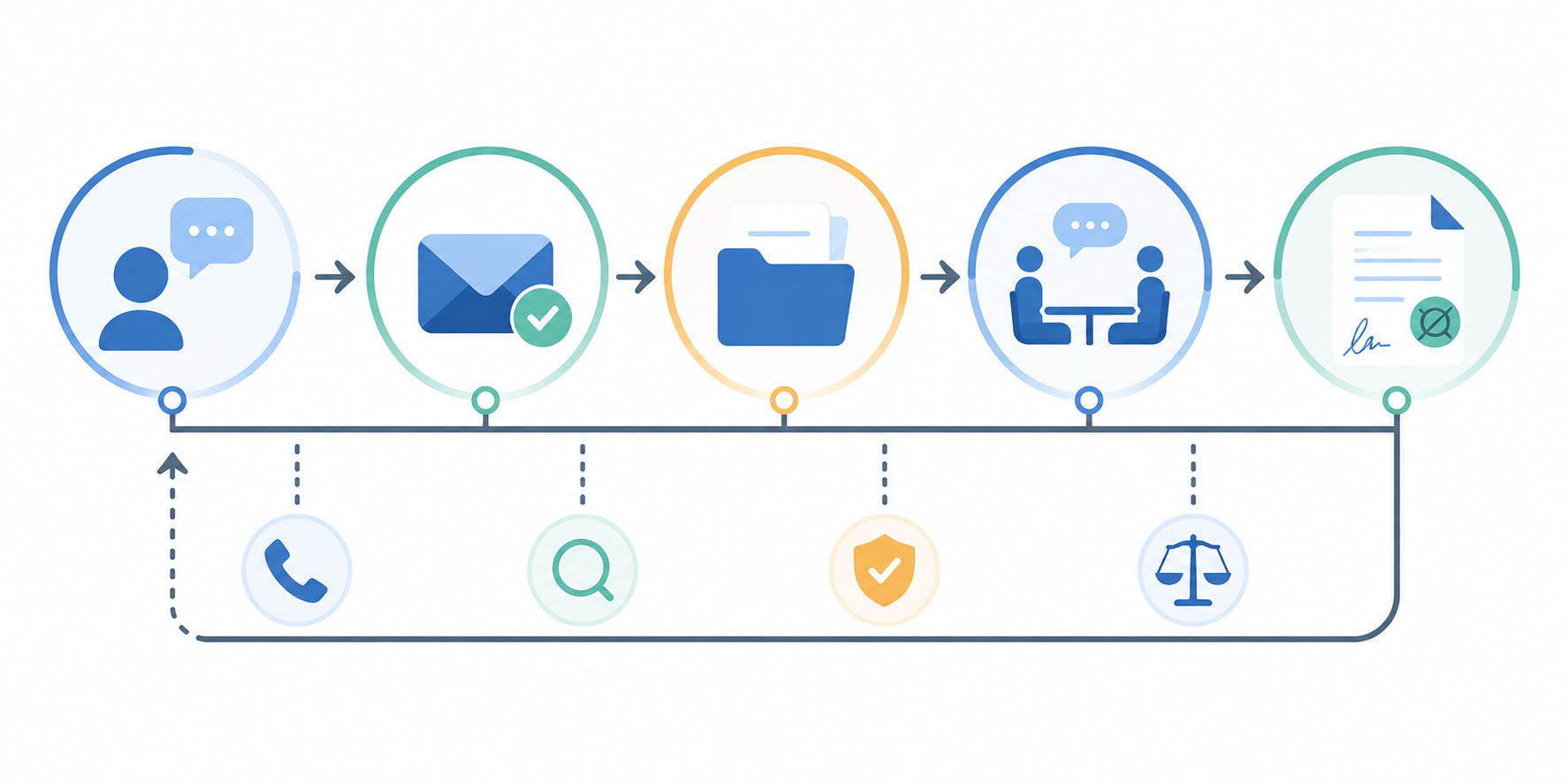
A documented intake workflow removes the inconsistency and guesswork that costs firms retained clients every day.
A workflow is just a documented process. If this happens, then this happens next. The reason workflows matter in intake is that without one, every inquiry is handled based on whoever happens to be available at the moment, which means the experience is inconsistent, things get missed, and nobody is accountable for the outcome.
Building a proper intake workflow starts with mapping what actually happens right now, before you try to fix it.
Map Your Current Process First
Before you redesign anything, document exactly what happens today when someone reaches out to your firm. Walk through each channel separately — phone, web form, email, live chat, text. For each one, answer these questions:
Who receives this inquiry? How quickly? What happens in the first five minutes after it arrives? Who is responsible for following up, and within what timeframe? What information is gathered at what stage? When does a potential client get to speak with someone who can actually help them? What happens if the inquiry arrives after hours, on a weekend, or when the responsible person is unavailable? How is the inquiry tracked so nothing falls through the cracks?
Most firms find, when they actually map this out, that the process is far more informal and inconsistent than they realized.
And that’s the problem. You can’t fix what you haven’t clearly seen.
Kelly Rossi, Founder and CEO of Marketing Magnitude, has been building and managing digital intake systems for law firms since 2002 and says the firms that stay organized track two things relentlessly: source and stage. Not just how fast they answered, but what happened after the answer. Booked consult, conflict check, no-show, unqualified, stalled. That’s where intake problems actually show up, and most firms aren’t tracking it at all.
Define the Ideal Workflow
Once you know what’s happening now, define what should happen.
For each channel, build a step-by-step process with named roles and specific timeframes.
Not “someone will follow up soon” but “the intake coordinator will call within 30 minutes during business hours, and within 2 hours on evenings and weekends.”
A basic phone intake workflow might look like this: call is answered live by a receptionist or intake specialist. Caller is greeted professionally and firm is identified. Caller’s situation is briefly assessed — what kind of matter, what happened, are they physically okay if it’s an injury case. Caller is confirmed to be in the right place or warm-transferred to a more appropriate resource. Consultation is scheduled before the call ends or a specific callback is committed to. Call notes are entered into the CRM immediately after the call. A follow-up reminder is set in the system for the next business day if the consultation is more than 24 hours away.
Every step should have a clear owner, a timeframe, and a way to confirm it happened.
Build in Redundancy
A workflow that depends on one person being available at all times will fail the moment that person is sick, on vacation, or in a meeting. Every intake workflow needs redundancy, a backup for every critical role, and a system that makes the status of every inquiry visible to more than one person. If the intake coordinator is out and a high-priority lead comes in, someone else needs to know it’s there and what to do with it.
Who Should Handle Intake?
This is a question that reveals a lot about how seriously a firm takes its intake process. In many solo and small firm practices, intake is handled by whoever picks up the phone, which might be the attorney, a paralegal, a receptionist, or a part-time administrator depending on the time of day. In larger firms, intake may be one of many responsibilities spread across several staff members. Neither approach is ideal.
The person handling intake is, from the potential client’s perspective, the firm. They form their first impression of how the firm operates, how professional it is, and whether it’s worth trusting with a significant legal matter based entirely on this interaction. The stakes are high enough that intake deserves dedicated attention rather than being an afterthought assigned to whoever is available.
The Case for a Dedicated Intake Specialist
A dedicated intake specialist is someone whose primary job is managing new client inquiries. They answer the phone with the sole purpose of converting inquiries into consultations. They know the firm’s practice areas, case criteria, and intake process inside out. They have the authority to schedule consultations without checking with anyone. And they are measured on their conversion rate, which means they’re incentivized to do the job well.
Firms that make this investment consistently see higher conversion rates than those that spread intake across general staff. The difference is focus and expertise. An intake specialist who handles 30 calls a day gets very good at it very quickly. A receptionist who handles intake calls between answering phones, greeting visitors, and managing the calendar never develops that same level of skill.
Not every firm can justify a dedicated full-time intake specialist, particularly at the solo or small firm level. The principle still applies — whoever handles intake should treat it as a primary responsibility, not a secondary one, and should have the training and authority to do it well.
Virtual Receptionists and Legal Answering Services
For firms that can’t staff intake coverage during all business hours or want to extend coverage after hours, virtual receptionist services and legal answering services are worth serious consideration.
Services like Smith.ai, Ruby, and Answering Legal specialize in handling inbound calls for law firms. They can answer calls in the firm’s name, follow a custom script, screen basic information, and transfer or schedule based on the firm’s criteria.
The quality of these services varies, and the best use of them is to handle overflow and after-hours coverage rather than replace a trained in-house intake specialist during peak hours. A real, trained person who knows the firm, the attorneys, and the practice areas will always outperform a third-party service on first-impression quality. But a good answering service is infinitely better than voicemail for after-hours inquiries, and better than an overwhelmed receptionist trying to handle too many things at once during busy periods.
The Attorney as Intake Person — When It Helps and When It Hurts
Some attorneys, particularly solos, handle their own intake calls. Done well, this can actually be a conversion advantage. A potential client who speaks directly with the attorney they’ll be working with often feels more confident in moving forward. The personal connection is real.
The problem is sustainability. As a practice grows, the attorney’s time becomes the firm’s most constrained resource. An attorney spending 90 minutes a day on intake calls that a trained specialist could handle equally well is an attorney not working on cases, not developing business, and not doing the things that only they can do. At some point, attorney-handled intake becomes a bottleneck rather than an advantage.
The right time to delegate intake is before it feels necessary. If you wait until intake is visibly breaking things, you’ve already lost clients and revenue that could have been retained.
Intake Scripts and Call Guides
The word “script” makes some lawyers uncomfortable. It sounds robotic. It sounds like a call center. The goal of an intake script is not to make your intake specialist sound like they’re reading from a page. It’s to make sure every potential client gets the same high-quality experience regardless of which staff member answers the phone, what day of the week it is, or how busy the office happens to be.
A good intake script is more like a call guide: a framework that ensures the right questions get asked in the right order, the right information gets collected, and the call moves efficiently toward its goal of scheduling a consultation, without sounding mechanical or impersonal.
What a Good Intake Call Should Accomplish
Every intake call has the same objectives, regardless of practice area or case type. It should make the caller feel heard and understood. It should quickly establish whether the firm can help with their situation. It should gather the information needed to prepare for the consultation. And it should end with a clear next step, ideally a scheduled consultation before the call ends.
The call should not feel like an interrogation or like the person on the other end is filling out a form. And it should not end without the caller knowing exactly what happens next and when.
The Basic Structure of an Intake Call
A well-structured intake call moves through four stages. The greeting and orientation stage establishes who the caller has reached and makes them feel welcome. Something like: “Thank you for calling [Firm Name], this is [Name]. How can I help you today?” Simple, professional, warm.
The listening stage gives the caller space to explain their situation in their own words before you ask structured questions. Most people want to tell their story. Let them. A brief, uninterrupted story-telling moment does more for rapport and trust than any scripted line. Then you can ask focused follow-up questions to fill in the gaps.
The assessment stage is where you determine whether this is a case the firm handles and gather the key details the attorney will need. This is where the script is most useful, providing a checklist of questions specific to the practice area that ensures nothing important is missed.
For a personal injury intake, this might include: when and where the incident occurred, what injuries were sustained, whether there was a police report, whether the caller has seen a doctor, and whether another party was at fault.
The next steps stage ends the call with a clear commitment. Ideally, a consultation is scheduled before you hang up. If that’s not possible, a specific callback time is committed to, not a general “someone will be in touch.”
If the firm can’t help, the caller should be thanked for reaching out and, where appropriate, given a referral to a firm that can.
Tailoring Scripts by Practice Area
The questions that matter in an intake call are different for personal injury, criminal defense, family law, and business litigation. Each practice area has a specific set of facts that determine whether the firm can help and what the attorney needs to know going into the consultation. Your intake guide should have a practice-area-specific question set for each area you handle.
For criminal defense, the key early questions include what charge the caller is facing, whether they’ve been arrested or are under investigation, whether they’ve spoken with police, and what their court date is if applicable. In criminal defense, urgency plays a much larger role in intake than it does in most other practice areas.
For family law, the key early questions include what type of matter it is (divorce, custody, support), whether there are children involved, whether there are immediate safety concerns, and whether the opposing party has an attorney.
For business litigation, the key early questions include what the nature of the dispute is, the approximate dollar amount at issue, whether litigation has begun, and what documentation exists.
Web Forms, Chat, and Text
Most law firm websites have a contact form. Most of those forms are designed for the firm’s convenience, not the potential client’s experience.
Often what you get are too many fields, unclear instructions, no confirmation that anything happened after submission, and no follow-up timeline. The form exists because the firm needed a way for people to make contact and not because anyone thought carefully about how a stressed, time-pressured person would experience filling it out.
Designing a Web Form That Actually Converts
The goal of a web form at the initial inquiry stage is to capture enough information to route the lead correctly and follow up intelligently. Not to gather everything you might ever need about the case. That information comes during the intake call and consultation.
A high-converting law firm intake form typically includes: first and last name, best phone number, email address, practice area or type of legal issue (a dropdown is fine), a brief description field with a 200 to 500 character limit, and optionally a preferred contact method and best time to reach them. That’s it. Every additional field reduces conversion.
The submit button should say something action-oriented. “Request a Free Consultation” rather than “Submit.” The page should reload to a confirmation message that tells the person specifically what happens next. “Thank you. A member of our team will call you within an hour. If your situation is urgent, call us directly at [phone number].”
Immediately after submission, an automated email should arrive in the potential client’s inbox. It should include the firm’s name and contact information, a confirmation that their message was received, the specific timeframe for follow-up, and ideally a direct link to schedule a consultation if you use online scheduling. This email should come from a named email address, not a noreply account.
Bryan Philips, Head of Marketing at In Motion Marketing, adds an important layer to this: the best intake flows pair a short web form with a calendar booking page and pull UTM data through so you can see which marketing source generated each inquiry. UTM parameters are small tracking codes added to URLs that tell your analytics platform exactly where a visitor came from, whether that’s a Google Ad, a LinkedIn post, an email campaign, or any other source. He also recommends asking a self-attribution question alongside the tracked source, because the two often tell different parts of the same story, and comparing both gives a much clearer picture of what’s actually working.
Live Chat
Live chat has become an increasingly important intake channel for law firms, particularly for potential clients who want answers to quick questions before they commit to a phone call. People who use chat are often in the research or early decision phase. They want to know whether the firm handles their type of case, what the process looks like, and whether a consultation is free, without having to talk to a person first.
Staffed live chat during business hours converts better than chatbots. The difference in conversion between a genuine human chat conversation and a chatbot interaction is significant, particularly for legal matters where the potential client’s emotional state and need for reassurance is high. If you’re going to offer live chat, staff it with a trained intake specialist during business hours.
Outside business hours, a well-configured chatbot can capture basic information and set expectations for follow-up. Keep the chatbot’s scope narrow. It should gather contact information, a brief description of the matter, and offer to schedule a callback. Chatbots that try to simulate a full intake conversation or provide legal information often create more problems than they solve.
Text Messaging
Text is the fastest-growing intake channel for law firms, and most firms are not set up to handle it well. Potential clients text because they want a quick, convenient response. They are not expecting a formal interaction. The tone should be professional but conversational, and the response should be fast.
Most practice management and CRM systems now support two-way texting, which allows your team to communicate with potential clients through the firm’s main number rather than personal cell phones. This is important for both client experience and data retention. Every text exchange should be logged in the CRM, not living on someone’s personal device.
Text intake works best when it’s used to capture initial information and move quickly to a phone call or scheduled consultation. Trying to complete a full intake screening over text is slow and error-prone. Use text to establish contact, confirm the case type, and get a consultation scheduled, then have the substantive conversation by phone.
Legal CRM and Intake Software

The right CRM connects every intake channel into one place so no lead falls through the cracks.
The right technology stack for law firm intake depends on the size of the firm, the volume of inquiries, the complexity of the intake process, and how it needs to connect to the firm’s existing practice management system. There is no single right answer. But there are some tools that are specifically designed for law firm intake and that are worth knowing about.
What to Look for in a Legal CRM
A CRM (Customer Relationship Management) system for a law firm tracks potential clients from first contact through retained client, manages follow-up tasks and reminders, stores intake information, and feeds data into the practice management system when a matter is opened.
Not every practice management system has strong CRM functionality built in, which is why standalone legal CRM tools exist.
When evaluating a legal CRM for intake, the features that matter most are lead capture and tracking, automated follow-up sequences, task and reminder management, integration with your practice management system, reporting on lead volume and conversion rates, and two-way texting capability.
The CRM should reduce the chance of a lead falling through the cracks, not add complexity that gets ignored. If your team won’t use it consistently, it doesn’t matter how many features it has.
Roland Parker, Founder and CEO of Impress Computers, who manages IT for Houston law practices, points to what he calls “access chaos” as the most common bottleneck he encounters — intake staff slowed down by fragmented systems and manual approval hurdles that force them to work around their tools rather than through them. Integrating web forms directly into case management platforms like Clio or MyCase, so that data flows automatically without manual handoffs, is in his experience the single biggest friction-reducer available to most firms.
Clio Grow
Clio Grow is the intake and CRM module within the Clio ecosystem, which also includes Clio Manage for case management. If your firm uses Clio Manage, Clio Grow is the natural intake companion because the integration is seamless. A lead that converts to a client moves from Clio Grow into Clio Manage without manual data re-entry.
Clio Grow includes online intake forms, e-signature for retainer agreements, a client portal, automated follow-up emails, appointment scheduling, and basic pipeline tracking. It’s not the most feature-rich CRM on the market, but its integration with Clio Manage and its legal-specific design make it a solid choice for firms already in the Clio ecosystem.
Lawmatics
Lawmatics is a legal CRM and intake automation platform that is more focused on marketing automation than Clio Grow. It includes intake forms, automated email and text follow-up sequences, appointment scheduling, pipeline management, document automation, and robust reporting. It integrates with Clio Manage, MyCase, Smokeball, and other practice management systems.
Lawmatics is a better choice than Clio Grow if your firm wants more sophisticated automated follow-up sequences, more control over the intake automation workflow, or more detailed reporting on lead sources and conversion rates. The trade-off is that it’s more complex to set up and has a steeper learning curve.
MyCase
MyCase is an all-in-one practice management platform that includes intake functionality. Its intake tools include customizable intake forms, a client portal, e-signature, appointment scheduling, and two-way texting. It’s a strong choice for firms that want a single platform for both intake and case management, and its pricing is competitive.
Filevine
Filevine is a practice management platform particularly popular with plaintiff-side litigation firms, including personal injury practices. Its intake and lead tracking tools are designed for high-volume practices that need to manage a large number of potential cases simultaneously. It includes lead tracking, intake forms, automated follow-up, and detailed reporting. For a high-volume PI firm, Filevine’s intake functionality is worth evaluating seriously.
A Note on General CRM Tools
Some firms use general-purpose CRM tools like HubSpot or Salesforce for intake management. These tools are powerful and flexible, but they’re not designed specifically for law firms. They require significant customization to work well for legal intake, and the customization often requires technical expertise to build and maintain. Unless your firm has someone on staff or on retainer who can build and maintain a custom legal intake workflow in a general CRM, a legal-specific tool will serve you better.
Call Tracking and Analytics Tools
Many law firms have no idea which of their marketing channels is actually generating phone calls. They know they spend money on SEO, paid search, and directories. They don’t know which of those sources is sending them the calls that convert into retained clients. This is a significant blind spot, and it’s completely fixable with call tracking.
What Call Tracking Does
Call tracking software assigns unique phone numbers to different marketing sources — one number on your website, one on your Google Ads, one on your Avvo profile, one on your directory listings. When a potential client calls, the tracking system records which number they called, which tells you which source generated the call. It also records the call itself, tracks call duration, and in more advanced setups, can integrate with your CRM to connect call data to lead records.
This data tells you which marketing channels are actually driving phone inquiries and which are not. It lets you make informed decisions about where to invest and where to cut. A firm spending $2,000 a month on a directory that’s generating zero calls can reallocate that budget to something that’s working. Without call tracking, you’re making those decisions blind.
Zack Bowlby, CEO of ROI Amplified, who has managed over $100 million in ad spend across hundreds of client accounts including personal injury law firms, describes broken attribution as typically the biggest intake bottleneck he encounters. When Google Ads aren’t properly linked to Analytics and configured with meaningful goals, firms can’t calculate the cost-per-acquisition math that makes sound budget decisions possible, and they end up wasting spend on inquiries that never become retained clients.
CallRail
CallRail is the most widely used call tracking platform for law firms and legal marketing. It assigns tracking numbers, records calls, transcribes them, and provides analytics on call volume, call duration, and lead source attribution. It integrates with Google Analytics, Google Ads, and most major CRM platforms.
CallRail’s call recording and transcription features are particularly valuable for intake quality management. You can listen to intake calls to identify where your process is breaking down, coach your intake team based on real calls, and spot patterns in the questions and concerns potential clients are raising. This is information you simply can’t get any other way.
One important consideration: recording calls without consent is illegal in some states. Most call tracking platforms include automated disclosures, but make sure yours is configured correctly for your jurisdiction and that your team is aware of any state-specific requirements around recorded calls.
WhatConverts
WhatConverts is a lead tracking platform that goes beyond call tracking to capture all types of conversions — calls, form submissions, chat, and text.
If you want a single platform that tracks every intake channel and attributes leads to their source, WhatConverts is worth evaluating alongside CallRail. It’s particularly useful for firms running paid advertising who want to understand cost per lead by channel and campaign.
Google Analytics and Search Console
Google Analytics and Search Console are free tools that provide essential data about your website traffic and how it connects to conversions. Setting up conversion tracking in Google Analytics, so that form submissions and click-to-call actions are tracked as conversion events, gives you the baseline data to understand how your website is performing as an intake tool. This is not optional for any firm investing meaningfully in digital marketing.
Automating Intake Without Losing the Human Touch
Automation in intake is one of those things that can either make your process dramatically more effective or quietly destroy it, depending on how it’s used. The firms that use automation well use it to eliminate the administrative friction and delay that loses leads, while keeping humans in every interaction that actually matters to the potential client’s decision.
The right question to ask about any automation in your intake process is: does this make the potential client’s experience better, or does it make the firm’s operations more convenient at the potential client’s expense? Those are not always the same thing.
Where Automation Belongs in Intake
Automation earns its place in intake at the moments where speed and consistency matter more than human judgment. Immediate confirmation emails after a web form submission. Automated reminders for upcoming consultations. Follow-up sequences for leads that went cold. Routing inquiries to the right team member based on practice area or geography. These are tasks where a human doing them manually introduces delay and inconsistency, and where automation produces a better outcome.
A simple automated sequence for a law firm intake process might look like this:
A potential client submits a web form. Within seconds, they receive a confirmation email with the firm’s contact information, a specific follow-up timeframe, and a link to schedule a consultation. If no consultation is scheduled within 24 hours, a follow-up email goes out the next morning. If still no response after 48 hours, a text message is sent. After 72 hours, a task is created in the CRM for a team member to make a personal phone call. At each stage, the communication feels like it’s coming from the firm, not from a robot.
That sequence converts leads that would otherwise go cold while requiring almost no manual effort from the intake team. The human effort is concentrated at the phone call stage, where it belongs.
Mike Ibrahim, Founder and CEO of RewardLion, who has spent over a decade building intake, CRM, and automation systems for service businesses including law firms, sees the same pattern consistently. As he frames it: “The biggest bottleneck isn’t lead volume, it’s delayed follow-up, fragmented conversation history across channels, and no coverage for after-hours inquiries. Hot leads go cold before a human ever gets involved.” The firms that win have all their inquiry channels feeding into one unified system and respond as close to immediately as possible.”
Where Automation Doesn’t Belong
Automation does not belong in the moments where the potential client needs to feel heard by a human. The initial phone call. The consultation itself. The moment when a potential client is declined and needs to understand why and where else they might turn. These are moments where a warm, genuine human interaction is what converts or retains the relationship, and where automation feels cold and dismissive.
The mistake many firms make is over-automating the intake process to the point where a potential client goes through multiple automated touchpoints without ever speaking to a human, and by the time a human does appear, the client has already moved on. Automation should reduce the time it takes to get a human in front of the potential client, not replace that human interaction.
Appointment Scheduling Tools
Online appointment scheduling is one of the highest-value automation tools for law firm intake. Tools like Calendly, Acuity Scheduling, and the scheduling features built into Clio Grow and Lawmatics allow potential clients to book a consultation directly from your website, a confirmation email, or a text message, without having to call the office and wait for someone to check a calendar.
For many potential clients, particularly those reaching out outside business hours or those who prefer not to make a phone call before they know more about the firm, the ability to book a consultation online is the difference between converting and not converting. The consultation gets on the calendar at the moment of peak motivation, before they’ve had time to look at other options.
Online scheduling works best when it’s offered as an option alongside the phone call, not as a replacement for it. Some people want to schedule online. Others want to speak to someone first. Give them both options.
AI in Legal Intake
AI is showing up in law firm intake in ways that range from genuinely useful to actively harmful, and many law firms are not yet equipped to tell the difference. The technology is moving faster than the practical guidance around it, which means firms that aren’t paying attention are either missing opportunities or walking into problems.
What AI Is Actually Doing in Intake Right Now
The most common AI application in legal intake right now is conversational AI for initial screening. AI chatbots and voice agents that can handle an initial inquiry, ask screening questions, and route the lead based on the responses. These tools have gotten meaningfully better in the past two years. The best of them can handle a basic intake screening conversation in a way that many potential clients don’t immediately recognize as automated.
AI transcription and summarization is another area where the technology is delivering real value. Call recording tools like CallRail now offer AI-powered transcription and call summary features that turn a 15-minute intake call into a structured summary with key facts, action items, and sentiment analysis. This reduces the manual note-taking burden on intake staff and makes it easier for attorneys to review leads before consultations.
AI-assisted follow-up drafting is also emerging. Some CRM platforms now use AI to draft follow-up emails and text messages based on the details of the intake conversation, which speeds up the follow-up process and improves consistency. Parker describes an “AI drafts, human approves” workflow that handles the bulk of common client FAQs and saves firms 30 to 45 minutes daily without removing human judgment from the interactions that actually matter.
The AI Inquiry Problem
There’s a growing challenge on the other side of the AI equation. Potential clients are increasingly using AI to draft their initial inquiries to law firms. The result is intake emails that are well-written, detailed, and articulate, and that may have little to do with an actual legal situation the person has. AI tools are great at generating plausible-sounding legal fact patterns, and some people are using them to submit speculative or exploratory inquiries that consume intake resources without any real intent to hire.
This doesn’t mean you should become suspicious of well-written inquiries. It means your intake screening process needs to include a human conversation early enough to separate genuine cases from noise. An AI-generated inquiry can be identified quickly in a phone call or a targeted follow-up question. The goal is not to screen out good clients but to not waste significant attorney time on consultations that were never real leads.
Using AI Responsibly in Legal Intake
The ethical constraints that govern law firm marketing apply to AI-assisted intake. If an AI tool is being used to communicate with potential clients, the firm is responsible for what it says. An AI chatbot that overpromises on outcomes, provides specific legal advice, or creates a misleading impression of attorney involvement is a bar ethics problem, not just a technology problem.
Any AI tool used in intake should be clearly scoped to information-gathering and scheduling functions, not legal advice or outcome representations. It should be clearly identified as automated where required by your state bar rules. And it should be configured conservatively. The downside of an AI tool saying something wrong to a potential client in a moment of vulnerability is significant.
Used within these constraints, AI can meaningfully reduce the administrative burden of intake and improve response speed.
Lucado notes that done right, AI-assisted conversational intake can save a mid-size firm $40,000 to $80,000 annually in labor costs, primarily by handling overnight intake capture and cutting conflict check time to under two minutes. But he is emphatic that AI intake works best as a triage stage, not a replacement for the qualifying phone call. That human call still needs to happen the same day. Used carelessly, the technology creates liability and damages the firm’s reputation with exactly the people it is trying to serve.
Qualifying Leads During Intake
Lead qualification is the process of determining, during intake, whether a potential client’s situation is one the firm can and wants to take on. It’s one of the most important functions of the intake process, and it’s one of the most uncomfortable for many lawyers because it involves saying no to people who need help.
Done well, qualification protects the attorney’s time, improves the quality of the caseload, and actually serves potential clients better by getting them to the right resource faster. Done poorly, it alienates good potential clients with clunky screening or lets unqualified leads waste everyone’s time.
Defining Your Case Criteria
Before you can qualify leads effectively, you need clear case criteria. These are the objective factors that determine whether a potential case is one the firm handles. For a personal injury firm, criteria might include: the injury must have occurred within the applicable statute of limitations, there must be a viable liable party, the damages must exceed a minimum threshold to make the case economically viable, and the matter must fall within the firm’s practice area rather than an excluded category like workers’ compensation.
Writing your criteria down is not bureaucratic. It’s what allows you to delegate intake with confidence. If the intake specialist knows exactly what a qualifying case looks like, they can make accurate routing decisions without attorney involvement in every call. The attorney’s time is reserved for cases that have already passed the initial screen.
How to Screen Without Alienating Good Leads
Screening feels like rejection to potential clients if it’s done poorly. The key to doing it well is framing. The goal of the intake conversation is not to find reasons to say no. It’s to find out whether the firm is the right fit for this person’s situation, and to get them to the right help as quickly as possible whether that’s the firm or someone else.
When a case doesn’t meet the firm’s criteria, the intake specialist should acknowledge what the potential client is dealing with, explain briefly why the firm isn’t the right fit, and where possible offer a specific referral.
“I’m sorry to hear what you’ve been through. This type of case is outside what we handle, but I’d recommend reaching out to [specific firm or resource] who specializes in this area.” That’s a far better experience than “we can’t help you” with no context or direction.
Statute of Limitations Screening
Statute of limitations issues deserve specific attention in intake because they create both urgency and risk. If a potential client’s matter is approaching the statute of limitations, that fact needs to surface early in the intake process so the attorney can make a quick decision rather than letting the matter sit in a follow-up queue. A firm that misses a statute of limitations because an intake inquiry wasn’t flagged as urgent has a serious problem on its hands.
Your intake screening process should include a direct question about when the incident or triggering event occurred for any practice area where time limits apply, and a clear protocol for escalating matters where the deadline is imminent.
Intake for Different Practice Areas
The fundamentals of good intake apply across all practice areas. The specifics look quite different depending on what kind of law you practice. The emotional state of the potential client, the urgency of the matter, the key qualifying questions, and the typical timeline from inquiry to retained client all vary significantly by practice area.
Personal Injury
Personal injury intake is characterized by high emotional stakes and high urgency. The potential client has typically been injured recently and is dealing with physical pain, financial pressure from medical bills and lost wages, and uncertainty about what comes next. They are often calling multiple firms simultaneously.
Speed is the most critical intake variable for PI firms. A potential client who calls three firms and gets a live answer and a scheduled consultation from one of them within the hour is very likely to go with that firm. The quality of the follow-up matters less than whether it happens immediately.
Key qualifying questions for PI intake include: when and where the incident occurred, what injuries were sustained and whether the caller has received medical treatment, whether there was a police report, whether a third party was at fault, and whether the caller has spoken with any insurance company or signed any documents. The last question matters because a recorded statement or early settlement can significantly affect what the firm can do for the client.
Criminal Defense
Criminal defense intake is the most time-sensitive of any practice area. A potential client who has just been arrested or is facing an imminent court date is not in a position to wait for a callback tomorrow. The intake process for criminal defense needs to include genuine after-hours coverage and a protocol for urgent escalation.
Key qualifying questions include what the charge is, whether the person has been arrested or is under investigation, whether they’ve spoken with police or made any statements, what their court date is, and whether they’re currently in custody or out on bail. The answer to the court date question determines how urgently the attorney needs to be involved.
Criminal defense intake also requires careful attention to confidentiality. The person calling may be calling from a location where others can hear them, or may be calling on behalf of someone else such as a family member. The intake process should include a check on whether the caller can speak freely.
Family Law
Family law intake involves a high level of emotional volatility and often a longer decision-making timeline than PI or criminal defense. Potential clients in family law matters are often not in an acute crisis at the moment of the call. They’re contemplating a significant life change and doing research. They may call multiple firms and take days or weeks to decide.
This means that for family law, the quality and warmth of the intake interaction matters even more than speed, and follow-up over a longer window is essential. A potential client who calls a family law firm, has a positive initial conversation, and then receives a thoughtful follow-up a few days later is much more likely to convert than one who was rushed through an intake call and never heard from the firm again.
Key qualifying questions for family law intake include what type of matter it is, whether there are children involved and their ages, whether there are immediate safety concerns that require emergency relief, whether the opposing party has retained an attorney, and in jurisdictions where it’s relevant, how long the couple has been married or separated.
Estate Planning
Estate planning intake is the least urgent of the major practice areas and tends to attract clients who are planners by nature. They are not typically in crisis. They’re thinking ahead. The intake process for estate planning should be thorough and consultative, focused on understanding the complexity of the potential client’s situation rather than speed.
Key qualifying questions include what documents the potential client currently has in place, whether there have been any recent life changes such as a marriage, divorce, birth, or death in the family, the general complexity of the estate, and whether there are any business interests or special needs considerations involved.
Business and Commercial Litigation
Business litigation intake tends to involve more sophisticated potential clients who are doing a more deliberate evaluation of their options. They may be comparing multiple firms on reputation, experience, and approach before making a decision. The intake process needs to project competence and seriousness from the first interaction.
Key qualifying questions include the nature of the dispute, the approximate amount at issue, whether litigation has already begun or is being contemplated, what documentation exists, and whether the other party has legal representation. The amount at issue matters because it determines whether the economics of litigation make sense for the client given the cost of legal representation.
Common Intake Mistakes Law Firms Make
Most intake failures are predictable. The same patterns appear across firms of different sizes, in different markets, across different practice areas. Knowing what they are makes them avoidable.
Letting Calls Go to Voicemail During Business Hours
This is the single most common and costly intake mistake. A potential client who calls during business hours and reaches voicemail has a high probability of calling the next firm on their list before they ever leave a message. If they do leave a message, the longer the callback takes, the lower the conversion rate. There is no substitute for a live answer during business hours.
No Follow-Up System
A potential client who submits a web form or leaves a voicemail and doesn’t hear back within a few hours has already mentally moved on. Most firms have no systematic follow-up process for web form submissions. The inquiry goes into an email inbox, gets seen when someone checks it, and may or may not be responded to the same day. This is not a follow-up system. It’s hope. Lucado makes a point that applies directly here: firms obsess over getting into the 5-minute response window and then lose 40% to 60% of qualified inquiries between Day 2 and Day 7 because nobody follows up. A systematic 14-day touch plan with 5 to 7 total contacts improves conversion on those otherwise-lost leads by 15% to 25%.
Treating Intake as Admin Work
When intake is treated as a low-priority administrative task rather than a high-priority revenue function, it gets staffed accordingly, underpaid, undertrained, and undervalued. The person who handles your intake calls is the first human contact potential clients have with your firm. That role deserves investment proportional to what it’s worth, which is a significant share of the firm’s new client revenue.
Asking for Too Much Information Too Early
Web forms that ask for a three-page case summary before anyone has spoken to the potential client, intake calls that feel like depositions, detailed questionnaires sent before the consultation is even scheduled — all of these create friction at the worst possible moment. The goal of early intake is to capture enough information to have a productive next conversation, not to gather everything you’ll ever need about the case before you’ve even agreed to take it.
Lowry has seen this cost firms serious money firsthand: one personal injury firm was losing $30,000-plus cases because their intake form had 47 fields and took 15 minutes to complete. Cutting it to 7 essential fields increased their conversion rate by 68%.
No Consistent Intake Script or Training
If different people at your firm handle intake calls differently, the potential client’s experience is a lottery. Some calls are handled professionally and convert. Others are handled poorly and lose the lead. Without a consistent process, you can’t identify what’s working and what isn’t, and you can’t improve systematically. Training and scripting are not optional for a firm that wants predictable intake performance.
Failing to Follow Up on No-Shows
A potential client who schedules a consultation and doesn’t show up is not necessarily a lost lead. People miss appointments for all kinds of reasons, many of them unrelated to their level of interest. A firm with a no-show follow-up process, a quick check-in call or text within an hour of the missed appointment, recovers a meaningful percentage of those leads. A firm with no no-show protocol loses them all.
No Referral Process for Declined Leads
Every declined lead is an opportunity to build goodwill and reinforce your reputation in the legal community. A potential client who is declined gracefully and given a useful referral will remember the experience positively and may refer others to your firm even though they themselves couldn’t be helped. A potential client who is declined curtly and given no direction will remember that too.
Measuring Intake Performance
You can’t manage what you don’t measure. Most law firms have a general sense of how many new clients they bring on each month, but very few have a clear picture of how many leads they’re generating, what percentage of those leads are converting, where the drop-off is happening, and what each new client is actually costing them to acquire. Without this data, improving intake is guesswork.
The Metrics That Matter
Lead volume is the total number of inquiries received across all channels in a given period. This is your starting point. Broken down by channel, it tells you which sources are generating leads and at what volume.
Lead response time is how long it takes from first contact to first response. This should be tracked by channel separately, since the standard for phone response is different from the standard for web form response. A firm with a goal of responding to web form submissions within an hour on business days needs to know whether it’s actually hitting that target.
Consultation rate is the percentage of leads that result in a scheduled consultation. A significant drop between lead volume and consultation rate points to a problem in early intake. Typically it signals slow response, poor phone handling, a web form that isn’t converting, or leads that aren’t being followed up on.
Show rate is the percentage of scheduled consultations that actually happen. A low show rate suggests a problem with either lead quality or consultation preparation — potential clients who scheduled but weren’t engaged enough to follow through, or a process that doesn’t adequately confirm and remind them about the appointment.
Conversion rate is the percentage of consultations that result in a retained client. This is the ultimate measure of intake and consultation effectiveness. If your conversion rate from consultation to retained client is low, the issue may be in how consultations are conducted rather than in early intake.
Cost per retained client is the total marketing spend divided by the number of retained clients. When you know your cost per retained client and the average value of a retained client, you have the data to make intelligent decisions about marketing investment and intake improvement.
Using Call Recording for Intake Quality Management
Call recordings are one of the most underused intake improvement tools available to law firms. Listening to a sample of intake calls every week, whether as the managing partner, the intake manager, or a designated team lead, tells you things about your intake process that no report or metric can. You hear how your team actually sounds on the phone. You hear the questions potential clients are asking. You hear where calls are going well and where they’re falling apart.
Coaching based on real calls is far more effective than coaching based on general principles. An intake specialist who hears their own call and understands specifically what they could have done differently in that interaction will improve faster than one who receives generic feedback about “being warmer” or “asking better questions.”
Tracking Lead Source to Retained Client
The most valuable intake data connects the source of a lead all the way through to whether that lead became a retained client. This requires that lead source information is captured at first contact and carried through the CRM into the case management system. When you have this data, you can answer the question that matters most: which marketing channels are producing retained clients, and at what cost?
A firm that knows its Google Ads are generating retained clients at $800 each while its directory listings are generating retained clients at $3,000 each has the information it needs to reallocate budget intelligently. A firm without this data is treating all marketing channels as equally valuable or worthless, which they never are. Rossi reinforces this point: the firms that get this right are tracking source all the way through to a signed retainer, not just to the initial inquiry. That full-funnel attribution is what separates the firms making smart marketing decisions from the ones guessing.
Summary
Client intake is where law firm marketing meets law firm revenue. Every dollar spent on SEO, paid advertising, content, and directories is buying you one thing — an inquiry. What happens to that inquiry determines whether it becomes a retained client or a wasted opportunity.
The most important things to take away from this guide:
Speed is the single biggest variable in intake conversion. A potential client who reaches out in a moment of need is highly motivated right now and significantly less motivated an hour from now. Responding within minutes, not hours, is not a nice-to-have. It’s the difference between winning and losing a meaningful percentage of your leads.
Intake is a marketing problem, not just an operations problem. Every firm that treats intake as administrative back-office work is leaving money on the table. The handoff between marketing and intake is where most leads are lost, and it deserves as much attention as the marketing itself.
The person handling your intake is representing your firm to potential clients in their most vulnerable moments. This role deserves dedicated focus, real training, and investment proportional to what it’s worth to the firm.
The right technology reduces friction and prevents leads from falling through the cracks. It does not replace the human interactions that actually convert potential clients into retained clients.
Measurement is what makes improvement possible. If you don’t know your lead volume, response time, consultation rate, show rate, and conversion rate, you have no way of knowing where your intake process is working and where it isn’t.
If your firm is generating inquiries but not converting them at the rate you’d expect given your reputation and experience, the intake process is almost certainly where the answer lies. Fixing it doesn’t require a complete overhaul. It usually starts with a clear-eyed look at what’s actually happening when someone reaches out, and a commitment to making that experience as professional, responsive, and human as possible.
If you’d like to talk through what an intake audit or intake improvement strategy could look like for your firm specifically, schedule a free strategy session with us here. No pitch. Just a straight conversation about what’s possible.