
In the digital marketing world, you often hear a lot of talk about keywords.
Some people go as far as ascribing magical powers to keywords as the cure-all for all the woes you might be experiencing whilst trying to market your legal practice online to find those elusive clients.
While keywords are not the only piece of the puzzle that you must have a good grasp of as you plan your marketing strategy, they are important. But what exactly are they and why should you care?
What are keywords?
When you’re trying to get your law firm found easily by prospective clients on search engines like Google and Bing, as well as the newer AI-driven generative engines like ChatGPT and Perplexity, keywords are the specific words, terms, or phrases that the engines use to match your web pages to their search users.
This matching is done to produce results for the organic search engine results pages (SERPs). Inclusion in the SERPs is typically the result of an effective search engine optimization (SEO) or generative engine optimization (GEO) strategy. For all intents and purposes both flavors of these engines are functioning as search engines in this context and we will stick with the terms search engine and search engine optimization.
A similar matching is also performed for paid digital advertisement placements, AKA search engine marketing (SEM), campaigns on those search engines.
These keywords are typed into the search engines by users looking for specific information.

Users search for lawyers using keywords on a search engine
For organic search results, if your law practice’s web pages are optimized with great content that’s relevant to those keywords – in addition to other important criteria that search engines use to determine the pages to rank on their SERPs – you are more likely to be matched with a user who conducted a search.
For paid advertising on the search engines, you need to place advertising bids on those keywords and pay to get matched with users searching for those terms.
Some examples of keywords and phrases that a search user could type into the search box are: “business attorney near me”, “Car accident lawyer in Miami”, “Employment lawyer in NYC”, “Help me find a good DUI lawyer in Salem”, etc.
Why Keyword Research is Important
Keyword research involves all the activities and processes you will employ to make sure that you’re working with the right keywords for your digital marketing activities.
While keywords are not the only important ingredient required for successful digital marketing campaigns – whether SEO or SEM – they are a critical foundation.
They are the basis for the content you will create for your web pages, and what you will be bidding on for your digital ads.
That’s why it’s important to pick the right keywords to focus your content creation efforts, and to attach your advertising dollars to.
To do that successfully, you need to make effective keyword research your starting point.
How to Conduct Keyword Research and Build a Keywords List
To successfully conduct keyword research for your law practice, you must let go of any assumptions you have about the keywords that you think your target audience is using to find legal services providers like yourself.
This is important because many lawyers – and most business owners in general – often have the wrong ideas about the keywords that they believe their audience will use to search for them.
These ideas are often informed by internal industry terminologies and jargon which are usually very different from how your target audience is conducting searches in reality.
Instead, let the data and the objective processes outlined below, guide your steps.
Find Out Your Law firm’s Real Versus Assumed Keywords
As you begin to brainstorm keywords for your list and marketing efforts you want to find out the prime keywords that you should be focusing on. To do this, you must first clearly identify your real audience.
For most lawyers and law firms, the target audience would be everyday individuals who need legal help. These are your prospective clients.
Now and then, other lawyers may visit your website and refer business to you, or even avail themselves of your services, but they are not your primary audience.
Therefore, it’s important to remember that your primary audience is not immersed in legal jargon and that the way they may think of you, and search for lawyers like you, might not necessarily be the way that you and your legal peers would think of, or search for, yourselves.
An example is of a lawyer who practices in the area of Family Law. Her primary focus with her practice is divorce law. If she focuses on the keywords “Family Law”, “Family Law Practice”, “Matrimonial Attorney”, which are all technically the areas of law she practices, she will almost completely miss out on searches by her target audience.
The current data shows that the vast majority of searches for those services in her practice area are those that include the phrase “Divorce Lawyer”.
Take Surveys and Polls of Your Clients and Mine Customer Intake Data
Taking regular surveys and polls of clients that come to you can reveal patterns that could help with your keyword research processes.
Ask clients how they found you if they came through your website. Get to know if they found you from a search or if your website was recommended to them by someone else.
If they found you via search, ask them what search terms they used. This could be instructive in identifying the terms you are ranking for and will also let you know how others describe you.
Look for clues in the phone conversations you have with clients and potential clients that could reveal important keywords they relate with you and your services. Similarly, examine intake forms and email or webchat submissions that your firm receives.
Josiah Roche with JRR Marketing takes this client-first approach to keyword research. “What’s working best for my clients now starts with intake, not Ahrefs or SEMrush,” he explains. “We mine phone calls, website chats and email enquiries for exact phrases people use before they know the legal term: ‘Can I get out of my AVO?’, ‘Do I lose my license on the spot?’, ‘What if I can’t afford a lawyer?’ That becomes the base keyword set.”
Browse the Top Legal Portal Sites
Potential clients are asking lots of questions on many platforms and properties online. Top legal portal sites like Findlaw, Avvo and Justia can be a great source of keywords.
Visit any of those sites and check out the FAQ or Questions and Answers sections of those portals and you will find real questions that your audience is asking.
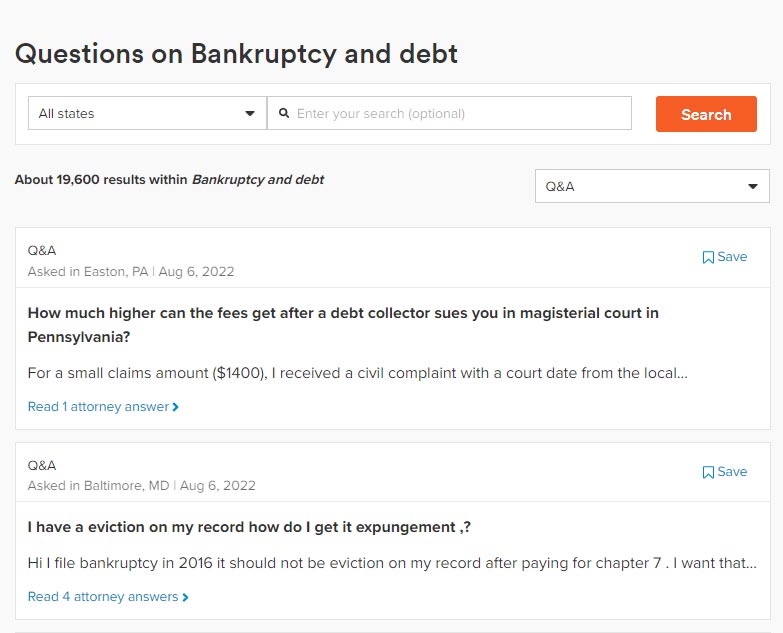
Legal questions asked by real individuals who need legal help on legal portal sites
Most of the questions will be specific, longer form keywords (AKA “Long tail keywords”, discussed later in this post), but they will provide valuable clues about the legal concerns of your audience.
Research on Social Media
There are lots of active conversations going on in various parts of the Internet and on social media constantly. Find and participate in groups on social media or discussion boards that are dedicated to issues that are relevant to your law firm. That can often be very insightful and yield valuable keyword research data.
Michael Lalonde, a digital marketing consultant with PPC Assist takes that approach with keyword strategy. He says, “Instead of keyword research taking place strictly on Google or using search tools, we’ve expanded it to more conversational spaces like Reddit, Quora, TikTok, and Instagram to see how those conversions are taking place, what people are tagging, and how they are asking questions. From there, we can quickly create highly targeted content based on issues people are talking about. That content is not only posted to social media, but also linked back to FAQs or Media sections on the website with full transcriptions, citations, and extra resources, providing more detailed information that help rankings in LLM results.”
Research Your Top competitors’ keywords
Imitation is said to be the sincerest form of flattery – so go ahead and check out the keywords that are driving traffic to the websites of the dominant players in your practice area and markets.
If you find keywords that are also relevant to your practice, you can adopt them and work on ranking for them.
Targeting Brand keywords of a Competitor in Your Digital Advertising Campaigns
There might be a dominant player in your space with a lot of name recognition.
This could be a result of long-term, heavy investment in media advertising like radio, TV, billboards, etc.
While you don’t want to optimize your content based on another brand, you could bid on keywords related to their brand and possibly get some rub-off exposure to your own brand as a result.
However, it’s important to note that on some advertising platforms, such branded keywords are often going to be expensive to bid on and are sometimes restricted.
Use Keyword Research Tools
There is a plethora of tools that can be used for keyword research. Some are free to use while others are paid utilities.
At the bottom of this section is a list of tools that can be used for keyword research.
The ways to conduct keyword research with each one of these tools varies greatly. Consulting the relevant documentation for any particular product is a good starting point.
However, some of the important information you should be obtaining from these tools includes the most important keywords for your practice area and local market, volume of searches for those keywords and phrases, who is ranking for those keywords, and where you currently rank for those keywords.
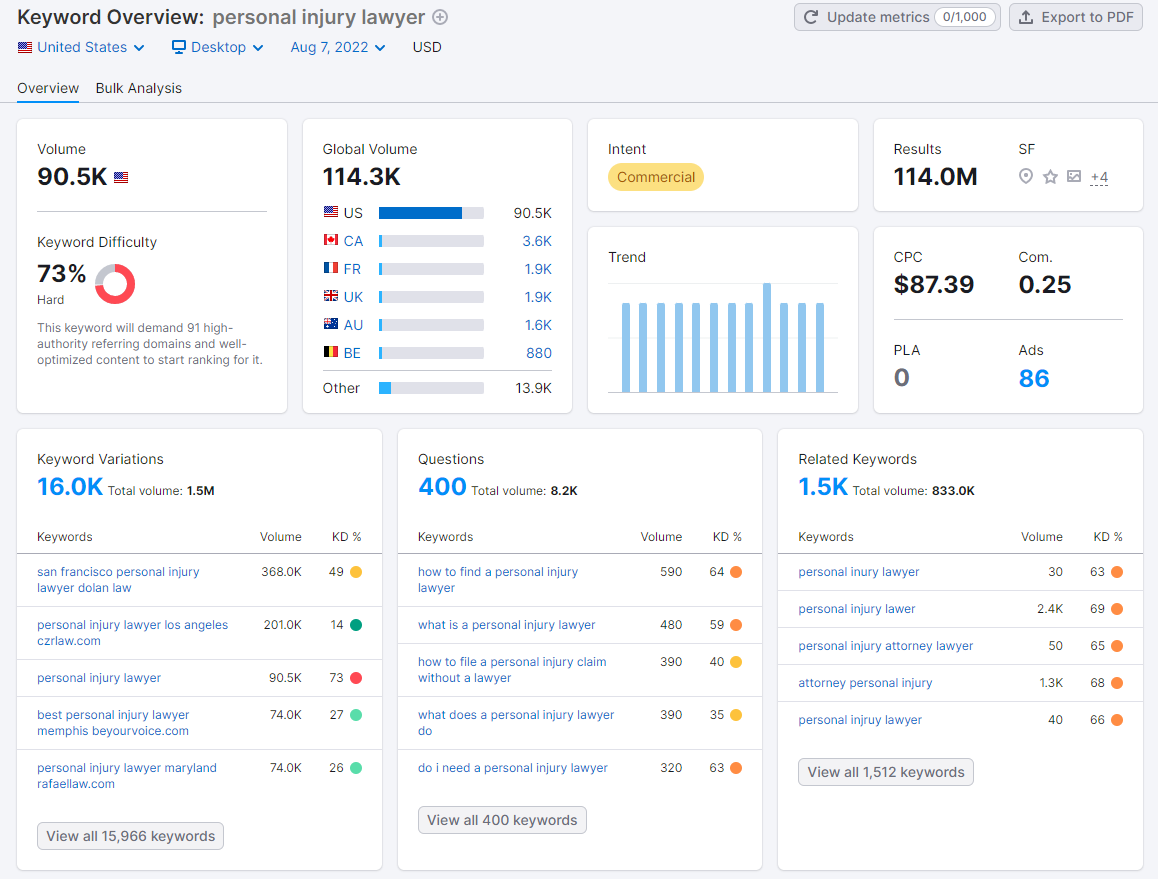
keyword research tool showing results of a keyword analysis
It is often necessary to use a combination of tools to get the full picture of where you stand and where you want to go with the keywords you discover.
A Word of Caution with Your Analytics and Search Console Traffic Data
When you use tools like Google Webmaster Search Console, for example, you might see some keywords that you rank for or that are driving traffic to your website.
Scrutinize the results carefully to be sure that those keywords are actually relevant to the content you’re providing and for which you’re optimizing your website.
If you’re getting hits for content you don’t provide, it means your visitors will be abandoning your site quickly after a visit – what’s known as a bounce – which can hurt your SEO efforts. If that is the case, explore your content carefully to be sure you’re not inadvertently optimizing for irrelevant keywords.
Keyword Research Tools
- Keywords Everywhere
- Google Keywords Planner
- Google Trends
- Semrush
- Moz
- UberSuggest
- Google Search Console
Understanding Search User Intent and How It Relates to Your Ideal Keywords
When users search for information online their motivation and goals vary.
Some might be looking for general information about a topic for research purposes, while others might be actively searching for a legal services provider to help with an immediate need they have.
The motivation behind a user’s search activity is known as the User Intent.
The keywords users employ in their searches can reveal their intent. Knowing this can help you as you produce your content.
Search intent is grouped into four main categories: informational, navigational, commercial, and transactional.
Informational intent, as the name suggests, denotes that the user’s primary goal is information. An example could be a search like, “How much does an IP attorney make?”
Navigational search intent suggests the user is trying to get directions of some kind. Example: ” website of Jacoby and Lipchinsky PLC”.
Commercial search intent suggests that a product or service evaluation or brand comparison might be taking place. An example could be, “Best employment attorney in Miami”.
Transactional intent suggests a transaction might be imminent. Example: “Car accident lawyer near me”.
As you plan your content creation strategies, you will typically need to create content that satisfies your audience’s intent and falls into all four categories to be successful with your digital marketing efforts.
Every intent type provides an opportunity to acquire a client or promote your thought leadership and expertise.
The Keywords You Currently Rank for and What They Mean
When you start to use keyword research tools like Google’s Webmaster Search Console, you may discover that you’re ranking for some keywords that, while not bad, are not optimal.
As an example, you might find yourself ranking for keywords associated with your firm’s name or the names of individual attorneys or staff at your practice.
That is not a bad thing in itself, but if those are the only major keywords your firm is ranking for, it means that you’re only getting found on the search engines by people who already know of you and are trying to find your website.
It would suggest that the intent of those search users was navigational. It also means that you’re not bringing anybody new into the fold.
Your practice will never grow if only the same people who have already been exposed to you are the same ones who are finding you on the search engines.
What you want happening is for people who have never heard of your firm, but who have a need that your law practice can service, finding you on the search engines, using their search terms.
For that to happen, you must be ranking for keywords that relate to the services you can provide, rather than just your business name.
For example, if you’re a New York City divorce attorney, you want to be ranking well for “NYC divorce lawyer”, not only “Sullivan Family Law PLLC”.
Primary keywords and Long Tail Keywords
After you’ve gone through the process of identifying the primary keywords that you’d like to rank for, it is often advantageous to target another set of keywords known as long tail keywords.
Long tail keywords are related to your primary keywords but are more specific in nature and are usually longer phrases or word groupings.
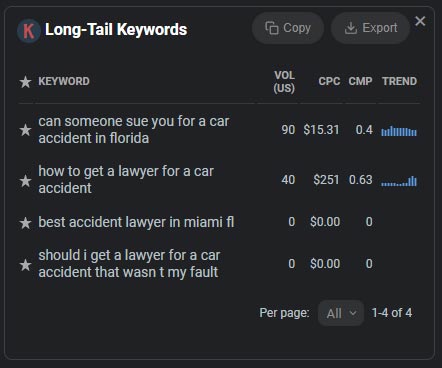
Long tail keywords associated with primary search keywords
Their search value is often diminished because they may not have a high volume of associated search activity, or the user-intent they suggest might not be directly relevant to the kinds of search intent you primarily want.
However, they will often be easier to rank for than the primary keywords you are targeting, and they will usually convert better because of how specific they are. You can view them as low hanging fruit that could yield some positive returns.
An example of a long tail keyword for a Personal Injury lawyer might be, “How do I know If My Car Accident Case Is Worth Anything?”
How to Use Your Keywords Lists
Mapping Keywords to Your Content
Once you’ve assembled your keywords lists, you need to plan how you’ll use them to create your content or bid on them for your digital advertising campaigns.
For your content and search engine optimization needs you should create content that’s focused on one keyword per page or section of your website.
The reason why is that search engines do not return an entire website in their search results pages. They return a single page at a time.
The page they return is the page that most closely matches what the search user was looking for and the search intent of that user. Therefore, you need to make sure that you’re optimizing each page for one keyword at a time.
If, for example, you have the following keywords in your list: “Personal Injury attorney NYC”, “Car accident lawyer”, “What should I do if I’ve been in a car accident?”, “Medical malpractice lawyer”, each of those keywords should have their own dedicated pages or sections of your website, with unique content that’s directly related to just those keywords.
When you introduce the keywords into your content, be careful not to load your content repeatedly with the keywords and phrases. This is called “keyword stuffing” and is frowned upon by the search engines and attracts penalties.
Instead, focus on answering the questions that your audience has about those keywords as authoritatively and comprehensively as possible. Then you can use them judiciously in specific places like your content headings, as well as important page metatags like the page meta title which the search engines use to decipher what your page is about.
Using Your Keywords in Your Digital Advertising Campaigns
For your digital advertising campaigns, you’re going to be bidding on individual keywords or keyword groups, dependent on the type of ad campaign you’re running.
There is an art and science to bidding on keywords, but you must first evaluate what your primary goals are. Do you just want to drive traffic to your website, or do you want to acquire clients?
If the former is the case, you could bid equally on informational and commercial keywords, as well as transactional keywords.
However, if conversion and client acquisition is the goal, then you’d need to be more aggressive with your bids on transactional keywords, while spending less on informational and commercial intent-driven keywords.
Every firm’s needs and goals will be different so a strategy that is uniquely tailored to your practice will be important.
How AI Generative Engines Are Changing Keyword Research for Lawyers
The ways that potential clients find lawyers is changing. While traditional search engines like Google and Bing still dominate, AI generative engines such as ChatGPT, Claude, Perplexity, Gemini, and others are increasingly becoming the first stop for people seeking legal help.
These AI platforms don’t just return a list of links—they provide direct answers, recommendations, and guidance based on conversational queries. Understanding how these systems work and optimizing your content for them is no longer optional; it’s becoming essential for law firms that want to stay competitive.
How AI Generative Engines Connect People with Lawyers
AI generative engines operate differently from traditional search engines, though they often use similar underlying principles. Here’s how they’re connecting potential clients with legal services:
Conversational Query Processing
Unlike traditional search where users type short phrases like “divorce lawyer NYC”, people often ask AI engines complete questions in natural language: “I’m going through a difficult divorce in Manhattan and need a lawyer who specializes in complex asset division. Who should I talk to?”
These engines analyze the full context of the query—the location, the specific legal issue, the complexity level, and even the emotional state implied by the question. They then synthesize information from across the web to provide tailored recommendations.
Paul Birkett of BSM Legal Marketing has seen this evolution firsthand. “The biggest change I’m seeing is this: keyword research is no longer just ‘find a term and write a page’,” he notes. “AI-driven search is rewarding clarity, topic coverage, and trust signals. What’s working for us right now is combining classic intent research with ‘retrieval-ready’ content. We still start with keywords, but we expand into the full set of questions behind them (definitions, scenarios, timeframes, costs, next steps). This tends to perform better in AI surfaces because the content reads like a complete answer, not a thin page built around a phrase.”
Multi-Step Research Assistance
AI engines often engage in back-and-forth dialogue with users. A potential client might start with, “What kind of lawyer do I need for a workplace discrimination case?” The AI provides an explanation, the user asks follow-up questions about their specific situation, and eventually asks for lawyer recommendations. This means your content needs to be comprehensive enough to appear at multiple stages of this research journey.
Source Attribution and Citation
Most AI generative engines cite their sources when providing recommendations. When someone asks for a lawyer recommendation, these systems pull from authoritative content across the web—law firm websites, legal directories, review platforms, and informational articles. If your content is well-optimized and authoritative, the AI engine may cite your firm directly or reference your content as a source, effectively giving you a referral.
Synthesis Over Rankings
Traditional search shows ten links on page one. AI engines synthesize information from dozens or hundreds of sources to provide one comprehensive answer. Your firm doesn’t need to rank #1 for a keyword to be included in an AI’s recommendation—you need to have authoritative, well-structured content that the AI can understand and reference.
The New Keyword Landscape: From Search Phrases to Natural Language
The traditional approach to keywords—optimizing for short phrases like “car accident attorney Los Angeles”—still matters, but AI generative engines require a broader strategy.
Question-Based Keywords
AI engines excel at answering questions. Your keyword research should now include the full questions your potential clients are asking, such as:
- “What should I look for when hiring a personal injury lawyer?”
- “How do I know if I have a valid medical malpractice case?”
- “Can I sue my employer for wrongful termination in California?”
- “What’s the average settlement for a rear-end collision?”
Create dedicated content that directly answers these questions with authoritative, comprehensive information. The AI engines will then surface your content when users ask similar questions.
Ben Foster, CEO of The SEO Works agrees. “People speak to AI differently than they type into a search bar. They ask full, detailed questions about their specific situation. We advise our legal clients to focus on these long phrases”, he says and advises to “Look for the specific questions clients ask in your initial meetings.”
Conversational Variants
Traditional keyword research might identify “estate planning attorney” as a target phrase. For AI optimization, you also need to consider how people actually talk about these needs:
- “I need to create a will but don’t know where to start”
- “How do I make sure my kids are taken care of if something happens to me?”
- “What’s the difference between a will and a trust, and which do I need?”
Your content should naturally incorporate these conversational phrases and address the underlying concerns, not just the legal terminology.
Intent-Rich Long-Form Keywords
Long tail keywords become even more valuable with AI engines because they capture specific intent. Instead of just “bankruptcy lawyer”, optimize for scenarios like:
- “Small business owner considering chapter 11 bankruptcy options”
- “How to stop wage garnishment through bankruptcy”
- “Can I keep my house if I file for bankruptcy in Texas?”
Actionable Strategies for AI-Optimized Content
Making sure AI generative engines can effectively connect potential clients with your firm requires a strategic approach to content creation and keyword optimization.
1. Create Comprehensive, Structured Content
AI engines favor content that thoroughly addresses a topic. Instead of thin 300-word pages targeting single keywords, create comprehensive resources that cover topics in depth.
For example, rather than just having a page that says “We handle car accident cases”, create a detailed resource covering:
- What to do immediately after a car accident
- When you need a lawyer versus when you don’t
- How insurance companies evaluate claims
- Common mistakes that hurt your case
- What to expect during the legal process
- How to choose the right attorney
Use clear headings (H2, H3 tags) that often mirror the questions people ask. This structure helps AI engines extract and cite specific information from your content.
2. Build an FAQ Section That Mirrors Real Queries
Create extensive FAQ sections that address the actual questions your potential clients ask. Don’t just answer obvious legal questions—address the concerns, fears, and uncertainties people have.
Analyze the questions being asked in:
- AI chatbot conversations (if you have access to data)
- Your consultation calls
- Legal forums like Avvo and Reddit’s legal advice communities
- The “People Also Ask” section in Google search results
Each FAQ answer should be substantive (150-300 words) and should naturally incorporate related keywords and concepts.
Aaron Winston, Strategy Director and Head of Content with Express Legal Funding, employs this approach. “From a practical standpoint, instead of targeting keywords, we focus a significant portion of our original content creation efforts on what I like to refer to as primary FAQs,” he says. “It helps us build topical authority. Additionally, since Google prioritizes ranking multiple sources and angles within its AI overview, it enables adjacent content, like ours, to still rank for relevant queries. In part, this largely means that keyword search volume is less of a data point we consider. We aim to post content that fully explains the process and the ‘why,’ not just the definition.”
3. Demonstrate Clear Expertise and Authority
AI engines prioritize authoritative sources. Strengthen your content by:
- Citing relevant laws and statutes specific to your jurisdiction
- Providing case examples (anonymized) that illustrate your points
- Including author credentials prominently on your content
- Publishing regularly to demonstrate active expertise
- Showing depth of knowledge rather than surface-level information
When an AI engine needs to recommend a lawyer for a complex legal matter, it’s more likely to cite content that demonstrates sophisticated legal knowledge and experience.
4. Optimize for Local and Hyper-Specific Queries
AI engines are excellent at understanding geographic context and specific circumstances. Make sure your content addresses:
- State-specific legal nuances: “In California, the statute of limitations for personal injury cases is…”
- City and county-level information: “Brooklyn divorce cases filed in Kings County require…”
- Neighborhood relevance: “For Manhattan residents dealing with landlord disputes…”
The more specific and locally relevant your content, the more likely an AI engine will cite you when someone asks a location-specific question.
5. Include Clear Calls-to-Action and Contact Information
When AI engines recommend your firm, you want it to be easy for the potential client to take the next step. Every piece of content should include:
AI engines may directly reference this information when connecting users with your services.
6. Create Content for Every Stage of the Decision Journey
Potential clients using AI engines are often at different stages of their journey:
- Awareness Stage: “I think something wrong happened to me, but I’m not sure if it’s illegal”
- Consideration Stage: “I know I need legal help, but what kind of lawyer do I need?”
- Decision Stage: “I need a specific type of lawyer in my area now”
Create content that serves each stage. Early-stage content builds authority and trust, making your firm more likely to be recommended when that person is ready to hire.
7. Monitor How AI Engines Represent Your Firm
Regularly test how different AI platforms respond to queries relevant to your practice. Try asking:
- “I need a [practice area] lawyer in [your location]. Who should I contact?”
- “What should I know before hiring a [practice area] attorney?”
- “Can you recommend a law firm that handles [specific legal issue]?”
Document whether your firm is mentioned, how you’re described, and what content is cited. This intelligence can inform your content strategy.
8. Embrace Semantic Keywords and Topic Clusters
AI engines understand context and relationships between concepts better than traditional search algorithms. Instead of thinking in isolated keywords, think in topic clusters.
For a personal injury practice, your cluster might include:
Central Topic: Personal Injury Law
Related Topics: Car accidents, slip and fall, medical malpractice, insurance claims, settlement negotiations, trial preparation, damages calculation, statute of limitations.
Create interconnected content that thoroughly covers the central topic and all related subtopics. Link between related pieces. This comprehensive coverage signals authority to both traditional search engines and AI systems.
The Future-Proof Approach: Quality Over Gaming the System
The most important principle for succeeding with AI generative engines is this: focus on genuinely helping your potential clients rather than gaming the system.
AI engines are trained to identify and surface helpful, authoritative, accurate content. They’re constantly improving at distinguishing genuinely useful information from keyword-stuffed, thin content designed only to rank well.
The law firms that will succeed in this new landscape are those that:
- Answer questions thoroughly and honestly
- Demonstrate real expertise and experience
- Provide genuinely helpful information, even to people who may never become clients
- Build comprehensive resources that serve their community
- Stay current with legal developments and update their content accordingly
Traditional keyword research isn’t dead—it’s evolving. The keywords that matter are shifting from short phrases to natural language questions, from broad terms to specific scenarios, and from isolated concepts to comprehensive topic coverage.
By understanding how AI generative engines work and adapting your keyword research and content strategy accordingly, you can ensure that when potential clients turn to these platforms for legal help, your firm is among those recommended. The investment you make now in comprehensive, authoritative, helpful content will continue to pay dividends as AI becomes an increasingly important channel for client acquisition.
Summary
Keywords are an important foundation of many of your digital marketing activities.
Use a deliberate, data-driven process to discover the optimal keywords for your legal practice.
Use your prime keywords appropriately in your content development and marketing efforts, as well as in your digital advertising campaigns.