
You went to law school to practice law, not to become a writer. That’s fair. But here’s the reality: the words on your website, in your emails, on your intake forms, and across your social media profiles are doing sales work every single day, whether you’ve thought carefully about them or not.
Most lawyers haven’t. And it shows.
Visit the average law firm website and you’ll find a homepage that talks extensively about the firm’s founding date and how “dedicated” and “passionate” the attorneys are. You’ll find practice area pages packed with legal terminology that the average person searching for help can’t parse. You’ll find attorney bios that read like a CV rather than an introduction to a human being you might want to hire during one of the most stressful moments of your life.
That’s not a knock on lawyers. It’s a predictable outcome of professional training. Law school teaches you to write with precision, to use defined terms consistently, to never leave anything ambiguous. Those are genuine skills. They’re just not the skills that make someone pick up the phone and call your firm.
Copywriting is different. It’s the craft of writing words that move people to take action. Not impress them. Not demonstrate your credentials. Move them. And for lawyers, getting this right has a direct and measurable impact on how many inquiries you get, how many of those convert to clients, and how much you pay to acquire each one.
In this guide, we’re going to break down what good legal copywriting looks like, where most law firms go wrong, and exactly how to fix it across every piece of client-facing content your firm produces.
What Is Copywriting?
Copywriting is the practice of writing persuasive, purposeful text intended to drive a specific response from the reader. That response might be clicking a button, filling out a form, picking up the phone, or simply feeling confident enough in your firm to take the next step.
It’s worth separating copywriting from a few things it often gets confused with.
Copywriting is not the same as legal writing. Legal writing is precise, structured, and written for an audience of other legal professionals or for the formal record. Copywriting is conversational, empathetic, and written for a person who is probably stressed, confused, and looking for reassurance that they’ve found the right help.
Copywriting is not the same as content writing. Content writing (blog posts, guides, articles) is primarily about educating and building authority over time. Copywriting is more directly tied to conversion, getting someone to do something right now. In practice the two overlap, and the best legal content does both, but it helps to understand the distinction.
Copywriting is not just about your website. Your copy lives everywhere: email subject lines, intake form field labels, social media captions, Google Business Profile descriptions, paid ad headlines, even the voicemail greeting on your office phone. Every word your potential clients encounter is copy, and all of it contributes to the impression your firm makes.
For lawyers, good copywriting means finding the right language to connect with a potential client where they are, often scared, often confused, often skeptical, and making them feel understood and confident that your firm can help. It doesn’t mean dumbing things down. It means translating your expertise into language that means something to the person who needs it.
Why Lawyers Struggle With Copywriting
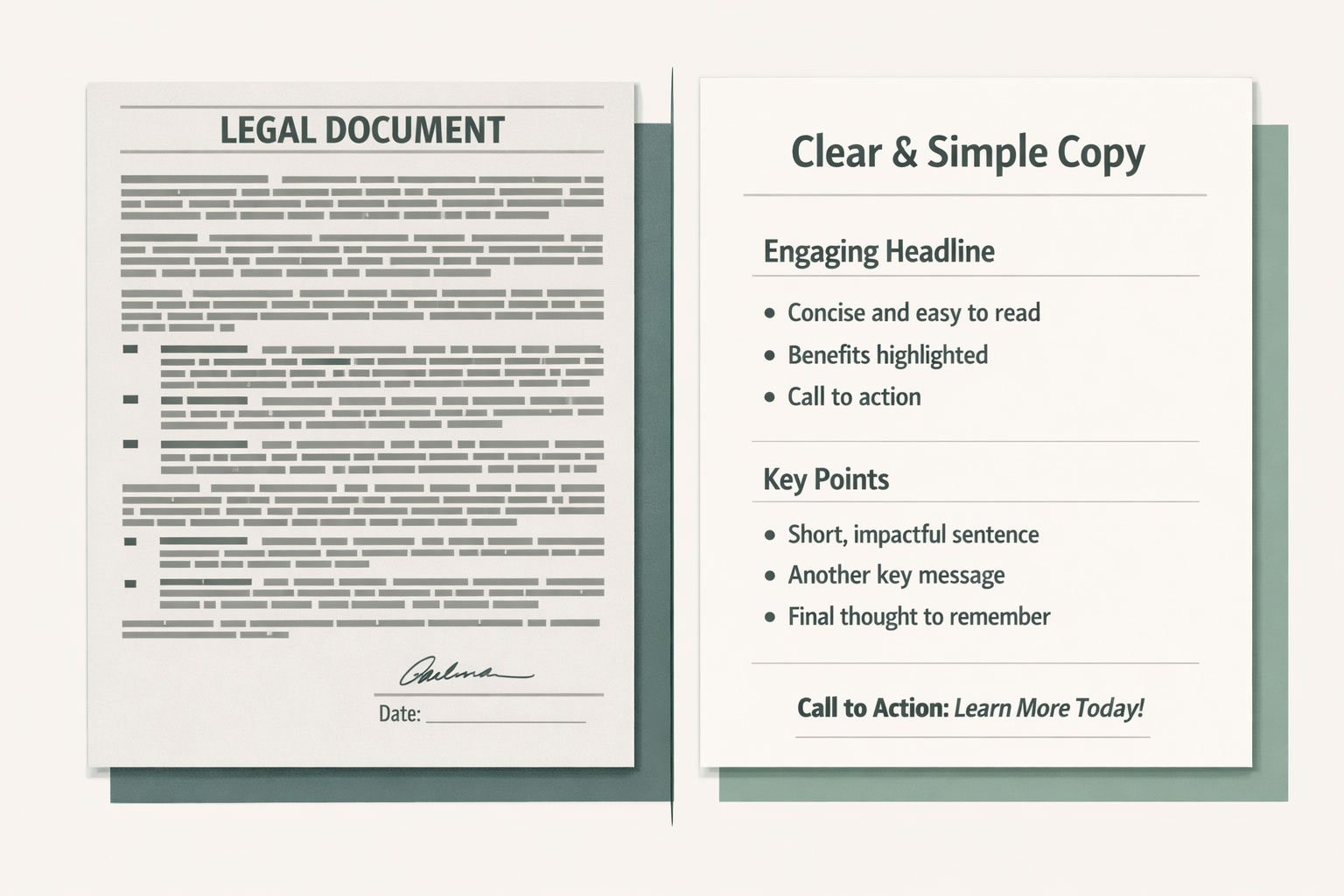 Difference between hard to parse legalese and easy to understand legal writing
The struggles most lawyers have with copywriting aren’t random. They’re almost entirely a product of professional training, and understanding where they come from makes them a lot easier to fix.
Legal Training Rewards a Different Kind of Writing
Law school teaches you to write in a specific way for very good reasons. Legal writing is designed to be unambiguous, defensible, and precise. Every term is defined. Every claim is qualified. Passive voice often appears because attributing action can create liability. Sentences are long because they need to account for every possible interpretation.
This style of writing is appropriate for contracts, briefs, and legal memos. It is actively counterproductive on a homepage designed to make someone feel confident enough to call you.
The Expert Curse
The more you know about something, the harder it becomes to remember what it’s like not to know it. Lawyers live in their practice areas every day. Terms like “tortfeasor,” “res ipsa loquitur,” or “subrogation” feel completely natural. The person reading your website has no idea what any of that means, and they’re not going to look it up. They’re going to click away and try the next firm on the list.
This isn’t a matter of intelligence. It’s a matter of familiarity. Your potential clients are experts in their own fields. They just don’t happen to be experts in yours.
Josh Samuels, Attorney at First Counsel, sees this play out in courtrooms as much as on websites. “Speaking plainly and meeting people where they are leads to faster trust building and means I don’t have to explain things again later with clients that were too polite to say they didn’t understand the first time.” The jargon problem doesn’t just cost you website visitors. It creates friction throughout the entire client relationship.
Writing for Other Lawyers
Many law firm websites are written, consciously or not, to impress other lawyers rather than to attract clients. The emphasis on credentials, law school rankings, bar admissions, and published articles reflects what the legal community respects. Potential clients care about very different things. They want to know you understand their situation, that you’ve handled cases like theirs, that you’re accessible, and that hiring you isn’t going to be more confusing than the problem they already have.
David Arato, CEO of Lexicon Legal Content, has spent his career solving exactly this problem and has a name for it: the three-audience problem. “You’re simultaneously writing for consumers, Google, and other lawyers, so your content needs to be readable to non-lawyers, compliant with advertising rules, legally accurate, SEO-optimized, and demonstrate EEAT. That’s a lot to ask of a single piece of content.” Most lawyers struggle with it, he says, and for understandable reasons. “Lawyers spend their careers communicating with other attorneys and judges, which is a completely different way of writing than for someone who just got rear-ended and is Googling at midnight trying to figure out if they have a case. The instinct to sound authoritative often works against sounding approachable, and most lawyers don’t even realize it’s happening.”
Discomfort With Self-Promotion
Many lawyers are genuinely uncomfortable with anything that feels like bragging or selling. The legal profession has historically frowned on aggressive self-promotion, and that instinct runs deep. The result is often copy that’s so cautious and hedged that it communicates nothing useful at all.
There’s a middle ground between hard selling and saying nothing. Good copywriting lives there. It’s honest, direct, and confident without being pushy or making claims you can’t back up.
Nobody Ever Taught This
Law school doesn’t cover it. Most continuing education programs don’t cover it. Unless you’ve specifically sought out marketing or copywriting knowledge, there’s no particular reason you’d know how to do it well. This is one of those areas where the gap between what lawyers think is good copy and what actually performs well can be significant.
Why Copywriting Matters More Than Ever for Law Firms
The way people find and choose lawyers has changed dramatically, and it continues to change. A few forces in particular have made copywriting more important for law firms right now than at any point in the past.
Your Website Is Your First Impression
Research consistently shows that the vast majority of people seeking legal help go online first. They search, they compare, and they form opinions about firms before ever making contact. Your website copy is doing the work of a first meeting. If it doesn’t land, the person moves on. You never get the chance to win them over in person.
AI Search Has Raised the Stakes
AI-powered search engines like Google’s AI Overviews, ChatGPT, and Perplexity are increasingly summarizing and synthesizing content to answer people’s legal questions directly. The firms whose content gets cited, quoted, or referenced in those answers are the ones whose copy is clear, authoritative, and written in plain language. Dense, jargon-heavy content doesn’t get surfaced. Content that answers real questions in real language does.
The Market Is More Competitive Than Ever
With over 1.3 million practicing attorneys in the United States, differentiation is a genuine challenge. Credentials and experience are table stakes in most markets. The firms that stand out are often the ones that communicate better, not the ones with the most impressive résumés. Copy is one of your most powerful differentiators, and it costs nothing to get right beyond the time and thought you put into it.
Client Expectations Have Shifted
People’s tolerance for dense, formal, impersonal communication has dropped across the board. They’re used to brands speaking to them like human beings. They expect clarity and accessibility. When they encounter a law firm website that reads like a legal brief, the subconscious reaction is often that this firm is going to be difficult to work with. That impression forms fast and it sticks.
Every Channel Requires It
You’re not just writing a website anymore. You’re writing emails, social posts, intake forms, Google Business Profile descriptions, paid ad copy, and more. Each of those touchpoints either builds confidence or erodes it. A coherent copywriting approach across all of them compounds over time into a genuine competitive advantage.
The Cost of Bad Copy
It’s easy to treat copywriting as a nice-to-have, something you’ll get to eventually. But bad copy has real, measurable costs that show up in your practice every day.
You Lose Potential Clients Before They Contact You
When someone lands on your website and can’t quickly figure out whether you handle their type of case, whether you serve their location, or whether you’re someone they’d feel comfortable talking to, they leave. They don’t email you to ask for clarification. They go to the next result. This happens silently and constantly on law firm websites with poor copy, and most firms have no idea how often it’s occurring.
Your Conversion Rate Suffers
Conversion rate is the percentage of website visitors who take a desired action, filling out a contact form, calling your office, booking a consultation. Even a modest improvement in the clarity and persuasiveness of your copy can move this number significantly. The difference between a 2% conversion rate and a 4% conversion rate means twice as many inquiries from the same amount of traffic, without spending an extra dollar on advertising or SEO.
Ron Vernon, Managing Partner at ELMNTL, has the data to back this up. He’s led web redesigns and copy overhauls for law practices and has seen what plain language does to lead volume. “One firm lost 25% of leads to overly formal homepage text. Simplifying to ‘Get your case reviewed in 24 hours’ spiked form fills by 40%.” That’s not a subtle improvement. That’s the difference between a struggling practice and a growing one, from a copy change alone.
Your SEO Results Underperform
Search engines evaluate content quality as a ranking factor. Copy that’s thin, keyword-stuffed, or written primarily for lawyers rather than for the people actually searching will underperform in rankings. Good copy that answers real questions clearly, uses natural language, and earns time-on-page signals to search engines that your content is valuable. Bad copy does the opposite.
Your Ad Spend Delivers Less
If you’re running paid search or social media ads, those ads drive traffic to landing pages. The quality of the copy on those pages determines whether that traffic converts. You can have excellent targeting and compelling ad creative, and still waste most of your budget if the landing page copy doesn’t close the deal. Bad copy makes every other marketing investment less efficient.
You Attract the Wrong Clients
Vague copy attracts vague inquiries. When your website doesn’t clearly communicate what kinds of cases you handle, what kinds of clients you work with, and what the experience of working with your firm is like, you end up fielding inquiries from people who aren’t a good fit. That wastes your time and theirs.
Your Reputation Takes a Quiet Hit
Copy that’s confusing, impersonal, or full of errors doesn’t just fail to convert. It actively undermines trust. People notice these things, even when they can’t articulate exactly what felt off. A firm that communicates poorly in its marketing raises a legitimate question about how it’s going to communicate during a stressful legal matter.
Website Copy That Converts
Your website is the hub of everything. Every marketing channel you invest in, SEO, paid ads, social media, Digital PR, ultimately drives people back to it. If the copy doesn’t convert, none of those investments perform the way they should. Here’s how to approach the pages that matter most.
Your Homepage
Most law firm homepages make the same mistake: they lead with the firm. How long it’s been around, how many attorneys it has, how committed everyone is to excellence. The problem is that a potential client landing on your homepage has one question on their mind: can you help me with my problem? Everything on your homepage should answer that question as quickly and clearly as possible.
Stephen Taormino, Founder & CEO of CC&A Strategic Media, has been writing copy for law firms since 1999 and puts it plainly: the biggest mistake he sees is “writing to impress other lawyers instead of answering the prospect’s next question in the order they feel it: cost, timeline, risk, what happens first, what you need from them.” That sequence matters. When you lead with your founding date and your credentials, you’re answering questions your potential clients aren’t asking yet.
His approach for practice area pages is a tight, repeatable structure: “short second-person sentences, then a tight proof stack: one case type you handle, one differentiator, one clear CTA like ‘Call for a 10-minute fit check,’ not ‘contact us for representation.'” Specific beats generic every time.
A converting homepage typically does the following:
- States clearly and immediately who you help and what you help them with. “We help New York families navigate divorce and custody disputes” is more effective than “A full-service family law firm serving clients across the tri-state area.”
- Addresses the emotional reality of the situation. People come to lawyers when something has gone wrong. Acknowledging that you understand what they’re going through builds more trust in two sentences than a full page of credentials.
- Makes the next step obvious. One clear call to action, schedule a consultation, call now, get a free case review, repeated at logical intervals down the page.
- Uses social proof early. A strong client testimonial or a recognizable media mention near the top of the page does significant trust-building work.
- Avoids jargon completely. If a 16-year-old couldn’t read your homepage and understand what you do and who you help, it needs work.
Try this now: Read the first three sentences of your homepage out loud. If they don’t tell a visitor exactly who you help and what problem you solve, rewrite them before you do anything else. Start with the client’s situation, not the firm’s history.
Practice Area Pages
Practice area pages are where a lot of law firms lose potential clients they’ve already worked hard to attract. Someone searches for a personal injury attorney, lands on your personal injury page, and encounters three paragraphs of legal definitions and a list of statute citations. They wanted to know if you can help them and what working with you looks like. They leave.
Effective practice area pages do several things well:
- Lead with the client’s situation, not the law. Start with what your potential client is experiencing, the accident, the injury, the employer’s denial of a workers’ comp claim, before getting into how the legal process works.
- Explain the process in plain terms. Walk them through what happens when they hire you. People fear the unknown. A clear, jargon-free explanation of what to expect reduces that fear considerably.
- Address common concerns and objections. Cost is almost always one of them. If you work on contingency, say so clearly. If you offer free consultations, make that prominent.
- Include specific, relevant proof. Case results, client testimonials specific to that practice area, and any relevant recognitions or media coverage all help.
- End with a clear call to action. Don’t let someone finish reading a practice area page without a natural, obvious next step.
Try this now: Pick your most important practice area page. Count how many sentences start with “I,” “We,” or your firm name versus how many speak directly to the client’s situation. If the firm outnumbers the client, flip the ratio.
Your About Page
The about page is one of the most visited pages on most law firm websites and one of the most consistently underused. People go to the about page because they’re considering hiring you and they want to know who you are. That’s a genuine opportunity to build a human connection.
Fred Poritsky, Chief Idea Consultant at FZP Digital, has rebuilt law firm homepages and about pages for dozens of firms. His observation is consistent: “I’ve rebuilt law firm homepages simply by leading with the client’s problem instead of the firm’s pedigree, and inquiry rates improve almost immediately.” He’s particularly direct about the bio problem. “One attorney I worked with added two sentences about why she chose family law. That page became her highest-converting page on the site.”
A strong law firm about page:
- Tells a real story. Why did you become a lawyer? Why this practice area? Why this community? Authentic answers to these questions are far more compelling than a recitation of your professional history.
- Connects your background to your clients’ benefit. Your experience and credentials matter, but frame them in terms of what they mean for the person reading. “Fifteen years handling insurance defense work means I know exactly how the other side thinks” is more useful to a potential client than “fifteen years of experience.”
- Sounds like a human being wrote it. If you read your about page out loud and it doesn’t sound like something you’d actually say, it needs to be rewritten.
Writing a Law Firm Bio That Doesn’t Put People to Sleep
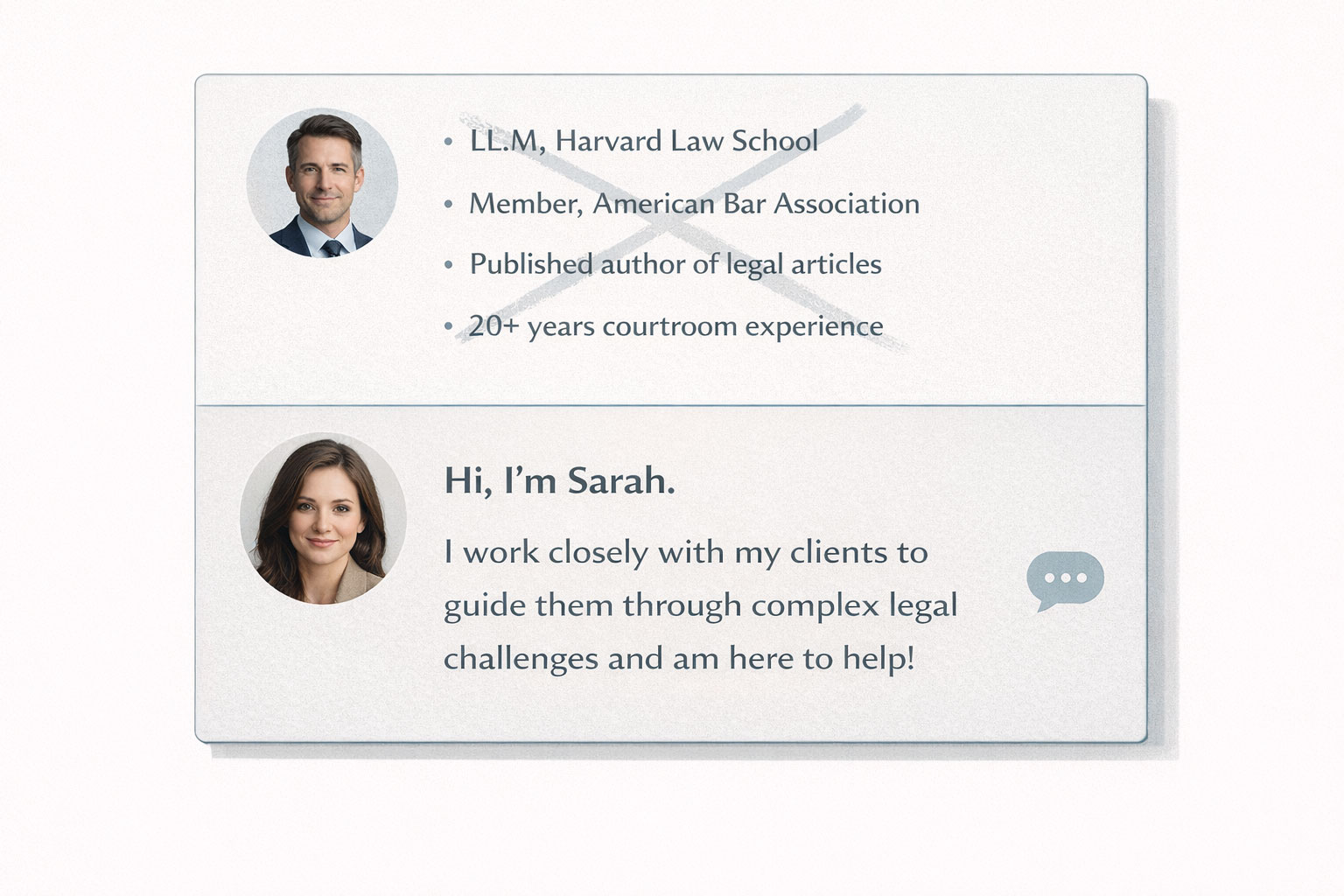
Attorney bios are almost universally bad. They follow a template so predictable you could write one without knowing anything about the attorney: law school, year of admission, practice areas, bar memberships, maybe a hobby or two bolted on at the end to seem human. Nobody reads past the first paragraph.
The problem is that the attorney bio is actually a significant trust-building opportunity. When someone is deciding whether to hire you, they spend real time on your bio page. They want to know who you are. They want to feel something, confidence, comfort, a sense that you’re someone they could work with under pressure. A list of credentials doesn’t do that.
Here’s a different approach to consider:
- Lead with what you do for clients, not where you went to school. Your law school appears near the top of most attorney bios because that’s what the legal profession values. Your potential clients value it much less than you think. Lead instead with what you do, who you do it for, and what drives you to do it well.
- Include a specific story or perspective if you can. “I started practicing employment law after watching a family member lose a job unfairly and have no idea where to turn” does more work in one sentence than a full paragraph of credentials. Specificity is memorable. Generic professional language is not.
- Use first person. Writing your bio in third person (“Mr. Smith has over twenty years of experience…”) creates distance. First person (“I’ve spent twenty years representing…”) is warmer and more direct.
- Keep credentials but put them in their place. Your education, admissions, and recognitions should be in the bio, just not leading it. They provide reassurance once someone is already interested in you as a person.
- Don’t overthink the personal section. A brief mention of family, community involvement, or genuine interests rounds you out as a human being. Keep it short and keep it real. Nobody is impressed by “enjoys golf and travel.”
Try this now: Rewrite just the opening paragraph of your bio as if you were introducing yourself at a dinner party to someone who just told you they need a lawyer. No titles, no law school, no bar admissions. Just who you are and what you do for people. Then read both versions back to back and see which one you’d actually want to read.
Blog Posts and Articles That Build Trust
A lot of lawyers write blog posts as SEO exercises. They pick a keyword, write something reasonably informative around it, publish it, and move on. That approach produces content that ranks occasionally but never really builds a relationship with the reader.
The blogs that do the most work for a law firm are the ones that make a potential client feel like they’ve genuinely learned something useful and that the attorney who wrote it understands their situation. That distinction matters a lot.
Write for the Person, Not the Algorithm
Start with a real question your clients ask you. Not a keyword research tool’s suggestion, but something you actually hear in consultations. “What happens if I can’t afford bail?” “Can my employer fire me for filing a workers’ comp claim?” “Do I really need a lawyer for a simple divorce?” Write a post that answers that question honestly and completely, in language that person would use. The SEO tends to follow when you do this well.
Samuels lives this principle in his own practice. “The biggest mistake lawyers make is not answering the question directly, and early on the page. The attention economy is real, and if a prospective client has to scroll through a wall of text to get the answer, they’re backtracking and using AI instead.” His content focus: educating potential clients about how the legal and medical billing industry works behind the scenes. Not generic legal content, but the specific insider knowledge that makes him worth reading.
Try this now: Write down the five questions you get asked most often in initial consultations. Those are your next five blog posts. You already know the answers cold, which means the writing will be faster and more confident than anything a keyword tool suggests.
Share Your Perspective
The safest blog posts are often the least useful ones. Endless hedging and “it depends” answers are honest, but a post built entirely around qualifications and caveats doesn’t give the reader anything to hold onto and doesn’t make you memorable.
This isn’t about stating definitive legal outcomes or giving advice you can’t stand behind. It’s about sharing your informed perspective as someone who has lived in this practice area for years. You’ve seen patterns. You know which arguments tend to hold up and which ones don’t. You have opinions about how certain situations are best handled. That kind of insight, when shared thoughtfully, is genuinely valuable to someone trying to understand their situation.
There’s a meaningful difference between “here’s exactly what will happen in your case” (which you shouldn’t promise) and “in my experience, courts in this jurisdiction tend to view this factor very seriously” (which is your professional perspective and is worth sharing). The first is an outcome guarantee. The second is expertise. Readers can tell the difference, and the second kind of content is what builds real authority over time.
Where you have a genuine opinion, share it. Where reasonable lawyers disagree, say so and explain where you come down and why. That’s not irresponsible. That’s thought leadership.
Structure for Readers Who Skim
Most people don’t read blog posts word for word. They scan headings, read the first sentence of paragraphs that catch their eye, and slow down when something directly addresses their situation. Write for that behavior. Use clear, descriptive headings. Keep paragraphs short. Put the most important information early in each section rather than burying it.
Avoid These Common Blog Post Mistakes
- Opening with a dictionary definition. “According to Black’s Law Dictionary, negligence is defined as…” is one of the most common and least effective ways to open a legal blog post.
- Writing in the abstract when you could be specific. “Many people going through divorce find the process stressful” tells the reader nothing. “If you’re not sure whether to keep the house or sell it during your divorce, here’s how to think through that decision” is immediately useful.
- Ending without a next step. Every post should close with something for the reader to do, whether that’s reading a related post, downloading a resource, or getting in touch with your firm.
- Burying the practical information under legal background. Get to the useful part quickly. Your readers aren’t studying for the bar exam.
Writing for SEO Without Sounding Like a Robot
 Good legal copywriting improves search engine optimization
SEO and good copywriting used to feel like opposing forces. Early SEO rewarded keyword repetition, exact-match phrases, and content volume over quality. Writing for search meant writing badly. That’s no longer true, and firms that still approach SEO copy that way are falling behind.
Modern search engines and AI-powered generative engines are genuinely good at evaluating whether content is useful to a human reader. The best SEO copy today is simply good copy that’s been written with a clear understanding of what people are actually searching for.
Understand Search Intent First
Before writing any page or post with SEO in mind, get clear on what the person searching for your target keyword actually wants. Someone searching “personal injury lawyer New York” wants to find a lawyer to hire. Someone searching “how long does a personal injury case take” wants information. Someone searching “personal injury settlement calculator” wants a tool. The copy for each of those needs to be completely different, and trying to serve all three with a single page won’t serve any of them well.
Use Keywords the Way People Actually Talk
Your target keywords should appear in your copy, but they should appear naturally, the way you’d use them in conversation, not jammed into sentences where they don’t quite fit. “Are you looking for the best personal injury lawyer personal injury New York?” is an obvious example of bad keyword usage, but subtler versions of this mistake appear on law firm websites constantly.
Write for Featured Snippets and AI Overviews
A significant and growing share of search results now surface direct answers pulled from web pages, either in featured snippet boxes or in AI-generated overviews. To get your content surfaced this way, structure your copy to directly and concisely answer specific questions. A heading phrased as a question (“What Is the Statute of Limitations for Personal Injury in New York?”) followed by a clear, complete answer in the first two or three sentences is the pattern that gets picked up.
Brandie Young, Co-Founder of RankWriters, builds content programs specifically for law firms around this principle and has seen what happens when it works. In one program, she scaled a firm to 16 posts per month and watched Q1 phone calls jump from 234 to 697, a nearly 200% increase, with form fills up 258%. The driver, she says, was “rewriting in plain language mapped to search intent.” Her answer-first rule: “the first two to three lines must say who you help, what problem you solve, and what happens next, then earn the right to add nuance.”
Amber Brazda, AI Search Specialist at AuraSearch, goes further. She’s not just writing for humans and Google anymore. She’s writing for extraction by AI engines. “I don’t A/B test vibes. I test units: a short ‘Can you help me if…’ block versus a traditional paragraph, and I watch two metrics: lead conversion and whether the firm gets cited or recommended in AI responses for the same prompt set.” For one specialist client, she engineered what she calls an “Attribution Flip,” going from zero presence in AI Overviews to being the featured source on high-value commercial queries inside 90 days.
Earn Time on Page
One signal search engines use to evaluate content quality is how long people spend on a page. Copy that’s genuinely useful, clearly written, and properly structured keeps people reading. Copy that’s dense, jargon-heavy, or obviously written for a robot sends them back to the search results quickly. That behavior is tracked and it affects your rankings over time.
Don’t Sacrifice Readability for Keyword Density
There is no magic keyword density percentage that improves your rankings. Write naturally, include your target terms where they fit, and focus on making the page as genuinely useful as possible. That’s what works now, and it’s what will continue to work as search engines get better at evaluating content quality.
Client Intake Forms People Actually Complete
Client intake forms don’t usually get thought of as copywriting, but they absolutely are. Every label, every instruction, every piece of microcopy on your intake form either makes it easier for a potential client to complete it or creates friction that causes them to abandon it. Given that a completed intake form is often the moment a prospect becomes a lead, it’s worth treating this copy seriously.
Ask Only What You Actually Need at This Stage
The most common intake form mistake is asking for too much information upfront. A potential client who just wants to know if you can help them doesn’t want to fill out a twelve-field form before they’ve even spoken to anyone. Every additional field you require reduces completion rates. Ask for name, contact information, a brief description of the situation, and whatever one or two things you genuinely need to do an initial screening. Everything else can wait for the consultation.
Write Field Labels in Plain Language
Field labels like “Matter Type” or “Nature of Claim” or “Opposing Party” mean something to a lawyer and nothing to most potential clients. Use language your clients would use: “What kind of legal issue do you need help with?” “Who is the other person or company involved?” Small changes like these reduce confusion and abandonment.
Explain Why You’re Asking
When you ask for information that might feel sensitive, a social security number for a conflicts check, details about prior legal matters, financial information, a brief explanation of why you need it goes a long way. “We use this to check for any conflicts of interest before our consultation” removes the hesitation that often comes with an unexplained request for personal data.
Make the Confirmation Feel Human
The message someone sees after submitting your intake form is the last piece of copy in that interaction and one of the most overlooked. “Your form has been submitted” is a missed opportunity. “Thanks for reaching out. We’ll review your information and get back to you within one business day” is warmer, sets a clear expectation, and reinforces the impression that there are real people on the other side of this process.
Test Your Own Form
Fill out your own intake form from start to finish as if you were a potential client who knows nothing about your firm or legal process. Note every moment of confusion, every field that feels intrusive, every instruction that’s unclear. You’ll almost certainly find things to fix that you’d never notice from the inside.
Try this now: Go through your intake form and find every field label written in legal language. Rewrite each one in plain conversational terms. Then check your confirmation message. If it reads like a system notification, rewrite it to sound like a person wrote it.
Email Copy That Gets Responses
Email is one of the most direct lines of communication you have with potential clients, existing clients, and referral sources. It’s also one of the most commonly neglected areas of legal copywriting. Most law firm emails are either overly formal to the point of being cold, or so generic that they could have been sent by anyone. Neither approach gets the response you’re looking for.
Subject Lines Do Most of the Work
If your email doesn’t get opened, nothing else matters. Subject lines that perform well are specific, relevant, and human. “Following up on your consultation” is fine. “Quick question about your employment situation” is better. “Newsletter, March 2026” is almost guaranteed to get ignored. Write subject lines the way you’d write the first line of a text message to someone you actually know.
Get to the Point Immediately
Most professional emails open with some version of “I hope this email finds you well.” Nobody reads that. Nobody feels anything when they read it. Start with the reason you’re writing. If you’re following up after a consultation, say so in the first sentence and say what you want them to do next. If you’re sending educational content, lead with the most useful thing in it.
One Email, One Purpose
Every email you send should have one clear purpose and one clear call to action. Emails that try to accomplish three things at once accomplish none of them. If you want someone to schedule a follow-up call, that’s the whole email. If you want them to read a new blog post, that’s the whole email. Keep it focused and keep it short.
Write Like a Person, Not a Law Firm
The gap between how lawyers talk and how law firm emails read is often enormous. If you’d say it in a conversation, you can write it in an email. Contractions are fine. Short sentences are fine. A touch of warmth is not unprofessional. The goal is to sound like a trusted advisor, not a form letter.
Follow-Up Emails Deserve Real Copy Too
Follow-up emails after consultations are often the difference between a prospect hiring you and going with someone else. A follow-up that says “Just checking in to see if you have any questions” is forgettable. A follow-up that briefly recaps what you discussed, reaffirms your understanding of their situation, and gives them a clear next step is the kind that converts. Put real thought into these.
Josiah Roche, Fractional CMO at JRR Marketing, has the numbers to prove how much email copy matters. One suburban family law firm he worked with changed their inquiry reply from a 380-word formal email to a 160-word plain one with three steps and a clear time frame. Their booked consult rate went from 22% to 31% over six weeks. Nothing changed except the words. “The biggest mistake I see is writing about the law firm instead of the client’s problem, then hiding the next step behind vague language,” he says. People reading your emails want to know: can you help me, how long will it take, what will it cost, and what do I do now?
Client Communication Emails Set the Tone for the Relationship
How you write to clients throughout a matter shapes their experience of working with you. Emails that are clear, direct, and free of unnecessary legal jargon make clients feel informed and respected. Emails that are dense and confusing make them anxious. Given that client referrals are one of the most valuable sources of new business for most law firms, the impression your routine communications make is worth paying attention to.
Try this now: Pull up the last five emails you sent to potential clients or existing clients. Delete the opening line of each one and read what’s left. In most cases the email is better without it. If it isn’t, that’s a sign the opening line is actually doing something useful.
Social Media Copy for Lawyers
Social media is an area where a lot of lawyers either over-formalize everything, producing content that reads like a press release, or avoid it entirely because they’re not sure what’s appropriate. The reality is that social media is one of the most direct ways to build familiarity and trust with potential clients and referral sources over time, but it requires a different writing approach than anything else in your marketing mix.
LinkedIn is the most important social platform for most lawyers, and the copy conventions there are more specific than people realize. Posts that perform well on LinkedIn tend to:
- Open with a single punchy line that stops the scroll. A question, a counterintuitive statement, or a specific observation works better than a formal introduction.
- Use short paragraphs, often one or two sentences each. Long blocks of text get skipped.
- Share a genuine perspective or a specific experience rather than generic professional advice.
- End with a question or a clear invitation to engage.
- Sound like a person wrote them, not a marketing department.
The lawyers who build real audiences on LinkedIn are the ones who are willing to have a point of view and express it directly. “Here are five things to know about employment law” gets ignored. “I’ve watched employers make this same costly mistake for twenty years, and it keeps surprising me” gets read.
Facebook skews toward a more personal tone than LinkedIn, and the audience is often less professionally minded. Copy that works well on Facebook for law firms tends to be community-focused, educational in an accessible way, and occasionally personal. Client success stories (with appropriate permissions and ethics compliance), community involvement, and practical legal tips written in plain language all tend to perform well.
Other Platforms
Instagram, TikTok, and YouTube all have their place for certain practice areas and certain audiences, but they require visual content alongside copy and represent a bigger production investment. If you’re just starting to think seriously about social media, get LinkedIn and Facebook right first before expanding.
Consistency Matters More Than Perfection
The biggest mistake lawyers make on social media isn’t posting the wrong thing. It’s posting inconsistently, a burst of activity followed by weeks of silence. A modest, sustainable posting schedule with decent copy outperforms an occasional brilliant post every time. Decide what you can realistically maintain and stick to it.
Try this now: Write a LinkedIn post about the most common misconception people have when they first contact your firm. One short paragraph, plain language, end with a question. Post it this week. That’s it. Don’t overthink it.
The “Explain It Like I’m Not a Lawyer” Principle
This is the single most useful mindset shift in legal copywriting, and it applies to every piece of content you produce.
Before you publish anything, a blog post, a practice area page, an email, a social post, read it through the eyes of someone who has never set foot in a law school, is stressed about a legal situation, and is trying to figure out if you’re the right person to help them. Ask yourself honestly: does this make sense to that person? Does it address what they actually care about? Would it make them more or less likely to pick up the phone?
This doesn’t mean being condescending or oversimplifying complex legal realities. It means translating. Your job as a copywriter for your own firm is to take what you know deeply and render it in terms that are genuinely accessible to the people who need your help.
A few practical techniques that help:
- Read your copy out loud. If you stumble over a sentence or it sounds unnatural when spoken, it needs to be rewritten. Good copy sounds like something a real person would actually say.
- The “so what” test. After every statement of fact or credential, ask “so what does this mean for my client?” If you can’t answer that, the statement probably doesn’t belong in client-facing copy.
- Replace every piece of jargon with plain language. Go through your copy and highlight every term that a non-lawyer might not know. Then replace it. “The defendant” becomes “the other driver.” “Damages” becomes “compensation.” “Retainer agreement” becomes “the contract we sign before we begin work.”
- Ask a real person to read it. A family member, a friend, anyone who isn’t a lawyer. Ask them to tell you, honestly, what they understood and what confused them. The answers are usually illuminating.
Voice and Tone Across Different Practice Areas
One of the more nuanced aspects of legal copywriting is that the right voice and tone aren’t universal. The person searching for a criminal defense attorney is in a very different emotional state than the one looking for a business transactions lawyer. The copy that resonates with each of them needs to reflect that difference.
Personal Injury and Criminal Defense
These practice areas deal with people who are often frightened, overwhelmed, and in urgent need of help. Copy here needs to be warm, reassuring, and immediately practical. Lead with empathy. Acknowledge what the person is going through before you start talking about your qualifications. Avoid anything that feels bureaucratic or detached. The most effective copy in these areas communicates, above all else, that you understand what your potential client is facing and that you’ve helped people in exactly this situation before.
Family Law
Divorce, custody, and family law clients are often in emotional turmoil. Copy here needs to be sensitive and human without being maudlin. Avoid aggressive or combative language, even if aggressive litigation is something your firm is known for. That framing can feel threatening to someone who is already dreading what’s ahead. Focus on clarity, guidance, and the sense that you’ll be a steady presence through a difficult process.
Employment Law
Employment clients often feel wronged and are looking for validation as much as legal help. Copy here can be more direct and assertive. They want to know you believe in their case and that you’re willing to fight for them. At the same time, managing expectations around outcomes is important. Overpromising in copy creates problems down the road.
Business and Corporate Law
Business clients are typically less emotional and more analytical. They want competence, efficiency, and the sense that you understand the commercial realities they operate in. Copy here can be more formal than in consumer-facing practice areas, but it still shouldn’t be needlessly dense. Business decision-makers are busy people. Get to the point quickly and demonstrate that you understand their world.
Estate Planning
Estate planning copy has to navigate some delicate territory. It necessarily involves talking about death, incapacity, and family conflict. The tone that works best here is calm, matter-of-fact, and reassuring. Frame estate planning as an act of care for the people you love rather than dwelling on the morbid aspects. The copy that converts in this practice area tends to be the copy that makes the process feel manageable and the conversation feel less daunting.
Ethics and Advertising Rules That Affect Your Copy
Copywriting for law firms isn’t just a craft challenge. It’s a compliance challenge. Every state bar has rules governing how lawyers can advertise and communicate about their services, and those rules directly affect what you can and can’t write. Violating them carries real professional consequences.
The specifics vary by jurisdiction, so you should always review your state bar’s rules directly. That said, here are the areas that most commonly create issues in legal copy:
- Claims of specialization. Most states restrict or regulate the use of words like “specialist” or “expert” in attorney advertising unless you hold a specific board certification. Saying you “focus on” or “concentrate in” a practice area is generally safer language.
- Guarantees and outcome promises. You cannot promise results. Copy that implies a guaranteed outcome, “we win our cases” or “we’ll get you the maximum settlement,” is problematic in virtually every jurisdiction. Results can be referenced with appropriate disclaimers, but they should never be framed as promises.
- Superlatives and comparative claims. Claims like “the best personal injury lawyer in New York” or “New York’s top-rated employment firm” require substantiation. Unsubstantiated superlatives are restricted under most bar rules.
- Testimonials. Client testimonials are permitted in most jurisdictions but often come with requirements around disclaimers noting that results vary. Check your state’s specific rules before publishing them.
- Required disclosures. Many states require specific language in attorney advertising, often something along the lines of “attorney advertising” or “prior results do not guarantee a similar outcome.” Know what your state requires and make sure it appears wherever it’s supposed to.
- Communication with represented parties. This is less of a copy issue and more of a direct outreach issue, but it’s worth noting: targeted advertising directed at people who are known to be represented by counsel raises ethical questions beyond the advertising rules.
The safest approach is to build a compliance review into your content process. Before publishing any new copy, especially on your website or in paid advertising, have it reviewed against your state bar’s current advertising rules. If you’re working with a legal marketing agency, make sure they understand these constraints and factor them into everything they produce for you.
Using AI Tools for Legal Copywriting
AI writing tools have become genuinely useful for law firm copywriting, and pretending otherwise would be doing you a disservice. But they come with real limitations that are especially important in a legal context, and using them well requires understanding both sides of that equation.
Where AI Tools Add Real Value
- Overcoming the blank page. The hardest part of writing is often starting. AI tools are excellent at generating a first draft that gives you something to react to and improve, which is almost always faster than writing from scratch.
- Repurposing content. Taking a long-form blog post and asking an AI tool to generate a LinkedIn post, an email newsletter blurb, and a few social captions from it is a legitimate time-saver that doesn’t compromise quality.
- Editing and simplification. Pasting dense legal copy into an AI tool and asking it to rewrite in plain language for a non-lawyer audience can produce useful results quickly. You’ll still need to refine the output, but it can dramatically accelerate the plain-language translation process.
- Headline and subject line generation. AI tools are reasonably good at generating multiple variations of headlines, email subject lines, and page titles. Having ten options to choose from or combine is more useful than staring at a blank field.
- FAQ generation. Asking an AI tool to generate a list of questions a potential client might have about a specific legal situation often surfaces questions you wouldn’t have thought of yourself.
Where AI Tools Fall Short for Legal Copy
- Accuracy. AI tools hallucinate. They generate plausible-sounding legal information that is sometimes simply wrong, wrong statutes, wrong deadlines, wrong procedural details. Any legal content produced with AI assistance needs to be reviewed carefully by someone who actually knows the law.
- Your voice. Out-of-the-box AI copy sounds like AI copy. It’s competent, occasionally fluent, and completely generic. Your firm’s voice, the particular way you connect with your specific clients in your specific market, doesn’t exist in any AI model’s training data. It has to be put in through prompting and editing.
- Ethics compliance. AI tools have no awareness of your state bar’s advertising rules. They will happily write copy that makes outcome guarantees or uses restricted superlatives without flagging any concern. Compliance review is entirely your responsibility.
- Nuance and empathy. The most effective legal copy connects with people at an emotional level at a moment when they’re often scared or in pain. AI tools can produce technically correct empathetic language, but it often reads as hollow. The copy that actually builds trust in these situations usually comes from a human who understands what that experience feels like.
The Right Way to Use AI for Legal Copy
Arato puts the AI question in perspective from the content production side: “AI has changed our workflow but it hasn’t changed the core problem. AI content alone won’t rank, and it definitely won’t convert. And for legal content specifically, it’s a compliance and accuracy minefield.” The tools are faster. The judgment required to use them responsibly hasn’t changed at all.
Think of AI tools as a capable first-draft assistant, not a finished-copy generator. Use them to accelerate the early stages of the writing process, then bring real human judgment, legal accuracy review, and your firm’s authentic voice to the editing process. The output of that combination is genuinely better than either alone.
Samuels has built a specific workflow around this as a solo practitioner managing multiple sites alongside an active practice. “I use AI to take my sometimes rambling voice and simplify the structure of my idea into digestible parts. As long as the content creator, even non-lawyers writing legal copy, does not overly rely on AI for substance, they can maintain their voice and authority.” He’s also integrated tools like Plaud for call recording and transcription, using Claude to automate follow-up summaries. “Integrating those tools adds an efficiency that just wasn’t possible for small or solo practitioners before.”
Poritsky’s take from the agency side aligns closely. “I use it constantly to draft first passes of copy, then edit aggressively for the specific attorney’s voice. The danger for lawyers is letting AI produce generic ‘we are committed to excellence’ filler, which every firm already has. Feed it something personal and specific, and it becomes genuinely useful.”
Taormino draws the line clearly: “AI helps me outline and generate variants fast, but the final draft still comes from real intake language. AI doesn’t know what your receptionist hears 30 times a day.” That’s the distinction that matters. AI can structure and polish. It can’t replace the raw material that only comes from actually running a law firm.
Young and Roche both use AI for outlining and generating variants, then human-edit hard, particularly for jurisdictional nuance and anything that could be read as a promise or outcome guarantee. Brazda has taken it furthest by treating AI extraction as a target: she writes specifically so that AI tools cite her clients’ content, not just rank it. The common thread across all of them is the same: AI accelerates the process, but human judgment and authentic voice determine the result.
Common Copywriting Mistakes Lawyers Make
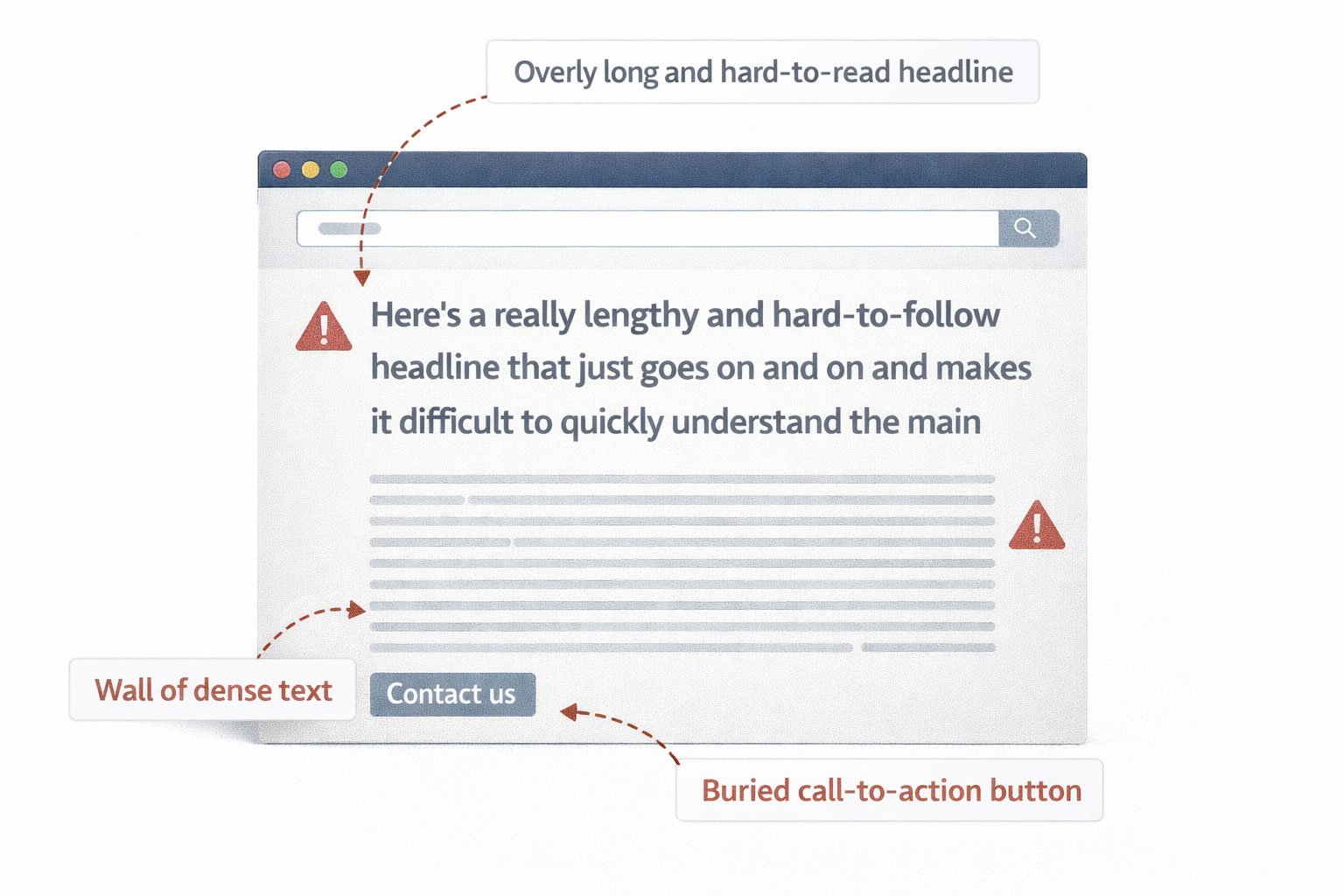 Common legal copywriting mistakes
Most of the copywriting problems on law firm websites and in legal marketing follow predictable patterns. Here are the ones that come up most consistently:
- Writing about the firm instead of the client. Every sentence that starts with “we” or “our firm” is a sentence that isn’t addressing the person reading it. Good copy keeps the focus on the client’s situation, needs, and concerns. The firm’s credentials come in as supporting evidence, not as the main event.
- Using passive voice everywhere. Passive voice is deeply ingrained in legal writing and it drains energy from marketing copy. “Cases are handled with the utmost care” is weaker than “We handle your case with the utmost care.” Active voice is more direct, more confident, and more readable.
- Burying the call to action. If someone has to scroll to the bottom of your homepage to find out how to contact you, your copy isn’t working. Your call to action should appear early, repeat logically throughout longer pages, and be impossible to miss.
- Writing headlines that don’t say anything. “Welcome to Smith and Associates” is not a headline. It communicates nothing useful and does no persuasive work. Every headline on every page should tell the reader something specific about what they’re going to get from that page.
- Ignoring mobile readers. A significant majority of legal searches now happen on mobile devices. Long paragraphs that look fine on a desktop become walls of text on a phone screen. Short paragraphs, clear headings, and prominent calls to action are even more important in a mobile context.
- Treating all practice areas the same. Using the same tone and structure across every practice area page regardless of the emotional context of that area is a missed opportunity. The voice for a criminal defense page and the voice for a business formation page should feel noticeably different.
- Never updating anything. Copy that references outdated laws, past case results without context, or technology and trends from five years ago signals to readers and to search engines that the firm isn’t paying attention. A regular review cycle for your most important pages is worth building into your process.
- Confusing thoroughness with usefulness. A ten-thousand-word practice area page that covers every possible legal scenario is not automatically better than a focused, well-written two-thousand-word page that answers the questions your actual clients have. More copy is not better copy.
Try this now: Do a quick “we audit” on your homepage. Copy the text into a document and use Find to count how many times the word “we” appears versus the word “you.” If “we” wins by a significant margin, go through and rewrite as many of those sentences as you can to put the client at the center instead of the firm.
Roche has tested his way to a clear answer on calls to action specifically. Changing “Request an appointment” to “Book a 15-minute call” and adding “Same-day call back most weekdays” took one personal injury page from a 3.4% to a 4.6% inquiry rate over a month with no change in traffic. “The consistent win is reducing jargon and adding specifics,” he says. Young’s A/B testing points the same direction: “specificity wins, ‘Free 15-minute case review’ plus what you’ll cover, as long as it’s ethics-safe.” Vernon’s data from his ELMNTL work confirms it from the other side: “A/B tests showed ‘Talk to us free’ doubled email clicks over stiff alternatives.”
The pattern is unmistakable. Vague invitations to contact get ignored. Specific, low-friction offers with a clear time commitment get clicked.
When to Hire a Professional Copywriter
There’s real value in understanding copywriting principles and applying them yourself. But there’s also a point where bringing in professional help makes more sense than continuing to do it in-house. Here’s how to think about that decision.
Signs It’s Time to Bring in Help
- Your website has been largely the same for two or more years and you know it’s not performing the way it should.
- You’re investing in SEO or paid advertising and your conversion rates are disappointing, but the traffic numbers are fine.
- Every time you sit down to write something for the firm, it either takes far longer than it should or you’re not happy with the result.
- You’re launching a new practice area, a new office location, or rebranding the firm and need a coherent voice established from the ground up.
- Your copy sounds like every other law firm in your market and you genuinely can’t figure out how to differentiate it.
What to Look for in a Legal Copywriter
Not every copywriter is equipped to write for law firms. Look for someone who:
- Has specific experience writing for lawyers or professional services firms, not just general marketing copy.
- Understands or is willing to learn your state bar’s advertising rules and incorporates compliance into their process.
- Asks substantive questions about your clients, your firm’s culture, and what differentiates you before writing a single word.
- Can show you examples of legal copy they’ve written that sounds human and converts, not just content that looks polished.
- Is willing to interview you or your team to capture authentic voice rather than writing entirely from a brief.
Working With a Legal Marketing Agency
A full-service legal marketing agency that handles copywriting as part of a broader strategy has some advantages over a standalone copywriter. They understand how copy fits into SEO, paid advertising, and content marketing holistically. They can ensure consistency across channels rather than optimizing each piece in isolation. And they typically have processes in place for compliance review that a generalist copywriter may not.
If you’re finding that copywriting is just one piece of a larger marketing challenge, and for most growing law firms it is, working with an agency that understands the legal market and can execute across all your channels is often the most efficient path forward. At Legal Hero Marketing, this is exactly what we do. If you’d like to talk through what that could look like for your firm, schedule a free strategy session here.
Summary
Copywriting is one of the highest-leverage investments a law firm can make in its marketing, and it’s one of the most consistently underestimated. Every word your potential clients encounter, on your website, in your emails, on your intake forms, across your social media profiles, is either building trust and moving them toward hiring you, or creating friction that sends them somewhere else.
The good news is that the gap between where most law firms are and where they could be with their copy is significant, which means the opportunity is significant too. You don’t need to become a professional writer. You need to understand a few core principles, apply them consistently, and be willing to keep refining based on what’s working.
Here’s a quick recap of what we covered:
- Copywriting is fundamentally different from legal writing, and the skills that make you an excellent legal writer can actively work against you in marketing copy.
- The legalese trap, the expert curse, and writing for other lawyers instead of for clients are the root causes of most law firm copy problems.
- Bad copy has real, measurable costs: lower conversion rates, underperforming SEO, wasted ad spend, and the wrong kinds of client inquiries.
- Your website’s homepage, practice area pages, and about page are your highest-priority copy investments and the places where improvements have the most immediate impact.
- Attorney bios are a significant and consistently underused trust-building opportunity.
- Blog posts that build real authority share genuine perspective and are written for a specific person with a specific question, not for a keyword tool.
- Good SEO copy and good copy are the same thing: clear, useful, written in natural language, and structured for how real people read.
- Client intake forms, email copy, and social media content all deserve the same thoughtfulness as your main website pages.
- The “explain it like I’m not a lawyer” principle is the most consistently useful mindset in legal copywriting.
- Different practice areas require meaningfully different voices and tones, calibrated to the emotional reality of the clients in each area.
- Ethics and advertising rules constrain what you can write, and compliance review needs to be part of your content process.
- AI tools can accelerate the copywriting process significantly, but they require human oversight for accuracy, compliance, and authentic voice.
- Professional copywriting help makes sense when your current copy clearly isn’t performing, when you’re going through a significant growth phase, or when you can’t find the time to do it well yourself.
If your copy isn’t working as hard as it should be, the good news is that this is one of the most fixable problems in legal marketing. The firms that get their copy right tend to see improvements across every other channel they’re investing in, because good copy makes everything else more efficient.