
Years ago, I started describing the internet as a digital landfill.
The amount of content being produced every day had already outrun anyone’s ability to consume it — millions of blog posts, articles, pages, and, of course, an endless supply of smut published daily.
Most of this content broke no new ground, saying nothing at all, or roughly the same thing as thousands of pages that already existed.
The web was filling up with content nobody asked for and nobody would ever find.
At the time, that was an observation about waste. Today it is something more serious, something that should concern any content author hoping that the content they create will help to drive visits to their websites via search engines — especially law firms whose content is held to a much higher standard.
This is because the landfill has changed how search engines behave. And if your law firm has been producing or paying for copious amounts of content with the belief that it was helping in some way, there is a real chance a large share of it is sitting in that landfill right now, invisible to every search happening anywhere on the planet.
Let me explain what changed, how to check where your content stands, and what actually keeps content out of the landfill.
How It Used to Work in the Golden Days: Google Indexed Almost Everything
For most of Google’s history, the deal was simple. You published a page, Google crawled it, and Google added it to the index. You can think of the index as a library that Google maintains, a collection of pages it can show in search results.
Previously, getting into the library was nearly automatic, but being indexed never guaranteed rankings. Your page could sit on page nine for every query it was remotely relevant to but, at least, it was in the library. And, theoretically, the possibility existed that it could show up for somebody searching for something specific enough. Thus, every page you published was at least a lottery ticket.
That era shaped how the content industry sold marketing to law firms. Volume was the strategy. More pages meant more lottery tickets. Agencies built entire service models around it. Four posts a month, every month, invoice attached. Whether anyone read the posts was rarely discussed, because the posts were at least in the game.
That deal is over.
What Changed? AI Slop and Content at Scale
Then the landfill trucks started running around the clock.
AI made content production essentially free. What used to take a writer a day now takes a prompt and thirty seconds. An entire industry sprang up around “content at scale,” publishing hundreds or thousands of pages at a time.
Unfortunately, much of that content is what’s known in plain terms now as AI slop.
A lot of it is content generated with low effort and less imagination. Often with very little human oversight — which is very careless — and saying exactly what every other AI-generated page on the topic says, because it was all drawn from the same well.
Legal content has been hit especially hard. Search any common legal question and you can find dozens of law firm blog posts that are functionally identical.
They all have the same structure, the same generic advice, and the same five reasons to hire a lawyer. Just with a different logo slapped at the top.
Many of these posts were produced by marketing vendors running the same tools and the same templates for every client on their roster, which means firms are often paying to publish near-duplicates of their own competitors’ content.
Google’s own people have described how readers react to this kind of content. In a recent Google podcast on indexing, John Mueller of Google’s Search team said people land on an AI-generated site and think, “anyone could have written this. This tells me nothing.”
His colleague Martin Splitt added a second blunt reason pages get left out — when plenty of existing content already covers a topic just as well, another version of the same thing adds no value worth indexing.
Google likely looked at the incoming volume and did the math. Storing and evaluating the entire landfill costs real money, and showing landfill content to searchers destroys the product. So Google changed the deal.
The Purge Is the New Deal: Google Is Now Refusing and Removing Content
Two things are now true that were not true a few years ago.
First, Google no longer indexes everything it finds. It crawls far more than it keeps. A page gets discovered, crawled, evaluated, and then, if Google judges it thin, generic, or interchangeable with content it already has, it simply never enters the index.

The library is not just refusing new donations. It is pulling old books off the shelves.
In Google Search Console, this shows up under a status every law firm should know: “Crawled – currently not indexed.”
There is a related status, “Discovered – currently not indexed,” which is even more dismissive. It means Google found the page and decided it was not worth crawling at all.
Let me translate both. Google looked at your content, or looked at the link to your content, and decided it was not worth a spot in the library. Those pages don’t have the option of ranking poorly on page ten or page one hundred. They simply do not exist in search and no query or searcher under any circumstance will surface them.
That is the landfill.
Second, and this is the part most firms have not caught up to, content that was indexed before is not safe.
Google is actively purging its index, re-evaluating pages it accepted years ago against today’s standards and quietly dropping the ones that no longer make the cut.
Firms are watching indexed page counts shrink month over month without publishing anything new or deleting anything old. The library is not just refusing new donations. It is pulling old books off the shelves and sending them to the dump.
The practical result is a hard break with the volume era. Every page used to be a lottery ticket. Now a weak page is not a ticket at all. It is landfill mass, and as I will get to below, it can drag your good pages down with it.
What This Means for Law Firms Producing or Paying for Content
There is a pattern I keep finding in audits.
A firm has been creating or paying for content for years. The deliverable arrives on schedule and the blog shows hundreds of published posts. On the invoice and in the monthly report, the content program looks healthy.
Then we open Search Console and it’s a different story.
A large share of those posts sit under “Crawled – currently not indexed.” Of the pages that did make the index, only a handful have earned a single impression in the last ninety days. Essentially, the firm has been paying for content that exists just to fill up space.
To be fair, nobody involved was necessarily acting in bad faith. The content satisfied a deliverable. It just was never built to satisfy a reader, and now Google’s systems have gotten good enough to notice the difference. But the time and money are just as spent either way, and the growth the content was supposed to produce never arrived.
If you want to understand whether that is happening to your firm, you do not need to take anyone’s word for it. Google will tell you directly.
How to Check Where Your Content Stands
This takes about ten minutes, and it requires access to your own Google Search Console. If you do not have that access, stop here and fix that first. I wrote about why your firm should own its own accounts, and this is a live example of why. Verification should never require trust.
Start with the crude check. Search Google for site:yourdomain.com and look at what comes back. This is a rough list of your pages in the index. Are your important pages there? Homepage, practice areas, attorney pages, locations? How does the total compare to the number of pages you have actually published?
Then open Search Console and go to the Pages report under Indexing. This is where Google shows its sorting decisions. Look at how many pages are indexed versus not indexed, and read the reasons in the not-indexed list. “Crawled – currently not indexed” and “Discovered – currently not indexed” are the landfill statuses. If a large share of your blog sits under them, Google is telling you exactly what it thinks of that content.
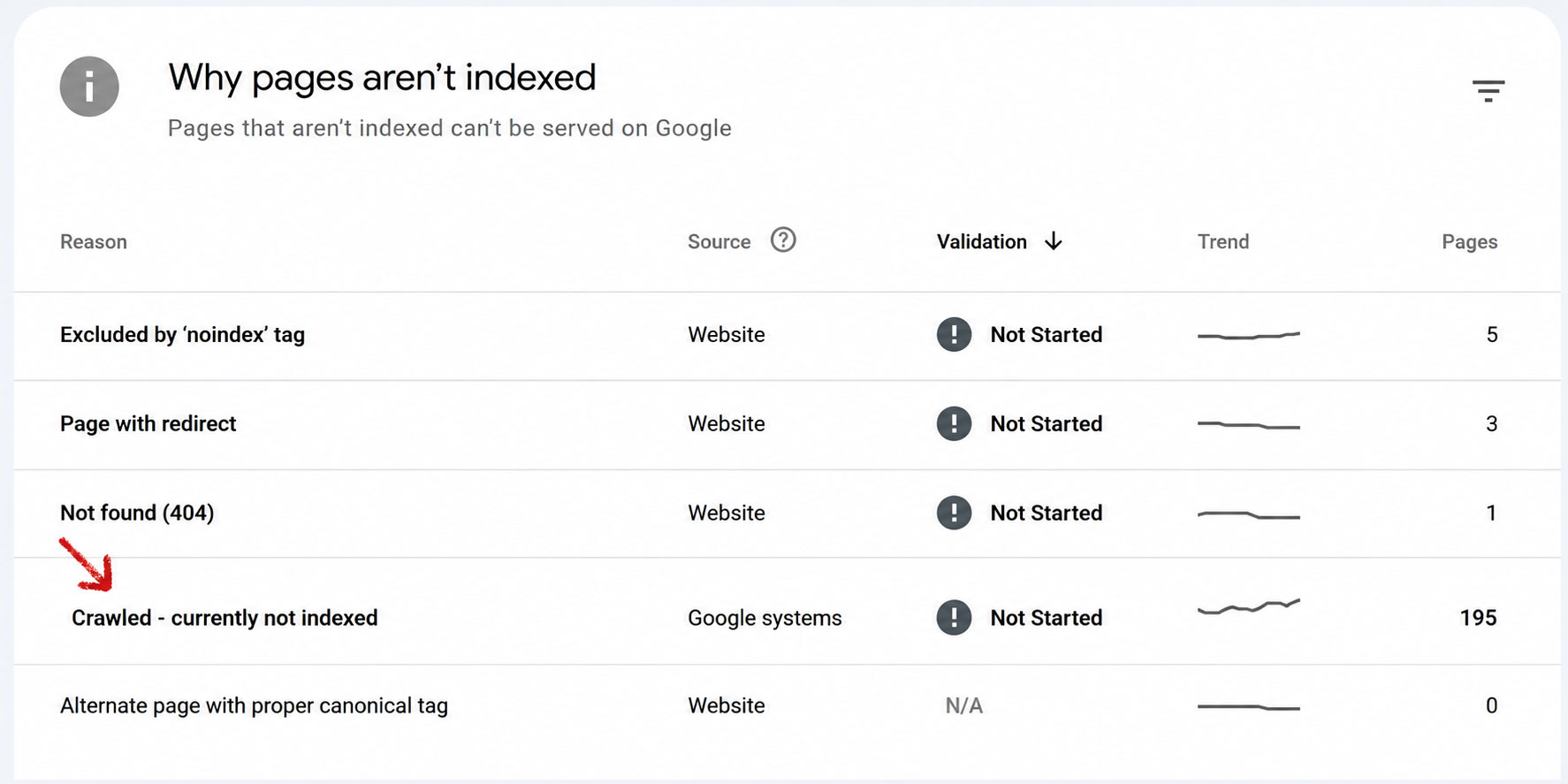
This is what the landfill looks like in Google Search Console.
Next, open the Performance report and set the date range to the last three months. Look at which pages earned impressions, meaning Google actually showed them to someone. Many firms discover that most of their search visibility comes from a small handful of pages, while the long tail of blog posts earned nothing at all.
Indexed but invisible is only one small step above the landfill. And could be on the chopping block next.
Finally, do the human check. Read your last five blog posts and ask honest questions. Could these appear on any law firm’s website, or only yours? Does each one answer a specific question a real potential client would type? Would a person who read one actually learn something? Would an AI tool have any reason to cite it? If the answers are no, Google’s judgment and your judgment are pointing the same direction.
What Keeps Content Out of the Landfill
The purge is not random, and it is not hostile to law firm content. It is hostile to interchangeable content.
What survives, earns impressions, and increasingly gets cited by AI tools tends to share a few traits.
It answers one specific question per page. Not “everything about car accidents in one post,” and not the same broad question fifteen of your other posts already target, competing with each other for the same query. Just one real question a potential client actually types, answered properly.
It contains things only your firm can say. Your cases, your outcomes, your local courts, the procedural details you know from practice, the mistakes you watch clients make.
First-hand experience is the one ingredient content mills and AI tools cannot fake, and both Google and AI platforms have been moving steadily toward rewarding it. A page that could not have been written by your competitor is a page with a reason to exist.
It has a real author. Content attributed to a named attorney, connected to a real profile and real credentials, carries more weight than content published by nobody in particular.
That connection between content and accountable expertise matters more in legal topics than almost anywhere else, because search engines treat legal content as high-stakes information.
It goes deep enough to be the answer. Depth does not mean length for its own sake. It means the reader finishes the page with their question actually resolved instead of clicking back to the results to try again.
And, counterintuitively, it sits on a site that is not full of junk. Google evaluates quality at the site level as well as the page level. In the same podcast I mentioned above, Mueller confirmed the mechanics directly. When Google’s systems have strong concerns about a website’s overall quality, they respond by crawling less and indexing less across the entire site.
A large mass of landfill content on your domain drags down Google’s assessment of everything you publish, including the good pages. That is the part the volume era never priced in. The four hundred thin posts are not just useless individually. They are actively poisoning the well for the twenty good ones.
What to Do With the Landfill Content You Already Have
If the check comes back ugly, the instinct is usually to publish more. Resist it. More of the same content produces more of the same result, and now you know it also feeds the site-level problem.
The work instead is cleanup and consolidation. Identify the posts that earn nothing and say nothing. The best candidates get rewritten properly, one real question each, with your firm’s actual experience in them. Overlapping posts that chase the same query get consolidated into one strong page, with the old URLs redirected to it. And the content that has no reason to exist at all, the purely generic filler, is better removed than left to rot on the domain. A smaller site of pages that earn their place will outperform a large site dragging a landfill behind it.
Then change what you accept going forward. If someone produces content for your firm, the standard is no longer “was it delivered.” The standard is “would a potential client learn something, and could a competitor have published the identical post.” Fewer, better pieces, built on what your firm actually knows. That is what stays in the library.
Final Thoughts
The digital landfill was always a waste problem. Google turned it into a sorting problem, and the sorting is only getting stricter as AI floods the web with more of the same.
The firms that win from here are not the ones producing the most content. They are the ones producing content that’s worth keeping, ranking, and citing.
Anyone can publish legal content but not everyone can be the answer.
So open Search Console this week and ask the question directly: how much of what my firm has produced or paid for is actually in the library, and how much is in the landfill?
If you want a second set of eyes on what you find, I do this kind of content review with law firms regularly. You can book a strategy session here. No pitch. Just a straight conversation about what your content is doing, what it isn’t, and what’s possible.