
If you’ve searched for a lawyer in Google, you’ve probably noticed the block of listings that appears above everything else on the search page. You’ll find them above the regular ads, the map pack, and the organic results. Those are Google Local Services Ads, and they occupy some of the most valuable real estate on the internet for law firms trying to get new clients.
LSAs have been widely available to lawyers since 2020, but some lawyers still don’t fully understand how they work, what they actually cost, or why some firms get great results while others burn through budget and wonder what went wrong. This guide covers all of it: from getting verified and setting up your profile, to bidding strategy, lead management, and how to make sure your intake process doesn’t cancel out everything you’re spending.
By the time you’re done reading, you’ll know exactly how LSAs work, whether they make sense for your firm, and how to run them in a way that actually benefits your firm.
What Are Google Local Services Ads?
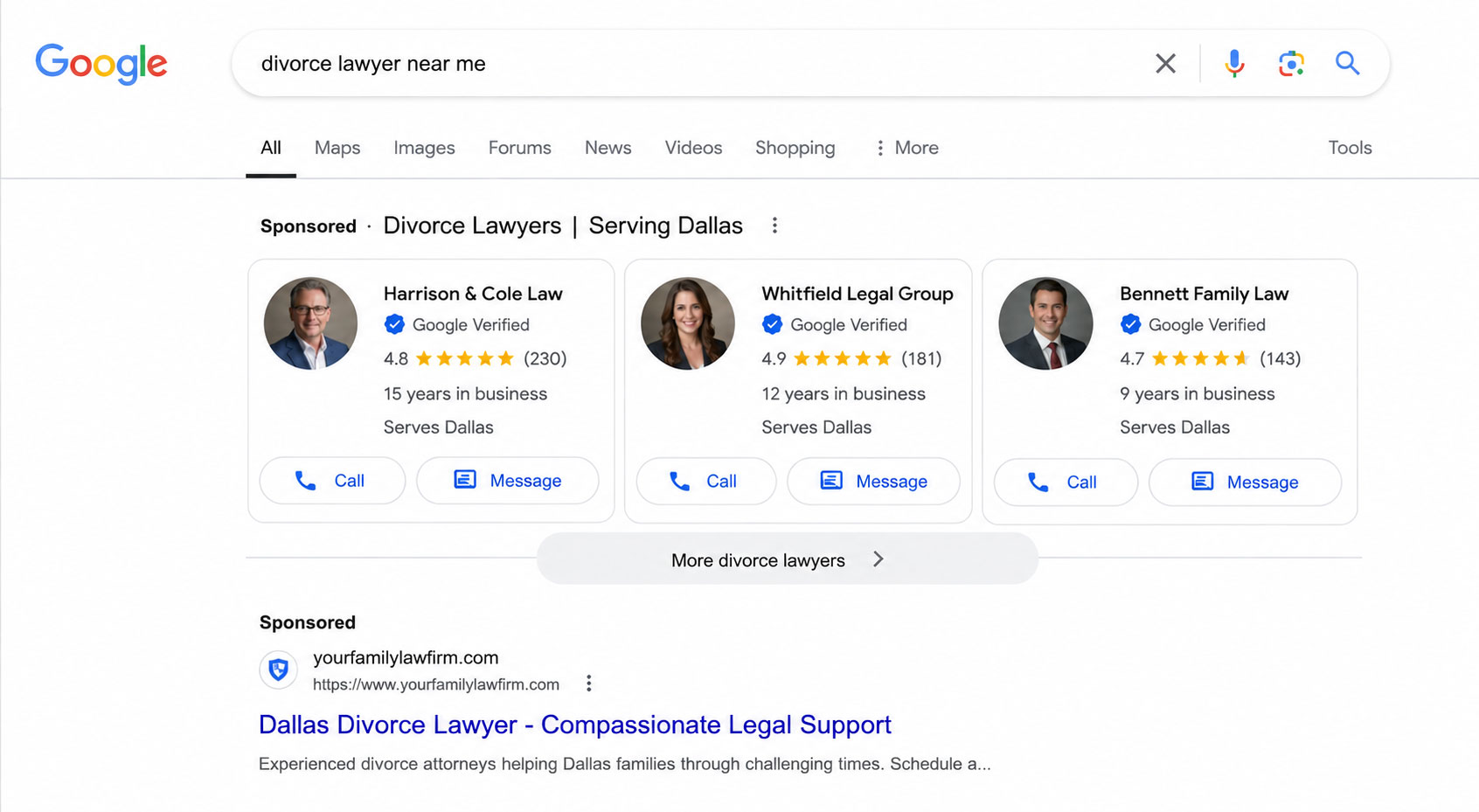
This is what the Local Services Ads unit looks like today: verified badge, ratings, and a direct call or message button, no website required.
Google Local Services Ads are a pay-per-lead advertising product that Google launched to connect local service providers, including lawyers, directly with people searching for help in their area. Unlike traditional Google Ads where you pay every time someone clicks your ad, LSAs charge you only when a potential client contacts you directly through the ad, either by calling the phone number shown or by sending a message.
When someone in your city searches for something like “divorce lawyer near me” or “personal injury attorney Houston,” Google shows a set of LSA listings at the very top of the results page. These listings display your firm name, your average star rating, your approximate location, and the years you’ve been in business. There’s no link to your website in the ad itself. The call-to-action is direct contact: call or message the firm right from the listing.
That distinction matters more than it might seem at first. LSAs aren’t designed to drive traffic to your website and let your website do the selling. They’re designed to put a potential client on the phone with you, or in your message inbox, as fast as possible. The entire model is built around that direct connection.
Google also attaches a verification badge to every LSA listing for lawyers. This is called the Google Verified badge. We’ll cover exactly what that involves in section five, but the short version is that firms have to pass a background and licensing check before their ads go live. That badge is part of what makes LSAs different from anything else in Google’s advertising lineup.
LSAs run on a separate platform from Google Ads. They have their own dashboard, their own bidding system, their own review collection process, and their own lead management tools. If you’re familiar with Google Ads, you’ll find LSAs feel simpler in some ways and more opaque in others. The controls you have over targeting are more limited, but the leads you get are generally more qualified because the person searching has already expressed explicit local intent.
The bottom line on what LSAs are: they’re Google’s way of connecting high-intent local searchers with verified local service providers, and they sit at the top of the most competitive piece of digital real estate a law firm can advertise on.
Mike Khorev, SEO and AI Visibility Consultant at Mike Khorev, puts it plainly: LSAs give law firms another avenue to reach potential clients who are most likely to hire an attorney, but if the intake process, lead tracking, or both are incomplete or poorly managed, the cost to acquire a client will rise at an exponential rate. The platform itself is only as good as the operation behind it.
How LSAs Differ from Traditional Google Ads
Law firms sometimes confuse LSAs with Google Ads, or assume they’re essentially the same product. They’re not. Understanding the differences is important because they have completely different cost structures, different requirements, different targeting options, and different roles in your overall marketing strategy.
The most fundamental difference is how you pay. With traditional Google Ads, you pay per click. Every time someone clicks your ad, money comes out of your budget, regardless of whether that person calls you, fills out a form, or bounces off your site in ten seconds. With LSAs, you pay per lead, meaning a real person has to either call the phone number in your ad or send you a message before you’re charged. If someone sees your LSA listing and does nothing, it costs you nothing.
The second major difference is placement. When Google Ads appear in the regular search results, they’re labeled “Sponsored” and they can appear at the top of the page or at the bottom. LSAs appear above Google Ads. They’re in their own dedicated unit at the very top of the page, sometimes referred to as the “Local Services” pack. When both LSAs and regular Google Ads are active, the LSAs are shown first.
Targeting works differently too. With Google Ads, you have enormous control. You can target by keyword, match type, device, time of day, demographics, location radius, and more. LSAs don’t work that way. You tell Google which services you offer and which geographic areas you serve, and Google decides when to show your ad based on searches it determines are relevant to those parameters. You don’t bid on specific keywords. You set a budget and a target cost per lead, and Google handles the matching. For marketers used to the precision of Google Ads, LSAs can feel like a black box.
The verification requirement is another major difference. Anyone with a credit card can run Google Ads tomorrow. LSAs require your firm to go through Google’s verification process, background checks, license verification, and insurance verification, before your ads are approved. This creates a higher barrier to entry, but it also means the ads carry more credibility with the people who see them.
The ad format itself is simpler. Google Ads can use multiple headlines, descriptions, callout extensions, sitelinks, images, and more. LSAs show your firm name, rating, general location, years in business, and a call or message button. There’s no headline to write, no ad copy to optimize, no landing page to build. The creative lift is minimal. The operational lift, managing leads, responding fast, disputing bad leads, is where the work actually lives.
There’s one more difference worth understanding. LSAs generate leads that live inside Google’s ecosystem. The calls and messages come through Google’s platform, they’re logged in your LSA dashboard, and Google uses how you handle those leads as a ranking signal. With Google Ads, once someone clicks your ad and lands on your website, Google’s visibility into what happens next is limited. With LSAs, Google is watching whether you answer the phone, whether you respond to messages, and whether you mark leads as valid or dispute them. That data feeds back into how Google ranks your listing.
Neither product replaces the other. They do different jobs, and for firms with the budget for both, they work well together. But they require completely different management approaches, and the mistake to avoid is treating LSAs like a simpler version of Google Ads. They’re a different product with different mechanics.
Why LSAs Matter for Law Firms Right Now
The legal industry is one of the most competitive spaces in digital advertising. Cost-per-click for legal keywords on Google Ads has been climbing for years. Personal injury, criminal defense, and family law keywords in major markets can run anywhere from $50 to several hundred dollars per click, and that’s just for the click, before you factor in whether your website converts that traffic into actual calls. Legal directories have consolidated their dominance in organic search results. Getting a law firm into the top organic positions for competitive legal keywords takes time, sustained investment, and isn’t guaranteed even when you do everything right.
LSAs represent a different path to the top of the page that isn’t dependent on your website’s domain authority, your SEO history, or your ability to out-bid everyone else on high-CPC keywords. Because LSAs appear above everything else in search results, including traditional Google Ads, they give firms that qualify and manage their profile well a chance to be seen first, every time, by people who are actively looking to hire a lawyer right now.
The intent behind LSA searches is as high as it gets in digital marketing. Someone searching “workers comp lawyer near me” isn’t browsing. They’re not in research mode. They’re trying to find someone to call today. LSAs are built specifically for that moment, and they put your firm directly in front of that person with a one-tap call button. There’s no website to navigate, no form to fill out, no friction between the search and the contact.
The Google Verified badge matters here too. Consumers have gotten more skeptical of online advertising in general. A badge that tells them Google has verified your license and run a background check on your firm creates a level of trust that no ad copy can replicate. For a person who just experienced a car accident, got served with divorce papers, or needs to talk to a criminal defense attorney, that badge reduces one more barrier to picking up the phone.
LSAs also tend to produce leads at a lower cost than traditional Google Ads in many legal markets, particularly for firms that manage their profiles well, maintain strong review counts, and respond to leads quickly. The pay-per-lead model eliminates the waste that comes with paying for clicks that go nowhere. You’re only paying when someone actually reaches out.
None of this means LSAs are a magic solution. Firms that set them up and walk away don’t get great results. Firms with poor intake processes waste a lot of money. Firms in some markets face stiff competition in the LSA unit just like everywhere else. But for a law firm that’s willing to manage the channel properly, LSAs are one of the most direct and accountable ways to put your firm in front of high-intent clients at the exact moment they’re looking for help.
Zack Bowlby, CEO of ROI Amplified, has managed over $100 million in ad spend and frames LSAs differently than most. He sees them less as a lead generation channel and more as an intake-quality channel. The firms that tend to win, he says, are the ones treating local search as a complete system rather than isolating LSA as a standalone product. The ad unit gets the call, but intake flow, reviews, and follow-up determine the economics.
Which Practice Areas Qualify for LSAs
Not every practice area is eligible for Google Local Services Ads, and the list of eligible categories has evolved over time as Google has expanded the program. As of now, the legal categories Google supports for LSAs in the United States include a broad range of practice areas, but it’s worth understanding how Google groups these and where the gaps are.
The practice areas currently eligible for legal LSAs include bankruptcy law, business law, contract law, criminal law, disability law, DUI law, elder law, employment law, estate law, family law, immigration law, intellectual property law, labor law, litigation, malpractice law, personal injury law, real estate law, tax law, traffic law, and general legal services. Google reviews and updates this list periodically, so if your practice area isn’t on this list today, it’s worth checking again in the future.
The way Google handles practice areas in LSAs is through categories you select when setting up your profile. You’re not locked into a single category: you can select multiple practice areas that reflect the actual work your firm does. However, there’s a balance to strike here. Selecting every available category in hopes of maximum exposure can actually hurt your performance. Google’s algorithm considers relevance, and a firm that lists fifteen practice areas looks less specialized than one that’s clearly focused on two or three. Select the categories that genuinely represent your primary work.
Geographic availability matters as much as practice area eligibility. LSAs are available in most major and mid-sized U.S. markets, but coverage isn’t universal. Firms in smaller rural markets may find that LSAs aren’t available in their service area yet, or that there aren’t enough searches in their area to generate meaningful lead volume. If you’re in a smaller market, it’s worth checking availability, but don’t be surprised if LSAs aren’t yet a viable channel for you.
For multi-location firms, each location operates as a separate LSA profile. This means each office goes through verification independently, maintains its own reviews, and manages its own leads. There’s no centralized multi-location dashboard the way there is in Google Business Profile or some other platforms. This can add administrative overhead for larger firms, but it also means each location can be optimized independently based on its specific market and practice mix.
One thing to flag specifically for estate planning and elder law attorneys is that while these categories are eligible, the search volumes tend to be lower than practice areas like personal injury or criminal defense. That doesn’t mean LSAs don’t work for these firms. It just means your lead volume expectations need to be calibrated to the actual search demand in your market, not compared to what a PI firm might experience.
Wayne Lowry, Marketing Coordinator at Local SEO Boost, has seen this play out in real campaign data. Practice area performance really depends on urgency. Criminal defense and family law perform exceptionally well because people need immediate help. Estate planning and corporate law tend to underperform because those searches are not time-sensitive in the same way.
If you’re unsure whether your specific practice area qualifies, the fastest way to check is to start the LSA setup process in Google’s Local Services Ads platform. Google will tell you during setup whether legal services are available in your area and what categories you can select.
The Google Verified Badge: What It Is and Why It Matters
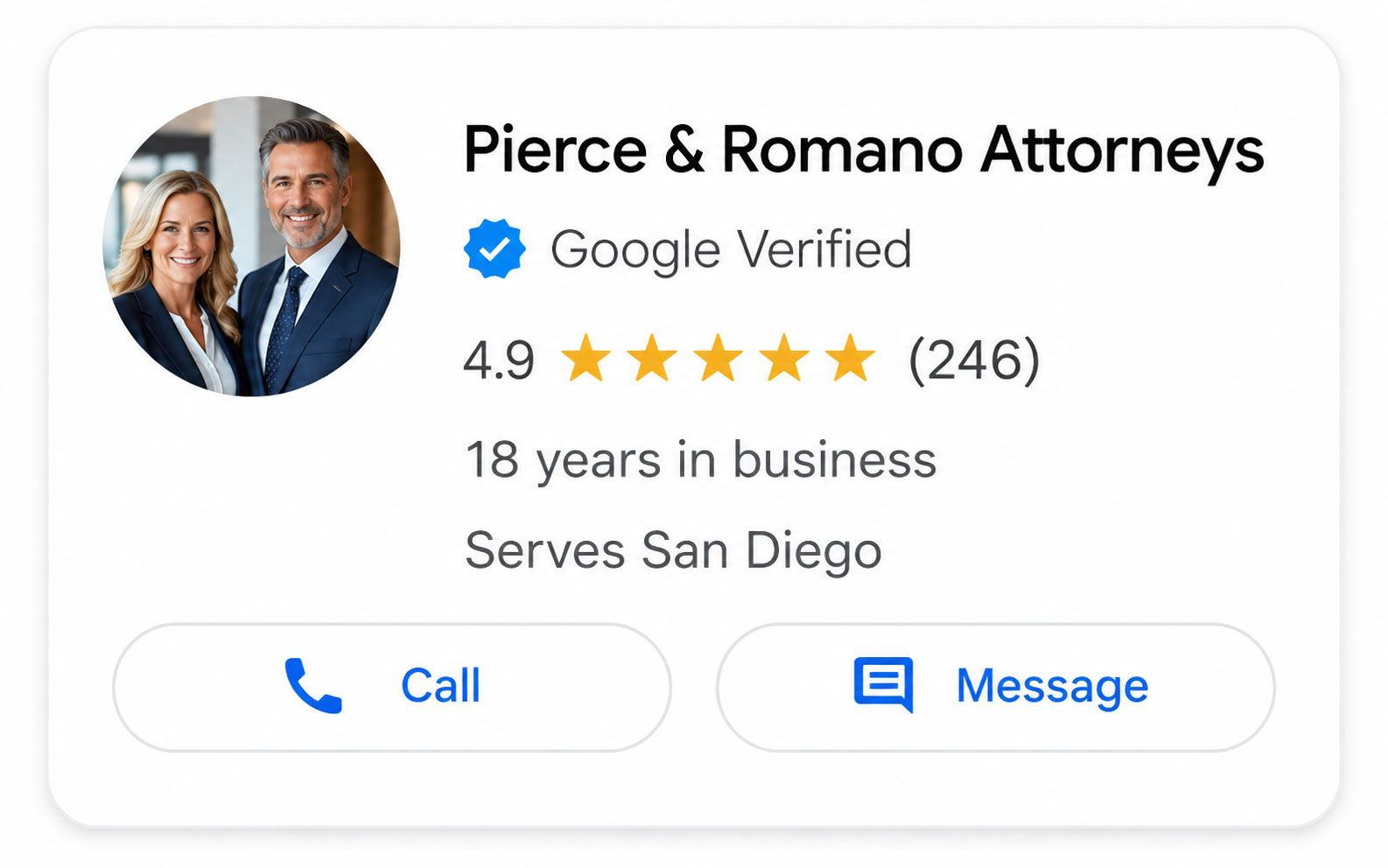
The Google Verified badge replaced Google Screened and Google Guaranteed, and it’s now the single trust signal across every LSA listing.
Every LSA listing for a law firm carries what Google now calls the Google Verified badge. This replaced the older Google Screened and Google Guaranteed badges, which Google retired in late 2025. There is now a single unified badge across all LSA categories: Google Verified. If your firm was already running LSAs under the old badge system, you were automatically transitioned. New advertisers earn the badge by completing Google’s verification process before their ads go live.
The badge is not decorative. It’s a verification signal that tells the person looking at your ad that Google has checked your firm’s credentials before allowing you to advertise. The verification covers background checks on the business entity and key personnel, confirmation that your firm holds an active law license in good standing, and proof of professional liability insurance. All three have to clear before your ads are approved.
To earn and keep the Google Verified badge, your firm has to pass background checks on the business entity itself and on any individual owners or key personnel Google requires to be verified. Google also verifies that your firm holds a valid law license in good standing in the states where you’re advertising. If your license lapses, if a background check comes back with a disqualifying issue, or if your verification materials expire without renewal, your ads can be paused.
From a consumer perspective, the badge does meaningful work. Legal consumers are often stressed, sometimes in crisis, and trying to make a fast decision about who to trust. The Google Verified badge is a shortcut that signals legitimacy. It’s especially effective for clients who don’t know how to evaluate a law firm beyond checking whether Google has already done some vetting for them. In markets where the LSA unit shows three or four firms, the badge is a constant visual signal that every firm in that unit has passed a baseline check, and it creates a perception of accountability that unverified organic listings or standard Google Ads don’t carry.
The badge also affects click behavior. Ads with verification signals consistently outperform similar ads without them across categories, and legal is no exception. When a potential client is deciding in a few seconds which firm to call, the presence of a trust badge can tip the decision. It’s not the only factor, but it’s a real one.
There’s also a competitive argument for being in the LSA unit that goes beyond the badge itself. Appearing in the verified unit alongside two or three other credentialed firms is a form of implied legitimacy. Google has decided your firm belongs in a curated set of vetted providers. Being excluded from that unit because you haven’t completed verification means you’re advertising further down the page against firms that have cleared a higher bar. For any firm that qualifies, not being in the LSA unit is a competitive disadvantage.
The badge doesn’t expire on its own, but Google does require periodic re-verification to confirm that your license remains active and your background check information is current. Keeping your verification materials up to date is part of ongoing LSA management. It’s not a one-time step that you complete at setup and forget.
The Verification and Background Check Process
The verification process is one of the first things that surprises law firms exploring LSAs. It’s more involved than most digital advertising, and it takes longer than most firms expect. Understanding what’s required and how to move through it efficiently will save you real time and frustration.
Google manages the verification process through a third-party provider, which has historically been Evident. The process covers several distinct areas: business background check, personal background check for owners and key personnel, license verification, and insurance verification. All of these need to be completed before your ads can go live.
The business background check looks at the legal entity itself: the name of your firm, registration status, and any public records associated with the business. The personal background check applies to individuals Google identifies as owners or principals of the firm. If you’re a solo practitioner, that’s you. If you’re a partner at a multi-attorney firm, it typically applies to the named partners. Google will tell you during setup who needs to be verified.
License verification is exactly what it sounds like. Google confirms that your firm holds an active law license in the state or states where you’re advertising. You’ll typically need to provide your bar number or a copy of your license, and Google cross-references this with state bar records. This is worth knowing ahead of time if your licensing status is anything other than fully active and in good standing, because anything that triggers a flag in verification will delay or block your approval.
Insurance verification requires proof that your firm carries professional liability insurance, also called malpractice insurance. You’ll need to provide a certificate of insurance showing your coverage, and the coverage limits need to meet Google’s minimum thresholds. Check the current requirements when you begin verification, as Google occasionally updates them. If your current policy is coming up for renewal around the time you’re setting up LSAs, it’s worth timing the renewal before you submit your verification materials to avoid any gaps in coverage documentation.
The timeline for verification is something firms consistently underestimate. Google tells you to expect a few weeks, and that’s roughly accurate under normal conditions, but if there are any issues with your submitted documents, any discrepancies between your submission and what Google finds in its checks, or any questions about your license status, the process can stretch significantly longer. The best approach is to gather all your documentation before you start the verification submission, submit everything at once, and respond quickly to any follow-up requests from Google’s verification team.
Once you’re verified, your ads can go live. But verification isn’t a permanent state. It requires renewal. Google will notify you when your verification materials are approaching expiration. This typically happens annually. Missing a renewal deadline can result in your ads being paused while you re-verify. Set a calendar reminder for yourself well ahead of your verification expiration date so this doesn’t catch you off guard.
One thing that sometimes trips firms up is that verification is tied to your Google account and your business profile. If you change your business name, add a new location, or make significant changes to your firm structure, you may need to re-verify. Any time there’s a material change to your firm, it’s worth checking whether it has implications for your LSA verification status before the change takes effect.
Shane Lucado Esq., Founder and CEO of InPerSuit, has talked to approximately one in four lawyers who experienced delays of 11 to 35 days due to background check holds, license verification issues, or insurance documentation problems. In his experience working across Alabama and Georgia markets, delays in obtaining malpractice insurance verification and bar certification documents are the number one complaint. James Shaffer, Managing Director of Insurance Panda, adds that if your firm’s legal name on the state bar registry doesn’t perfectly match your Google Business Profile, your application will stall for weeks. The fix is simple but often overlooked: check every name field for consistency before you submit.
Setting Up Your LSA Profile
Once you’ve completed verification, you need to set up your LSA profile. Your LSA profile is what determines how you appear in Google’s Local Services unit. This isn’t just an administrative task. How you set up your profile directly affects your ranking, your relevance to the right searches, and how many potential clients decide to call you versus the other firms showing up alongside you. It deserves careful attention.
Start at ads.google.com/local-services-ads. Google will walk you through the setup process, which begins with confirming your business details like the name of your firm, address, phone number, and service area. Use exactly the same business name and address that appear on your Google Business Profile. Consistency across your Google presence matters for how the system treats your listing. Discrepancies can cause problems during verification or affect how Google matches your ads to local searches.
Your service area is one of the most consequential settings in your profile. You can define your service area by city, zip code, or a radius around your office. Be specific and realistic. If your firm serves clients across a three-county region, add each relevant city or county. But don’t chase maximum coverage by selecting areas where you genuinely don’t compete for clients. Doing so dilutes your budget across areas where you’re unlikely to convert leads, and can drag down your overall performance metrics.
Practice area selection comes next, and we touched on this earlier. Select the categories that accurately represent your primary practice areas. If you’re a personal injury firm that occasionally handles social security disability claims, your primary selection should reflect where your volume actually is. Stretching your categories too thin works against you in Google’s ranking algorithm, which rewards relevance.
Your business hours are displayed on your profile and affect how Google treats unanswered leads. If someone calls during your listed business hours and nobody answers, that’s a signal Google can use against your ranking. Set your hours to reflect the times when someone at your firm will genuinely answer an incoming call. If your actual answering hours are more limited than your business hours, consider using an answering service to cover the gap, but make sure leads get a quality response, not just a voicemail. We’ll come back to this later when we talk about handling intake.
Your profile photo is the image that appears with your listing. It’s best to use a high-resolution professional headshot. Google also accepts a business logo or a photo of your office. A clean, professional version of your logo typically works better than an interior shot of a conference room, but whatever image is selected, it’s best to keep it simple and recognizable at small sizes, since that’s how it appears in the listing. But a friendly-looking, professional headshot works best. Skip stock photos. They look generic in the LSA unit and don’t differentiate your firm.
The “About” section of your profile gives you a brief opportunity to describe your firm. Keep it focused on what you do, who you serve, and where you’re located. Don’t try to be clever or vague here. “Personal injury law firm serving Houston and surrounding Harris County communities for over 15 years” tells a potential client exactly what they need to know.
This section isn’t heavily weighted in ranking, but it does appear when someone expands your listing, and clarity here can be the difference between a call and a scroll-past.
Connect your LSA profile to your Google Business Profile if you haven’t already. This links your reviews, keeps your business information consistent across Google’s products, and helps the algorithm understand your business context more completely. If you don’t have a Google Business Profile yet, create one before you set up LSAs. It’s foundational to how Google understands and ranks your firm across Search and Maps.
Finally, download the Google Local Services Ads mobile app. Leads come in through the app in real time, and responding quickly is one of the most important ranking signals in the LSA system. If your team is only monitoring leads through a desktop dashboard, you’re going to miss calls and messages during the hours when people aren’t sitting at a computer. The app solves that problem, but only if someone at your firm has it installed and notifications turned on.
How Google Ranks LSA Listings

Your LSA ranking isn’t a single number. It’s reviews, responsiveness, bid, proximity, and availability all working together.
When multiple law firms in a market are running LSAs, Google typically shows only two or three of them at a time in the Local Services unit. Which firms appear, and in what order, is determined by Google’s ranking algorithm. Understanding what drives that ranking is the difference between being in the unit and being invisible.
Google hasn’t published a complete breakdown of its LSA ranking formula, and it likely changes over time, but based on what Google has disclosed and what practitioners have observed in practice, there are several factors that consistently show up as significant.
Review score and review count are among the most visible ranking signals. Firms with higher average ratings and more total reviews tend to rank better than firms with lower ratings or thin review profiles. This makes intuitive sense from Google’s perspective. The LSA program is built around trust, and reviews are the most direct signal of whether a firm is delivering on that promise. A firm with 4.8 stars and 120 reviews will generally outrank a firm with 4.2 stars and 15 reviews, all else being equal. Building your review count consistently over time isn’t just good for conversion, it’s a direct ranking input.
Responsiveness is another major factor. Google tracks how quickly and consistently you respond to leads. Firms that answer calls promptly, respond to messages fast, and keep their booking status current tend to rank higher than firms that miss calls or let messages sit unanswered. This is one of the clearest examples of Google using behavioral data to rank LSA listings. They can see directly whether you’re a good partner for the leads they’re sending you.
Your bid, which in LSAs is expressed as a target cost per lead, also influences ranking. Higher bids signal to Google that you’re willing to invest more per lead, which can improve your position in competitive markets. But bid alone doesn’t determine placement. A firm with a lower bid and excellent reviews and responsiveness can outrank a firm with a higher bid but weak signals in those other areas. This is fundamentally different from Google Ads, where budget and bid have a more direct relationship with position.
Proximity to the searcher matters as well. Google factors in how close your firm’s office is to the location of the person searching. A firm located in the same neighborhood as the searcher has an inherent proximity advantage over a firm that’s listed as serving that area from an office twenty miles away. This is worth keeping in mind if you’re trying to compete in a market where your office is at the geographic edge of your service area.
Business hours and availability also play a role. If a search happens at 8 PM and your listed hours end at 5 PM, Google is less likely to show your listing, because even if a lead contacted you, you wouldn’t be available to respond. Firms that cover more hours, whether through extended office hours or an answering service, have a ranking advantage during the times when people search outside of traditional business hours. Legal matters don’t wait for business hours, and neither do the people who need help with them.
Your overall account health matters too. Disputing a high percentage of your leads without a legitimate basis, having a high number of unanswered calls, or generating complaints can all negatively affect your ranking. Google is watching how you manage the leads it sends you, and that behavior feeds back into whether it keeps sending them.
The practical implication of all this is that LSA ranking isn’t something you set and walk away from. It’s a dynamic score that reflects ongoing behavior: how you respond to leads, what clients say about you in reviews, what you’re willing to pay per lead, and whether your firm is genuinely engaging with the channel the way Google intends it to be used.
Cyrus Kennedy, Chairman and Acting CEO of The Ad Firm, has seen the review signal prove out in real competitive situations. Firms with over 150 Google reviews consistently outperformed competitors who spent more per month, because review signals impact lead generation in a way that raw budget can’t overcome. The ranking advantage from a strong review profile is real, and it compounds over time.
Bidding Strategy: Pay-Per-Lead, Not Pay-Per-Click
The bidding model in LSAs is fundamentally different from anything in traditional Google Ads, and getting your head around how it works is essential before you start spending money. The short version is this: you set a maximum amount you’re willing to pay per lead, and Google uses that as one of the inputs in deciding when and how often to show your ad.
Google gives you two bidding options: maximize leads, or set a target cost per lead. The maximize leads option hands Google full control over your bidding: it automatically adjusts your bids to get you the most leads possible within your weekly budget. The target cost per lead option lets you tell Google the maximum you want to pay for a single lead, and Google will aim to stay at or below that number while still showing your ad as much as possible within your budget.
For most law firms getting started with LSAs, the maximize leads option is a reasonable starting point. It gives you data on what Google is actually charging per lead in your market before you try to optimize around a specific number. Run it for four to six weeks, watch what your actual cost per lead ends up being, and use that baseline to inform your target if you decide to switch to the manual option later.
When you’re ready to set a target cost per lead, the right number depends on two things: what you can actually afford to pay and still run a profitable operation, and what the competitive reality of your market demands. In major metros with heavy LSA competition, cities like Los Angeles, New York, Houston, or Chicago for high-volume practice areas, target cost per lead figures for personal injury or criminal defense can be substantially higher than in smaller or less competitive markets. Going in with a target that’s significantly below the market rate will result in your ads showing infrequently or not at all.
There’s a calculation worth doing before you set your target. Start with what a new client is worth to your firm on average, not the outlier cases, but a realistic average across your case mix. Then factor in your close rate on incoming leads. If you close one in five leads, and the average case value is $3,000 in fees, you can afford to pay up to $600 per lead and still break even on lead cost alone, before factoring in overhead. Most firms want to be well below that break-even point. Use this math to anchor your target in reality rather than just picking a number that feels comfortable.
One nuance in LSA bidding that confuses some firms: your target cost per lead is not a cap on what you’ll pay for any individual lead. It’s a target average across all your leads. Google will sometimes charge more than your target for a particular lead if it determines that lead is high quality or high probability. Over time, Google aims to hit your target as an average, but individual leads can fall above or below it.
Competition in your market directly affects what you need to bid to stay visible. If four firms in your city are all running LSAs for personal injury law, and three of them are bidding aggressively, a below-market bid will result in your listing appearing rarely. You can check how your bid compares to what Google suggests in the LSA dashboard: Google will tell you if your current bid is too low to compete effectively and offer a suggested range. Take those suggestions seriously. They’re based on actual market data.
Seasonality also plays into bidding. Some practice areas have predictable seasonal patterns: DUI arrests spike around holidays, tax attorneys get busy in Q1, family law inquiries tend to rise after the new year. Adjusting your bids around these patterns, bidding more aggressively during peak demand periods and pulling back during slower periods, is a reasonable optimization strategy once you have enough data to see those patterns in your own account.
For firms trying to benchmark what a realistic cost per lead looks like, Wayne Lowry offers some real numbers from campaigns his team has managed. In competitive metros like Los Angeles, personal injury calls run $150 to $300 each. Secondary markets drop to $80 to $150 per call. Family law tends to come in cheaper, averaging $60 to $120 per lead. Estate planning runs $40 to $80 per lead, though those cases often carry lower fees. These ranges vary by market and competition level, but they give a useful starting point for setting realistic expectations before you go live.
Setting Your Budget and Lead Goals
Your LSA budget and your bid work together, but they control different things. The bid tells Google how much you’re willing to pay per lead. The budget tells Google how much you’re willing to spend in total over a week. Google operates LSA budgets on a weekly cycle, not a daily one. This is different from Google Ads, which runs on a daily budget. Understanding this distinction matters because it affects how you think about pacing and spend.
Google will spend up to your weekly budget amount across the week, but it doesn’t spread that spend evenly across every day. There will be days where it spends more and days where it spends less, based on search volume and competition. Over the course of a month, Google also has some flexibility to go slightly over or under your weekly target in ways that average out. The practical implication is that your LSA spend is less predictable on a day-by-day basis than Google Ads spend, and you should monitor it at the weekly level rather than checking every day and worrying about swings.
To set a realistic budget, start with how many leads you actually want per week and work backward. If you want ten leads per week and your expected cost per lead is $80, you need a weekly budget of at least $800. Build in some buffer, maybe 15 to 20 percent, to account for the natural variation in how Google spends. If your budget is too tight relative to your lead volume goal, Google will throttle your ad delivery, and you’ll end up with fewer leads than the market could actually deliver.
The question of how many leads you want is directly connected to your intake capacity. There’s no value in setting a budget that generates 30 leads per week if your intake team can only realistically follow up with 15 of them before the leads go cold. LSA leads have a short shelf life. These are people in motion, actively looking for help, often contacting multiple firms at once. If you’re generating more leads than you can respond to promptly, you’re paying for leads you’re not actually winning. Better to set a budget that matches your intake capacity and increase it as you build the systems to handle more volume.
Review your budget regularly, not just when you set it up. Markets change. Competition shifts. Google occasionally adjusts how it treats budgets and bidding across categories. A budget that made sense six months ago may be too high or too low today. Building a monthly review of your LSA performance and budget into your marketing rhythm will keep you from either underspending and missing opportunity or overspending in a market that’s shifted.
One practical tip: Google allows you to pause your LSA budget at any time. If your intake team goes on vacation, if you have a surge of cases and your capacity is maxed out, or if you want to pause for any operational reason, you can pause your ads without losing your account history or your verification status. This flexibility is one of the practical advantages of LSAs over some other lead generation channels where pausing and restarting has more friction.
Managing Leads Inside the LSA Dashboard
The LSA dashboard is where the day-to-day work of running Local Services Ads actually lives. It’s where incoming leads land, where you respond to messages, where you dispute invalid leads, and where you track your performance. Getting comfortable with it, and more importantly, building the right processes around it, is essential if you want to get real value from the channel.
Leads arrive in the dashboard in two forms: calls and messages. Phone calls are routed through a Google-provided number that forwards to your firm’s actual number. The call is logged in the dashboard automatically, including the time, duration, and whether it was answered or missed. Message leads come in through the listing directly and appear in the dashboard inbox, similar to an email. You can respond to messages directly from the dashboard or the mobile app.
Every lead that comes in needs to be categorized. Google asks you to mark each lead as either a valid lead or an invalid lead. Valid leads are contacts from people genuinely looking for legal help in your practice area. Invalid leads, which we’ll cover in detail in the next section, are calls that don’t meet the criteria for a billable lead. This categorization step matters because it’s how you dispute charges for leads you shouldn’t have been billed for, and because your lead management behavior is a ranking signal.
The speed at which you respond to incoming leads is one of the most consequential behaviors in your LSA account. Google watches response time closely and uses it as a ranking signal. Firms that consistently answer calls and respond to messages quickly rank better than firms that routinely miss contacts or let messages sit. But beyond the ranking impact, response speed has a direct effect on whether you actually win the client. LSA leads are typically contacting more than one firm. The first firm to have a real conversation with that person has a significant advantage. Every hour you wait to return a call or respond to a message is an hour your competitors have to beat you to it.
This is where the mobile app becomes non-negotiable. If the only person monitoring the LSA dashboard is sitting at a desktop during business hours, you’re going to miss leads that come in during evenings, early mornings, and weekends. People don’t limit their legal emergencies to 9 to 5. The mobile app sends push notifications for new leads in real time. Have at least one person at your firm with the app installed, notifications enabled, and a clear protocol for what to do when a lead comes in outside of normal hours.
For firms with a dedicated intake team, integrating LSA lead management into their existing workflow is worth some deliberate planning. Some legal CRM platforms and call tracking tools have integrations with the LSA platform that allow leads to flow automatically into your intake system. If your firm uses a CRM for intake, look into whether it supports LSA integration. Keeping everything in one place reduces the chance that a lead falls through the cracks because someone had to manually transfer it from one system to another.
Bookmarking and notes features in the dashboard let you add context to individual leads, notes about the case type, the caller’s situation, follow-up status, and outcome. Using these consistently makes it much easier to audit your lead quality over time, understand what types of cases your LSAs are actually generating, and make informed decisions about your service area and practice area targeting. Treat the dashboard as a working tool, not just a reporting view.
One more thing on lead management: be realistic about what happens after you mark a lead as valid but don’t ultimately sign the client. That’s normal. Not every lead converts.. But your conversion rate on LSA leads is worth tracking over time because it tells you something about the quality of leads the channel is generating and how well your intake process is working. If you’re getting plenty of leads but converting very few of them, the problem might be lead quality in your specific market, or it might be something happening in your intake process. We’ll dig into this specifically in a later section.
Disputing and Crediting Invalid Leads
One of the most practically important, and most underutilized, features of the LSA platform is the ability to dispute leads you believe you shouldn’t have been charged for. Google is clear that not every contact through your LSA listing qualifies as a billable lead, and the dispute process exists specifically so you’re not paying for calls that don’t meet the standard. Using it correctly can meaningfully reduce your effective cost per lead over time.
Google defines a valid lead as a contact from a user who is seeking the services your firm provides in the area you serve. An invalid lead, by Google’s definition, includes calls from people seeking a service you don’t offer, calls that were wrong numbers, calls from existing clients (as opposed to new inquiries), calls that were spam or solicitations, and duplicate contacts from the same person about the same matter. If a contact falls into any of these categories, you can dispute the charge and request a credit.
The dispute process works through the LSA dashboard. Navigate to the lead you want to dispute, select the reason for the dispute from the options Google provides, and submit. Google reviews disputes and typically resolves them within a few days, though it can take longer. If your dispute is approved, you receive a credit applied to your account, not a cash refund, but a credit against future charges. If your dispute is denied, you can review the reason and decide whether it’s worth appealing.
Be honest in your disputes. Google monitors dispute behavior, and firms that dispute a high percentage of their leads, especially when those disputes are frequently denied, can see negative effects on their account standing and ranking. The dispute system is designed for genuinely invalid leads, not as a mechanism to reduce your bill on leads that simply didn’t convert. A lead from someone who needed a personal injury attorney, called your firm, had a real conversation, and decided to go with a different firm is a valid lead even though you didn’t win the client. Disputing that kind of lead is not appropriate and can work against you.
Where disputes genuinely pay off is in the categories Google clearly allows. Wrong numbers are an obvious one: if someone dialed the wrong firm, that’s not a lead for you. Solicitation calls from vendors trying to sell you something are another common category, especially as your LSA listing becomes more visible and marketers start using your LSA number to pitch their services. Calls seeking services you clearly don’t offer, someone calling a family law firm about a commercial real estate dispute for example, are disputable. So are duplicate contacts, where the same person calls twice about the same matter and you end up billed twice.
Keep notes on your disputed leads so you can see patterns over time. If a significant portion of your invalid leads are coming from a specific service category you’ve listed, it may be worth reviewing whether that category is attracting the right searches for your firm. If you’re getting a lot of wrong-number calls, it’s worth double-checking that your phone number is correctly listed in the dashboard and on your Google Business Profile.
As mentioned in the previous section, speed to respond matters here too. One thing some firms don’t realize is that Google requires you to dispute a lead within a specific window after it comes in. If you let leads pile up unreviewed for weeks and then try to dispute something old, you may find the window has closed. Review your leads regularly, ideally daily, and dispute anything that qualifies before the deadline passes.
The financial impact of disciplined disputing is significant. Mike Ibrahim, Founder and CEO of Rewardlion, points out that firms who ignore this process effectively overpay by 20 to 30 percent on their true cost per lead without realizing it. Cyrus Kennedy has also seen firms reduce their cost per acquisition on signed cases by close to 28 percent once they started contesting bad leads through the LSA portal rather than accepting every charge. Google’s credit system works, but only if you use it consistently.
Reviews: How They Impact Your LSA Performance
Reviews are one of the most powerful levers in your LSA performance, and also one of the areas where firms most consistently underinvest. Your average star rating and total review count appear directly on your LSA listing: they’re visible to every potential client before they decide to call you or scroll past. They’re also a direct input into your ranking. Treating reviews as an afterthought is one of the more expensive mistakes you can make in LSA management.
LSAs pull reviews from your Google Business Profile. This means your review-building efforts aren’t siloed to the LSA platform. Every review you collect on your Google Business Profile shows up on your LSA listing. If you’ve been consistently building reviews on Google over time, you’re starting your LSA program from a stronger position than a competitor who hasn’t. If you haven’t been systematic about reviews, that’s work you need to catch up on, because it directly affects how you show up in the LSA unit.
The question most firms have is how to get more reviews without running into Google’s policies around review solicitation. Google’s rules allow you to ask clients for reviews, but you can’t incentivize them, coach them on what to say, or create fake reviews. The most effective approach is to build a review request into your case closing process. When a matter concludes and a client is satisfied, that’s the moment to ask. Make it easy by sending a direct link to your Google review page rather than asking them to find it themselves. A simple, genuine ask at the right moment converts far better than a mass email blast to your entire client list.
Volume matters, but so does recency. A firm with 200 reviews, most of which are two years old, looks less active than a firm with 80 reviews that are consistently coming in across the last six months. Google’s algorithm appears to weight recent reviews more heavily, and consumers definitely do. Seeing that the most recent review was posted last week signals that the firm is actively practicing and that clients are still being served. Build review collection into your ongoing operations, not just a one-time catch-up push.
Your average star rating is a threshold issue as much as a ranking issue. Consumers looking at the LSA unit are making fast decisions. A firm showing 4.8 stars next to a firm showing 3.9 stars, even if the lower-rated firm appears first due to bid, is giving the higher-rated firm a significant conversion advantage. Maintaining a rating above 4.5 should be a minimum standard. If your rating is below that, understand why before you pour money into LSAs. Reviews are a reflection of client experience, and if the experience has gaps, fixing them will pay more dividends than any amount of advertising spend.
Responding to reviews, especially negative ones, also matters. Google can see whether you engage with your reviews, and potential clients definitely can. A thoughtful, professional response to a negative review demonstrates that your firm takes client concerns seriously. Ignore negative reviews and they just sit there doing damage. Respond to them with care and they become evidence of accountability. Keep responses professional and never include confidential client information in a public reply.
One tactical note: Google’s LSA platform has its own review request tool built in. After marking a lead as valid in the dashboard, you can send an automated review request to that contact through Google. This is a useful feature, but use it selectively. Sending a review request to every lead, including ones that didn’t become clients or that had a difficult interaction, is going to generate mixed results at best. Use the built-in tool for satisfied clients and build a separate process for the systematic outreach to closed cases.
Kelly Rossi, Founder and CEO of Marketing Magnitude, observes that call quality rises or falls on profile structure and intake handling, not just ad spend. Firms get better results when their business profile, service categories, hours, response habits, and review strategy are tightly aligned with the exact cases they want to attract. Vague setups attract vague calls, and a weak review profile compounds that problem by reducing the trust signal that makes potential clients pick up the phone in the first place.
Speed, Intake, and Why Slow Follow-Up Kills Your LSA ROI

The first firm to answer the phone usually wins the client. LSA leads don’t wait.
This section might be the most important one in this entire guide for firms that are serious about getting real return from their LSA investment. Because you can do everything else right, complete verification, build a strong profile, set a competitive bid, generate a steady flow of leads, and still lose most of those leads if your intake process isn’t built to handle them. LSA leads are not patient. They’re not waiting for a callback tomorrow. They’re calling multiple firms, and they’re signing with whoever has the best first conversation.
The data on legal lead response times is consistently damning for the industry. Study after study has shown that law firms, even well-run ones, are slower to respond to new inquiries than almost any other professional services category. Leads that don’t get a response within the first five minutes of contact are significantly less likely to convert than leads that get an immediate response. By the time an hour has passed, the probability that the lead has already committed to another firm rises sharply. For LSA leads specifically, where the person has just searched, seen your listing, and made active contact, the window for a winning first response is measured in minutes, not hours.
LSA leads arrive pre-warmed and self-qualified in a way that most other lead sources don’t match. The person searched specifically for a lawyer in your practice area. Google filtered the results to verified firms. They saw your rating and your badge and chose to call or message you. That’s a highly motivated, well-qualified contact, and if they go to voicemail, they’re moving on. The cost of a missed LSA lead isn’t just the lead fee you paid. It’s the case value you didn’t win, multiplied across every lead that falls through the cracks the same way.
The first thing to audit is what actually happens when an LSA lead calls your firm. Call your own number right now, from a different phone, and see what the experience is like. How many rings before someone answers? What does the greeting say? Does the person who answers sound like they’re prepared to have a genuine intake conversation, or like they’re surprised to be receiving a call? Is there a voicemail if nobody answers, and does that voicemail sound professional? This is the most basic test, and a disturbing number of firms fail it.
For message leads in the LSA dashboard, set a response time standard for your firm and enforce it. Responding to a message lead within fifteen minutes is good. Responding within five minutes is better. Anything over an hour during business hours is too slow. Message leads have a slightly longer window than phone leads because the person knows they’re communicating asynchronously, but they’re still comparing response times across the firms they contacted, and the firm that replies fast signals that it’s attentive and eager to help.
After hours coverage is a gap that kills a lot of LSA ROI. People search for lawyers in the evenings and on weekends. If your office closes at five and nobody is covering the phone until nine the next morning, every lead that comes in during those hours goes to voicemail or goes unanswered in the message inbox. A significant portion of those leads will have signed with someone else before your team arrives in the morning. The solution is either an after-hours answering service staffed by people trained to handle legal intake conversations, or a technology solution that can at minimum acknowledge the inquiry immediately and set expectations on when a real response is coming.
Virtual receptionist services like Smith.ai, Ruby, and Answering Legal are built specifically for law firms and can handle after-hours legal intake in a way that general answering services can’t. They screen callers, gather basic case information, and either warm-transfer urgent calls or log intake notes for your team to follow up first thing. Depending on the volume of calls you get, the cost for such services can add up but it’s almost always justified when you consider what an after-hours LSA lead is worth if you actually win the case.
Pratik Singh Raguwanshi, Manager of Digital Experience at LiveHelpIndia, sees LSAs not as an ad product but as an active operational funnel. If you’re not answering the phone within ten seconds, he says, you’re effectively burning your lead budget. Call volume may be substantial, but the quality of those calls depends entirely on how quickly you respond. An intake process that isn’t set up for immediate engagement produces high-volume, low-quality results on which money gets wasted. Brian Hansen, President of Rocket Pilots, echoes this from direct campaign experience: quality is strongest when firms respond live and keep reviews current.
Natalia Lavrenenko, Marketing Manager at Smarfle CRM, has seen the numbers prove this out. For one small firm that dedicated a specific intake person to LSA calls only, with a goal of answering inside 30 seconds and booking a consultation within 10 minutes, cost per lead dropped by roughly a third in two months. The reason is direct: Google’s algorithm started routing more leads to them at the same bid because their responsiveness score improved. Better intake behavior doesn’t just win more clients. It reduces what you pay per lead by making Google want to send you more of them.
The connection between intake and LSA ranking is also worth understanding explicitly. Google measures how you handle leads, whether you answer calls, how quickly you respond to messages, whether your booking status is kept current. Poor intake behavior doesn’t just cost you clients. It signals to Google that you’re not a reliable partner for the leads it sends you, and that degrades your ranking over time. The LSA system is designed to route high-intent clients to firms that will actually serve them well. If your behavior in the system suggests you won’t, Google will start showing your listing less.
If your intake process needs work before you can get real value from LSAs, the right move is to fix intake first and then invest more aggressively in LSAs once the foundation is solid. We’ve covered law firm client intake in depth. If you want a complete framework for building an intake process that captures and converts leads, our Client Intake Optimization for Law Firms guide covers everything from first contact to signed retainer.
Tracking LSA Performance and Measuring Results
One of the legitimate advantages of LSAs over some other marketing channels is that the platform gives you direct access to core performance data. You can see lead volume, cost per lead, total spend, and lead status, without needing complex third-party tracking setups. The LSA dashboard is a reasonable starting point for understanding whether the channel is working. But starting point is the right framing. To actually measure ROI, you need to go further.
The metrics you should be monitoring in the LSA dashboard itself include total leads per week, cost per lead, lead type breakdown (calls vs messages), answered vs missed calls, and lead categorization (valid vs invalid). These numbers tell you whether the volume and cost are in line with your expectations, and whether your team is actually capturing the leads Google is sending you. If your missed call rate is high, that’s an operational problem. If your cost per lead is climbing, that’s a competitive signal worth investigating.
But the dashboard doesn’t tell you what happened after the initial contact. It can’t tell you how many of your valid leads became actual clients, what practice areas those clients came from, what the average case value was, or what your true cost of acquisition looks like once you factor in intake labor and overhead. For that, you need to connect your LSA data to your intake tracking.
Call tracking is a useful layer here. Tools like CallRail can track inbound calls by source, record calls for quality review, and feed data into your CRM or intake tracking system. There are integration options between CallRail and the LSA platform, though the setup requires some technical attention. At a minimum, make sure that anyone logging new client intake information is recording the source of the lead. If they came through LSA, that should be captured in your CRM or intake notes alongside the case outcome.
The metric that ultimately matters is cost per case, not cost per lead. A channel with a $150 cost per lead that converts at 25 percent gives you a $600 cost per case. A channel with a $60 cost per lead that converts at 8 percent gives you a $750 cost per case. The first channel is cheaper per case despite being more expensive per lead. Without tracking conversion through to signed clients, you’re making decisions based on incomplete information and you’ll systematically misallocate your marketing budget.
Set up a simple tracking structure if nothing else is in place. A spreadsheet that logs each LSA lead, the date, the practice area, whether it was contacted, whether it became a client, and the estimated case value is sufficient to calculate real ROI. It’s not elegant, but it’s far better than flying blind. As your volume grows, a proper CRM with source tracking becomes more important, but don’t let the perfect be the enemy of the good when you’re getting started.
Google’s LSA dashboard also provides some benchmarking data. You can see how your performance compares to similar businesses in your category and market. Pay attention to these benchmarks, particularly on responsiveness and review score. They’ll tell you where you’re competitive and where you have room to improve relative to the other firms Google is considering for the same placement.
Review your LSA performance monthly at a minimum, and quarterly do a deeper analysis that includes conversion data from your intake system. Look at trends over time. Is cost per lead stable, rising, or falling? Is lead volume seasonal? Which practice area categories generate the most convertible leads? These patterns, observed over multiple months, give you the data you need to make intelligent decisions about bid adjustments, budget changes, and where to focus your review-building efforts.
Jose Escalera, CEO of The Idea Farm by VM Digital, puts the tracking challenge directly: the cost-per-lead number alone will mislead you. What matters is cost per retained client, and that math only works if your intake process is fast, documented, and measured. If no one is tracking what happens after the call, LSA looks expensive when the real problem is post-click. Shane Lucado Esq. at InPerSuit has seen this play out in real numbers: operators’ worst mistake is taking Google’s reported cost per lead as the real number. Once you start weeding out junk leads, your qualified cost per acquisition can run three to five times what Google reports.
Common LSA Mistakes Law Firms Make
LSAs are straightforward enough that firms can get them running without much difficulty, but getting them running well is a different matter. The same mistakes come up repeatedly across firms of all sizes and markets, and most of them are avoidable with a little upfront awareness.
The most common mistake is treating LSA setup as a one-time task. Firms complete verification, turn on the ads, set a budget, and then check in occasionally to look at spend. Meanwhile, they’re not managing leads promptly, not building reviews, not disputing invalid charges, and not adjusting their bid as the competitive landscape shifts.
The LSA platform rewards active management, and firms that treat it as passive infrastructure consistently underperform firms that engage with it regularly.
Ignoring missed calls is a close second. The LSA dashboard shows you clearly when a call came in and went unanswered. Every missed call is money spent on a lead you didn’t capture, and a pattern of missed calls signals to Google that your firm isn’t reliably available. If you’re seeing missed calls in your dashboard, that’s an operational problem that needs to be fixed before you increase your budget. Spending more on a channel with a leaky intake process just accelerates the waste.
Setting a service area that’s too broad is another frequent error. Firms list their service area as the entire state, or as a region twice the size of where they actually compete for clients, because bigger seems better. In practice, a broader service area spreads your budget across more geography without necessarily generating better leads. It can also dilute your relevance signal in Google’s algorithm. Define your service area based on where your clients actually come from and where you can realistically serve people well.
Neglecting reviews once the ads are running is a mistake that compounds over time. Early on, if you have a decent review count, the gap between you and competitors might not be obvious. But if competitors are consistently collecting new reviews and you’re not, the gap widens quarter by quarter, and eventually it affects both your ranking and your conversion rate. Review building needs to be a permanent, ongoing process, not something you focus on at launch and forget.
Not disputing invalid leads costs firms real money that Google will happily credit back if you ask. Wrong numbers, spam calls, solicitations, and out-of-scope inquiries are all disputable, and many firms never bother because the individual charge seems small. But these add up. A firm paying $100 per lead that’s getting five invalid leads a month and not disputing them is burning $6,000 a year on charges Google would have refunded.
Running LSAs without fixing intake first is probably the most expensive mistake on this list. If you’re not answering calls, returning messages slowly, or converting leads poorly because your intake process is broken, LSAs will drain your budget without producing results, and you’ll conclude that LSAs don’t work for your firm when the real problem is what happens after the lead arrives. Fix your intake, then invest in the advertising.
Finally, firms sometimes panic when they don’t see their own ad appear when they search for themselves. This is normal LSA behavior. Google limits how often your ad appears when it detects searches from your own IP or location, to prevent self-clicks from distorting performance data. The fact that you don’t see your own ad doesn’t mean it isn’t showing to real potential clients. Check your impressions and lead data in the dashboard: that’s the accurate picture of how your ads are actually performing.
LSAs vs Google Ads vs Legal Directories: How They Fit Together

LSAs, Google Ads, and legal directories aren’t competing for the same spot. Together, they cover the whole page.
Law firms often frame these channels as an either/or decision, as if choosing LSAs means not doing Google Ads, or investing in directories means skipping paid search. That framing misses how these channels actually work and what role each one plays in a complete digital marketing strategy. They’re not competing for the same dollar. They’re doing different things, and for firms with the budget to run more than one simultaneously, the combination is almost always more powerful than any single channel alone.
LSAs occupy the top of the search results page. They’re pay-per-lead, they require verification, and they’re best suited for capturing high-intent local searchers who are ready to contact a firm right now. They’re built for the bottom of the funnel, people in decision mode, not research mode.
Traditional Google Ads sit just below LSAs and above the organic results. They’re pay-per-click, they’re highly controllable in terms of keywords and targeting, and they give you the ability to send traffic to a specific landing page where you can make a full case for your firm. Google Ads are effective for high-intent searches too, but they also work further up the funnel, for people researching their options rather than ready to call immediately. The ability to drive someone to a landing page built specifically to convert them gives you more control over the sales process than an LSA listing does.
Legal directories, Avvo, FindLaw, Justia, Martindale-Hubbell, and others, occupy organic search positions for competitive legal keywords. These directories have spent years and significant resources building domain authority that most individual law firm websites can’t match, and they rank for thousands of legal search terms as a result. Being listed and well-optimized in the major directories means your firm appears in results that come from those directory domains, which extends your visibility beyond your own website’s reach. Most directories offer both free listings and paid placements. Paid placements typically offer featured positioning within the directory and more detailed profile options.
The way these three channels work together is straightforward. Someone searching for a lawyer in your area might see your LSA listing at the top of the page and call you directly. Or they might scroll past the LSA unit to your Google Ad and click through to your website. Or they might see a directory result a few positions down, visit that directory, and find your profile there. Or they might do a combination of all three across multiple searches before they decide who to call. Your visibility across all three positions – LSA unit, paid search, and organic search directory listing, dramatically increases the probability that wherever they look, they find your firm.
There’s also a brand reinforcement effect. When a potential client sees your firm appear in the LSA unit, then again in a Google Ad, then again on Avvo or FindLaw when they do more research, it creates an impression of ubiquity. You look like the dominant firm in your market because you’re everywhere they look. That perception influences trust, and trust influences who they call.
Budget allocation across these channels depends on your market, your practice areas, and your current baseline. A firm that’s been running Google Ads successfully for two years has data that should inform how aggressively they add LSAs. A firm with strong directory placement but no paid search presence is a different situation. There’s no universal formula, but a reasonable starting point for firms entering paid search for the first time is to test LSAs before or alongside Google Ads. The lower financial risk of the pay-per-lead model makes it a more forgiving entry point, and the data you gather about what practice areas and locations produce the best leads will inform your Google Ads strategy if you add it later.
Matt Sullivan, Founder and CEO of Torro Media, makes this point from the paid media side: LSA and traditional Google Ads work better together than either does alone. LSA captures the top-of-page trust position while search ads cover keyword intent the LSA listing might miss. Firms treating LSA as a standalone set-it-and-forget-it tool are leaving serious volume behind.
Is LSA Right for Your Firm? Honest Assessment
LSAs are a strong channel for many law firms, but they’re not the right fit for every firm in every market. Rather than telling you LSAs are always the answer, it’s more useful to walk through the conditions that make them likely to work well and the conditions that make them less suitable.
LSAs tend to work best for consumer-facing practice areas with strong local search volume. Personal injury, criminal defense, family law, DUI, immigration, bankruptcy, and estate planning are practice areas where potential clients regularly search Google for local help. If your practice area has that kind of consumer search volume in your market, the demand signal that LSAs need to function is there.
They work best for firms that can actually answer the phone and respond to messages promptly. If your intake process isn’t built for fast response, LSAs will cost you more than they return. The channel rewards responsiveness structurally, in ranking, in lead conversion, and in the behavioral signals Google uses to assess your account. A firm with strong intake infrastructure gets dramatically more value from LSAs than a firm that treats them like a passive lead inbox.
They work best in markets where the verification requirements create a meaningful filter. In some markets, the LSA unit shows only a handful of verified firms among the dozens that might otherwise compete for attention on the same search. Being one of three or four verified firms in that unit is a genuinely strong competitive position. In more established markets where many firms have completed verification, the unit can be more crowded and the competitive dynamics are closer to traditional paid search.
LSAs are a harder fit for B2B or business-facing practice areas: corporate law, M&A, complex commercial litigation, securities law. These clients aren’t searching Google and tapping the call button on an LSA listing. They’re getting referrals, searching for specific expertise, and evaluating firms through a longer and more deliberate process. For those practice areas, LSAs are unlikely to generate meaningful volume because the demand pattern doesn’t match how the product works.
They’re also a harder fit for firms in very small markets where search volume is low. If there aren’t enough people searching for your type of legal help in your geographic area, the LSA engine doesn’t have much fuel to run on. You might still run LSAs in a small market. The cost per lead can be more favorable when competition is thin, but your volume expectations need to be calibrated accordingly.
If you’re a solo practitioner or small firm with a very limited marketing budget, LSAs can still make sense, but you need to be clear-eyed about the math. If your budget only supports a handful of leads per month, every lead becomes more critical, and the cost of poor intake or slow follow-up is proportionally higher. Firms with constrained budgets often do better starting with LSAs than with Google Ads, because the pay-per-lead model is more predictable and the minimum investment is lower. But the intake fundamentals need to be solid regardless of firm size.
The honest bottom line: if you’re a consumer-facing law firm in a market with real search volume, you’ve completed or can complete the verification process, and you have the intake capacity to handle leads with genuine speed and quality, LSAs should be part of your marketing mix. The channel is too visible, too direct, and too cost-accountable to ignore. But it’s not a plug-and-play solution. It requires ongoing management, strong intake processes, and realistic expectations about what it takes to compete in your specific market.
Kerry Anderson, Co-Founder of RankingCo, with over 15 years in local lead generation, puts it well. The biggest mistake he sees with LSA is judging it on raw lead count instead of lead fit. The firms that do best are the ones with tightly defined service areas, clear intake filters, and ad messaging aligned to the case types they actually want. What drives cost per lead up or down, in her experience, isn’t market competition alone. It’s weak geo settings, broad category choices, and poor tracking. The real economics of LSA show up in whether the firm can separate good leads from irrelevant ones fast, not in the volume number on the dashboard.
Summary and Next Steps
Google Local Services Ads have earned their place as one of the most direct and accountable advertising channels available to law firms. No other product puts a verified law firm at the very top of Google search results, charges only when real contact is made, and gives potential clients a one-tap path to calling you. For practice areas with strong local search demand, LSAs can deliver a consistent flow of high-intent leads at a cost that pencils out when you manage the channel well.
But managing the channel well is the part that most guides don’t spend enough time on. The setup, verification, profile, bid, budget, is the beginning of the work, not the end of it. The firms that consistently get strong results from LSAs are the ones that treat it as an active marketing channel. They monitor their dashboard regularly. They respond to leads immediately. They build reviews systematically. They dispute invalid leads when they qualify. They adjust their bids and budgets as market conditions change. And critically, they’ve built an intake process that can capture and convert the leads the channel generates.
If there’s one thing to take away from this guide, it’s that your LSA ROI is determined more by what happens after the lead arrives than by anything you set up in the platform itself. The ads can be perfectly configured, your verification can be spotless, your bid can be competitive, and you can still lose most of those leads if a slow response, a missed call, or a weak intake conversation hands them to a competitor. The intake side of the equation is where law firms most consistently leave money on the table, and it’s the most controllable variable in the whole system.
If you’re ready to get started with LSAs, the path forward is clear. Begin your verification process: gather your license documentation, background check materials, and insurance certificate before you start the submission to avoid back-and-forth delays. Set up your Google Business Profile if it isn’t already in place. Build your LSA profile with realistic service areas and relevant practice area categories. Set an initial budget that matches your intake capacity. Get the mobile app on your phone and on the phone of whoever is going to be managing leads. And audit your intake process before you turn the ads on, not after.
If you’re running LSAs already and not seeing the results you expected, start your diagnosis with intake and responsiveness before you change anything in the platform itself. The most common cause of underperforming LSA accounts isn’t a bidding problem or a targeting problem. It’s a lead handling problem. Fix that first, and the rest of the optimization follows.
Digital advertising for law firms has real complexity to it, and LSAs are just one piece of a complete marketing strategy. If you want to talk through how LSAs fit into the broader marketing picture for your firm, alongside SEO, paid search, content, and reputation management, reach out to us. We work with growth-focused law firms every day on exactly these questions. Schedule a FREE strategy session and let’s look at what’s possible for your firm in your market.